Software development company vs freelancer vs product builder: who should build your app
A software development company (in Europe often called a software house) builds custom software for other businesses and gives you a whole team: a project manager, developers, a tester and often a designer. Pick one for a large, well-defined scope. A freelancer costs less for a small, clear task, but you manage the work yourself. A product builder or small team fits a first version, when you first need to find out what to build, and an in-house team pays off only for a product you will grow for years.
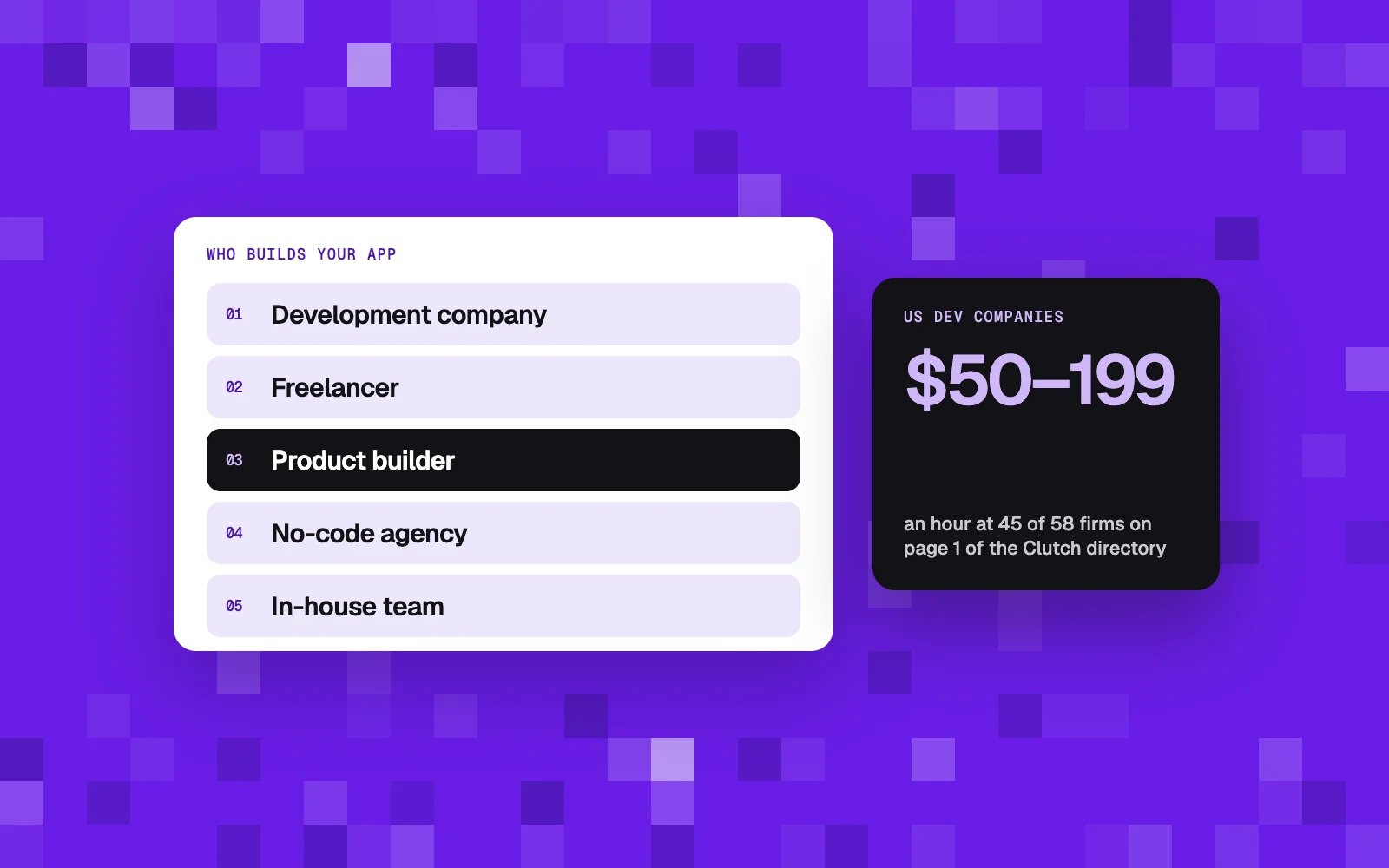
A software development company builds custom software for other businesses. What you buy from it is a team: a project manager, developers, a tester and often a designer. In Europe the same kind of firm is usually called a software house. If you are comparing software development company vs freelancer options before you build an app, the real choice is wider. An app can be built by a development company, a freelancer, a product builder with a small team, a no-code agency or your own in-house team.
We read the pages that rank highest in Google for these questions in the US. Almost all of them are written by firms that sell one of these options, and the numbers move from blog to blog without a source. This guide uses data you can check yourself: the Clutch directory, Upwork's pricing page, the Stack Overflow Developer Survey and the US Bureau of Labor Statistics (BLS).
We've been on both sides: founders who had to validate our own product ideas, and the team that designs and builds products for clients. Max Miskow co-founded Skillsbite, an AI startup for CV analysis, in 2021, and later built Podium, his own product, from scratch. Today he works as a product builder, which makes him one of the options compared here. That is why every option is judged by the same criteria.
What is a software development company
A software development company is a firm whose product is developer time for clients: it builds web and mobile apps, internal systems and integrations to order. You will also hear "development agency", "dev shop" or, in Europe, "software house". They either run whole projects or rent developers by the hour (staff augmentation).
A typical project team at a software development company looks like this:
- a project manager or product owner on the vendor's side, who guards scope and deadlines,
- developers: frontend, backend, sometimes mobile,
- a QA tester, who checks each release before it ships,
- a UX/UI designer, if you order interface design,
- a DevOps engineer on larger systems, the person who runs servers and deployments.
The market is large. In November 2026 the Clutch directory for the US listed 9,575 software development companies, and the Poland listing, a common nearshore choice for US buyers, listed 1,689. Searching for "best software development company" mostly returns lists of firms. It is much harder to find out whether a development company is the right choice for your situation at all.
Five ways to build an app
There are five ways to get a custom app built, and they differ mainly in who runs the project and who is accountable for the result. Price comes second. Here is each option in one row.
| Option | Who is on the team | Who runs the project | Best for | Main risk |
|---|---|---|---|---|
| Software development company | project manager, 2–6 developers, tester, often a designer | the vendor, you approve | a large, well-defined scope | high entry threshold, many meetings, the team can change |
| Freelancer | one person | you | a small, clear task or one feature | one person with no backup, managing the work stays with you |
| Product builder / small team | one person covering product and build, plus a trusted developer when needed | the product builder, together with you | a first product version, when you need to find out what to build | limited capacity on a large system |
| No-code agency | specialists in Bubble, Webflow, FlutterFlow and similar tools | the agency | simple apps, prototypes, internal tools | platform limits and costs, a harder move later |
| In-house development team | your employees | you or your CTO | a product you will grow for years, at the core of the business | high fixed cost, long hiring |
A product builder is a person or a very small team that takes a product from idea to working version: first checking with you whether the product makes sense and in what form, then building it. A freelancer usually executes a task someone has already defined; a product builder helps define it and owns whether the result solves the problem.
Software development company vs freelancer: the differences in numbers
A software development company gives you a team and a process, while a freelancer gives you a lower rate and a direct line to the person doing the work. The choice depends on whether someone on your side can manage the project. Directory and platform data say the most here.
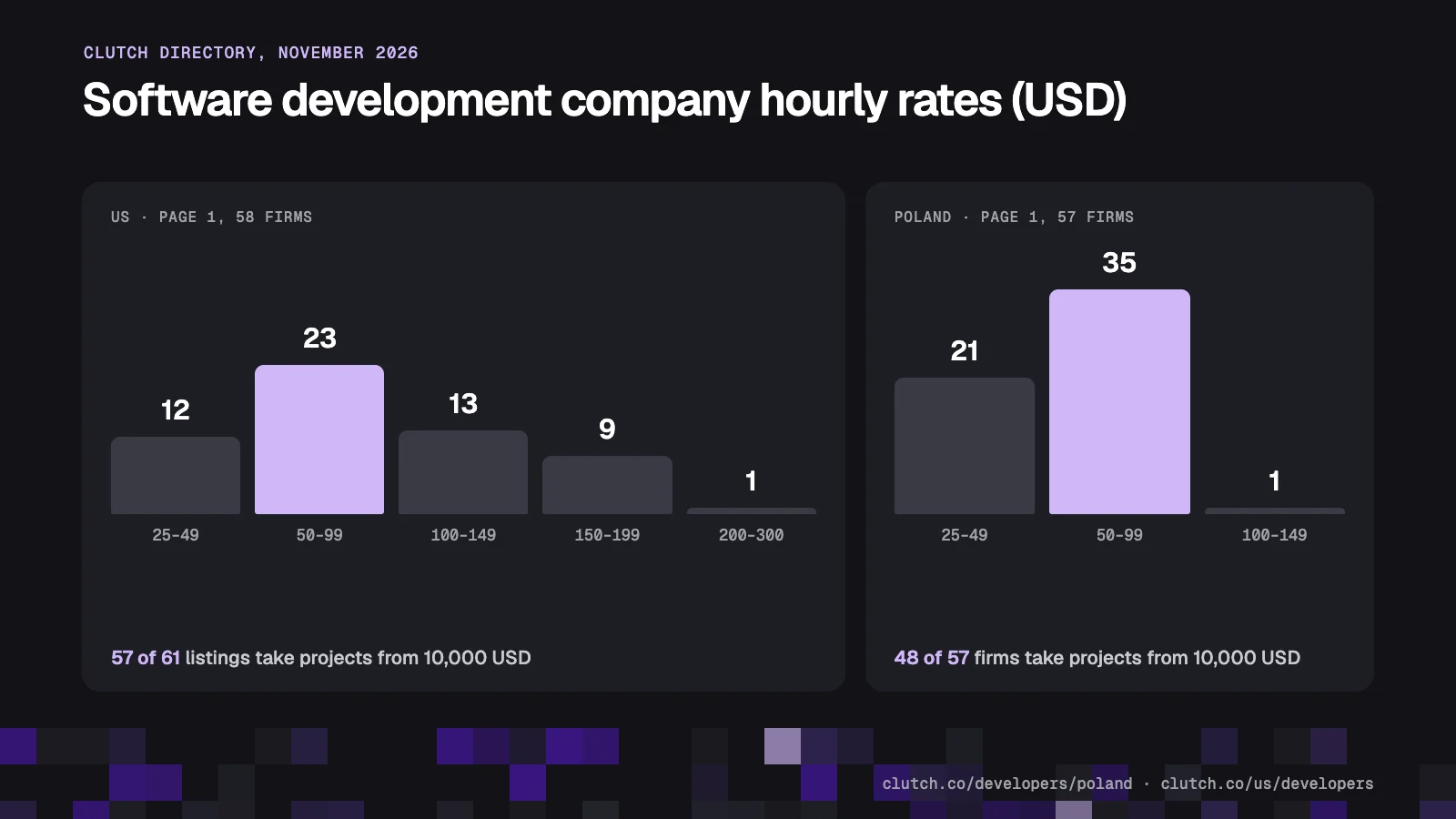
On the first page of the Clutch US listing (58 firms, November 2026), 23 companies list a rate of 50–99 dollars an hour, 13 list 100–149 dollars, 12 list 25–49 dollars, 9 list 150–199 dollars and 1 lists 200–300 dollars. For a small business the entry threshold matters even more: 57 of the 61 listings on that page take projects of 10,000 dollars or more, including 14 from 50,000 dollars and 3 from 75,000 dollars. On the Poland listing rates are lower: 35 of 57 firms list 50–99 dollars and 21 list 25–49 dollars.
There are plenty of freelancers. In the Stack Overflow Developer Survey 2025, 13.9% of 48,178 developers described themselves as independent contractors, freelancers or self-employed, and in the US it was 10% of 7,218 responses. When you hire a freelance app developer through a platform, you add its fee. Upwork charges clients 5% on the Basic plan and 10% on Business Plus, and charges freelancers 0 to 15%. A one-time contract initiation fee of 0.99 to 14.99 dollars comes on top.
| Criterion | Software development company | Freelancer |
|---|---|---|
| Rate (November 2026 data) | US: mostly 50–199 USD/h (Clutch, 45 of 58 firms on page 1); Poland: mostly 25–99 USD/h | each sets their own; on a platform you add its fee, e.g. Upwork 5–10% on the client side |
| Minimum project | usually 10,000 USD or more (57 of 61 US listings on Clutch page 1) | none, you can hire for a few hours |
| Who manages the work | a project manager on the vendor's side | you |
| Testing before release | usually a dedicated tester on the team | depends on the person, often just the developer |
| Backup if someone is sick or leaves | another developer from the firm | none, the project stops |
| Range of skills | several specialties on one team | one person, usually 1–2 specialties |
| Ownership of code and accounts | set in the contract, usually passes to the client on payment | set in the contract, on a platform also in its terms |
The takeaway is practical. A freelancer pays off when you know exactly what needs to be built and have time to review the work every week. A software development company pays off when the scope is large, the budget clears its entry threshold, and you would rather buy a working process than build one yourself.
App development company cost vs the alternatives: a 400-hour example
The cost of each option is the rate times the hours, plus what comes on top of the rate: a platform fee, your own time spent managing, or the cost of employment. To compare the options on one scale, take an example project of 400 developer hours. It is an assumption, not a quote: the real scope depends on the features. We break down full app budgets in how much it costs to build an app.
| Option | Rate (source) | 400 hours | What comes on top of the rate |
|---|---|---|---|
| US development company, lower band | 50–99 USD/h (Clutch) | 20,000–39,600 USD | usually clears the 10,000 USD minimum |
| US development company, upper band | 100–149 USD/h (Clutch) | 40,000–59,600 USD | project management time is sometimes billed separately |
| US development company, premium band | 150–199 USD/h (Clutch) | 60,000–79,600 USD | as above |
| Nearshore company in Poland | 25–49 USD/h (Clutch) | 10,000–19,600 USD | time zone overlap with the US is shorter |
| Freelancer via Upwork, 20,000 USD contract | per the offer | 20,000 USD | +5% (Basic) = 21,000 USD or +10% (Business Plus) = 22,000 USD, plus up to 14.99 USD |
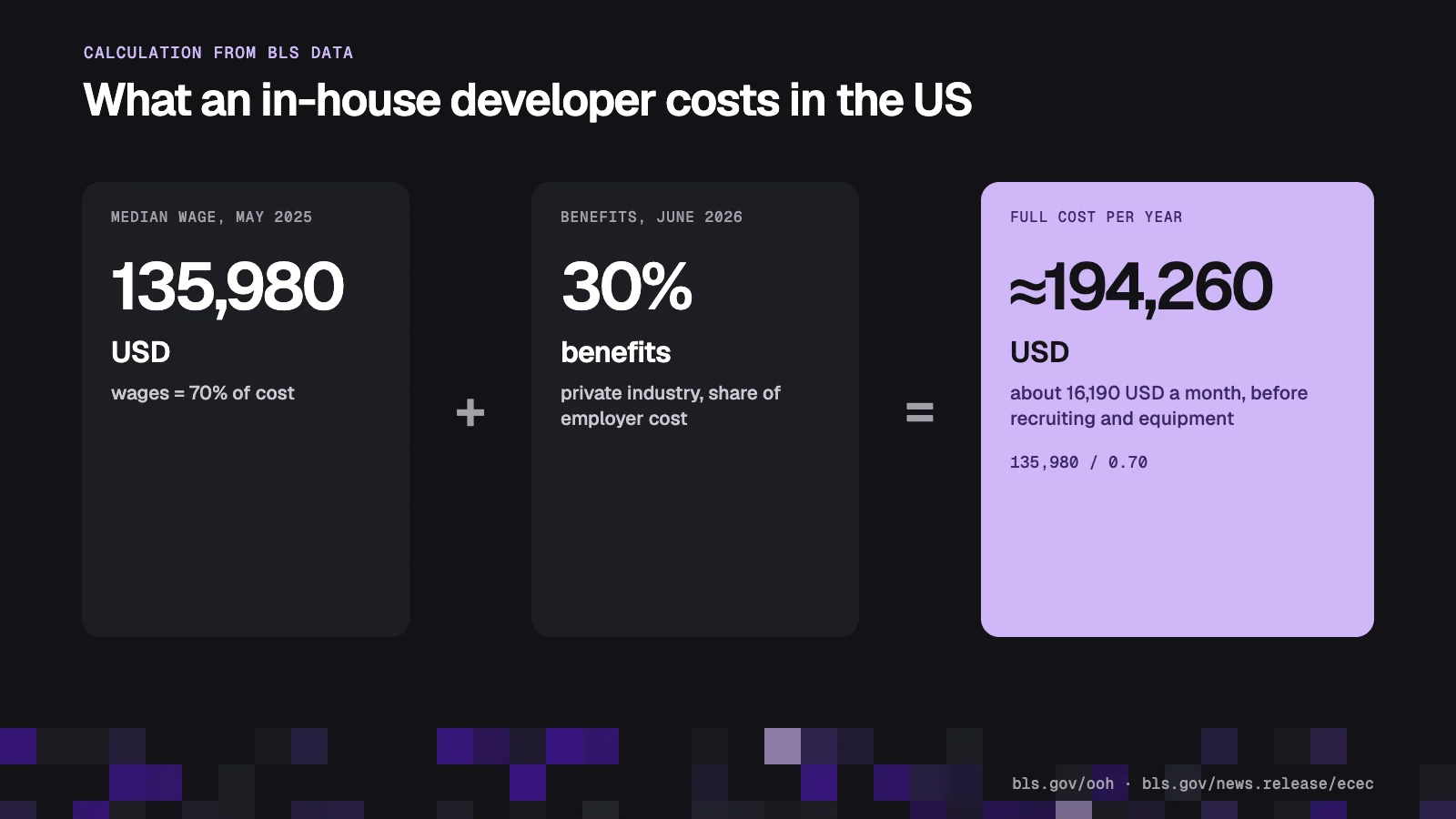
| In-house developer in the US | median 135,980 USD a year (BLS) | you hire for a whole year, not 400 hours | benefits are 30% of employer cost, so the full cost is about 194,260 USD a year |
The in-house row needs explaining. According to the BLS, the median annual wage for software developers was 135,980 dollars in May 2025. The BLS Employer Costs for Employee Compensation release for June 2026 shows that in private industry, wages make up 70.0% of employer costs and benefits the remaining 30.0%. If wages are 70% of the cost, 135,980 dollars divided by 0.70 gives about 194,260 dollars a year, or about 16,190 dollars a month, for one person. That excludes recruiting, equipment and management time.
Product builder: what it is and when it makes sense
A product builder is a vendor who combines the product manager and the builder: first helping you decide what to build, then leading the build to a working version. It makes the most sense for a first product version, when the biggest risk is building something nobody will use.
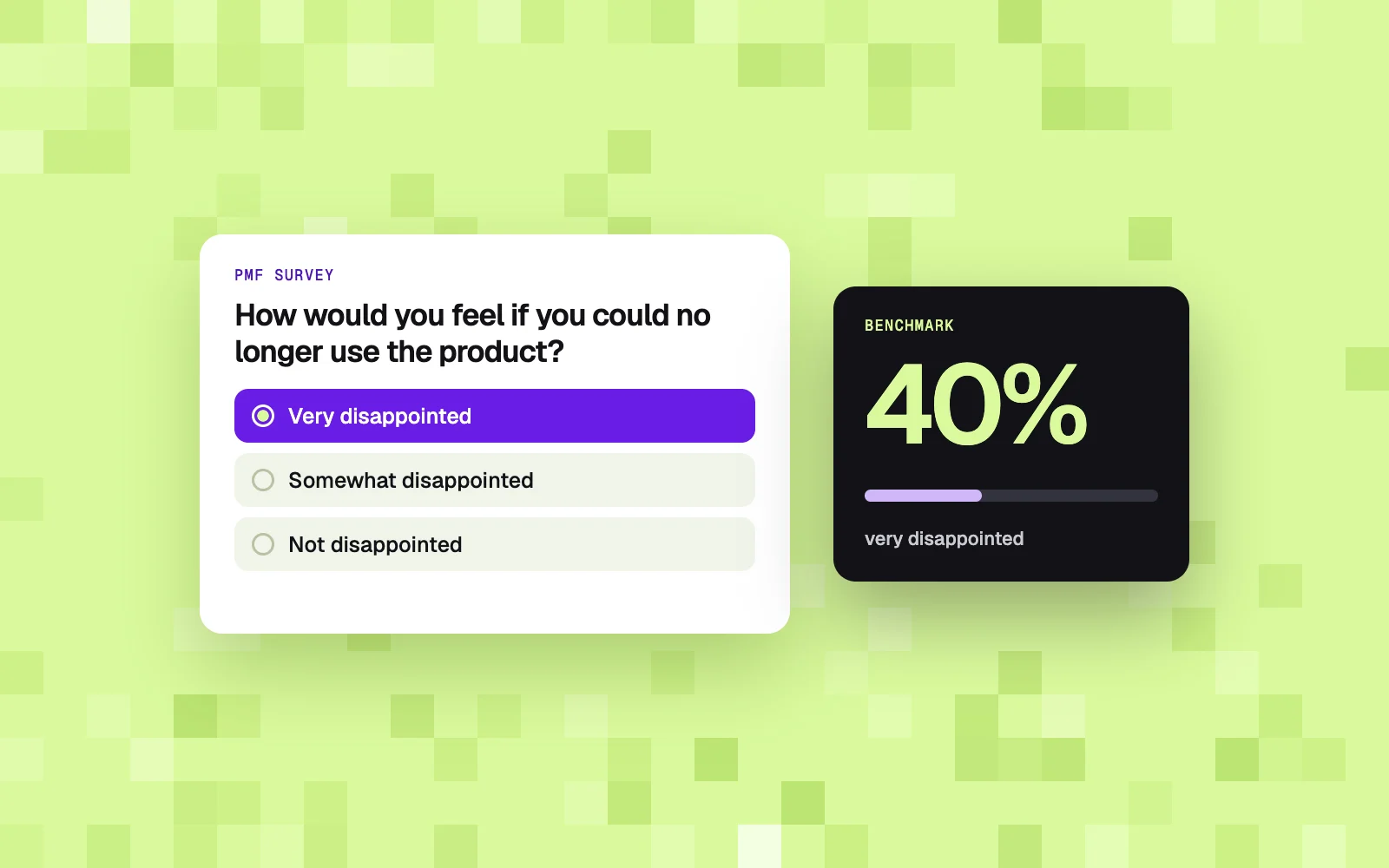
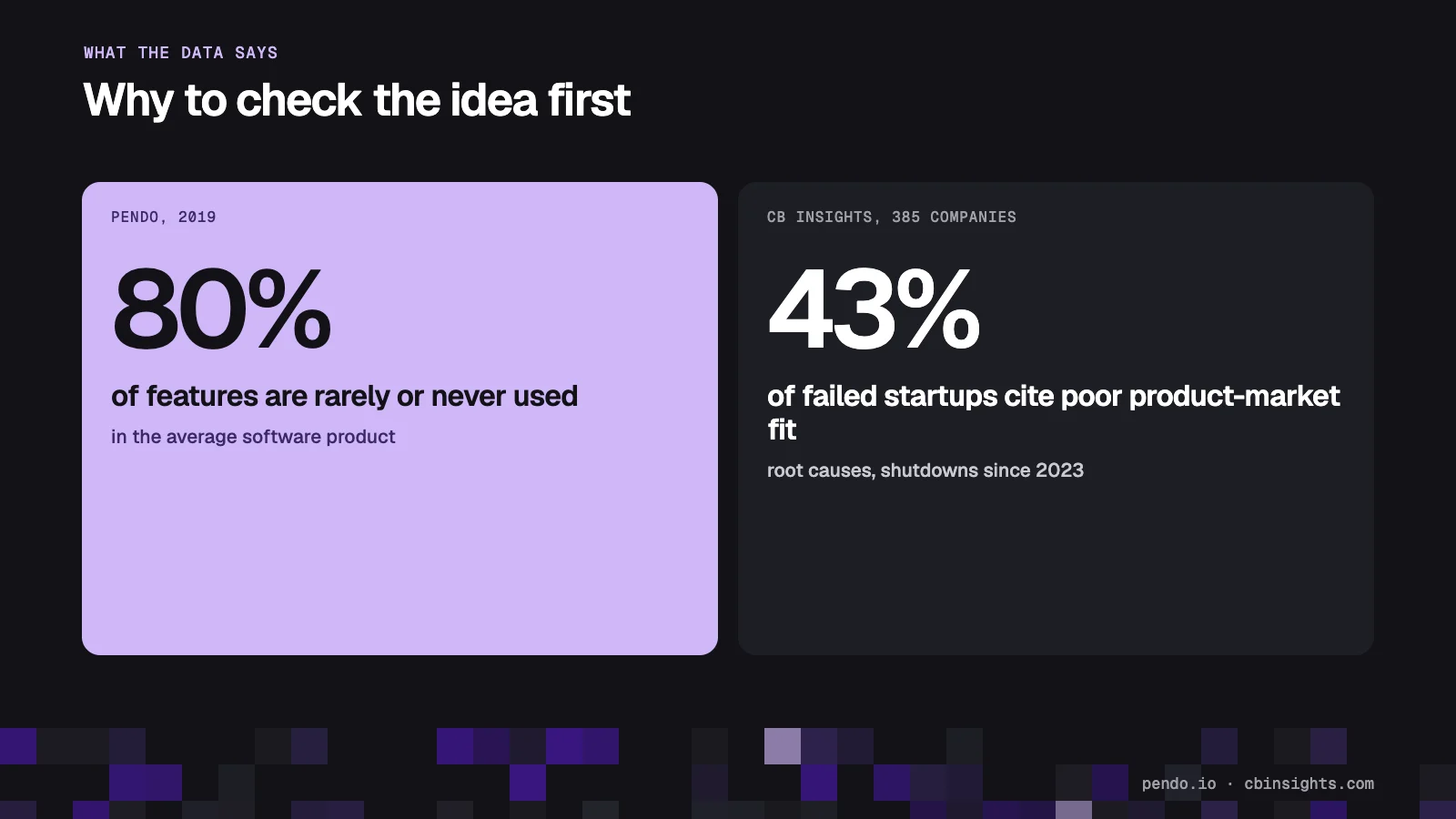
The data show that the risk is real. In its 2019 report, Pendo found that 80% of features in the average software product are rarely or never used. CB Insights analyzed 431 venture-backed startups that shut down since 2023. Among the 385 with identifiable reasons, 43% cited poor product-market fit. A development company or a freelancer will build what you order. If the order is wrong, good work will not fix it.
This is how Max works: one person from start to finish, with no agency layers, and a trusted developer joins when the project needs one. The work has three stages.
- Diagnosis (week 1). Conversations with you and, where possible, a few of your customers, a list of the riskiest assumptions and a decision on what goes into the first version.
- Prototype on your data (week 2). A clickable or working version of the most important flow, checked against real examples from your business.
- Build and launch (weeks 3–6). Building the first version, testing and launch, then monthly care if you need it.
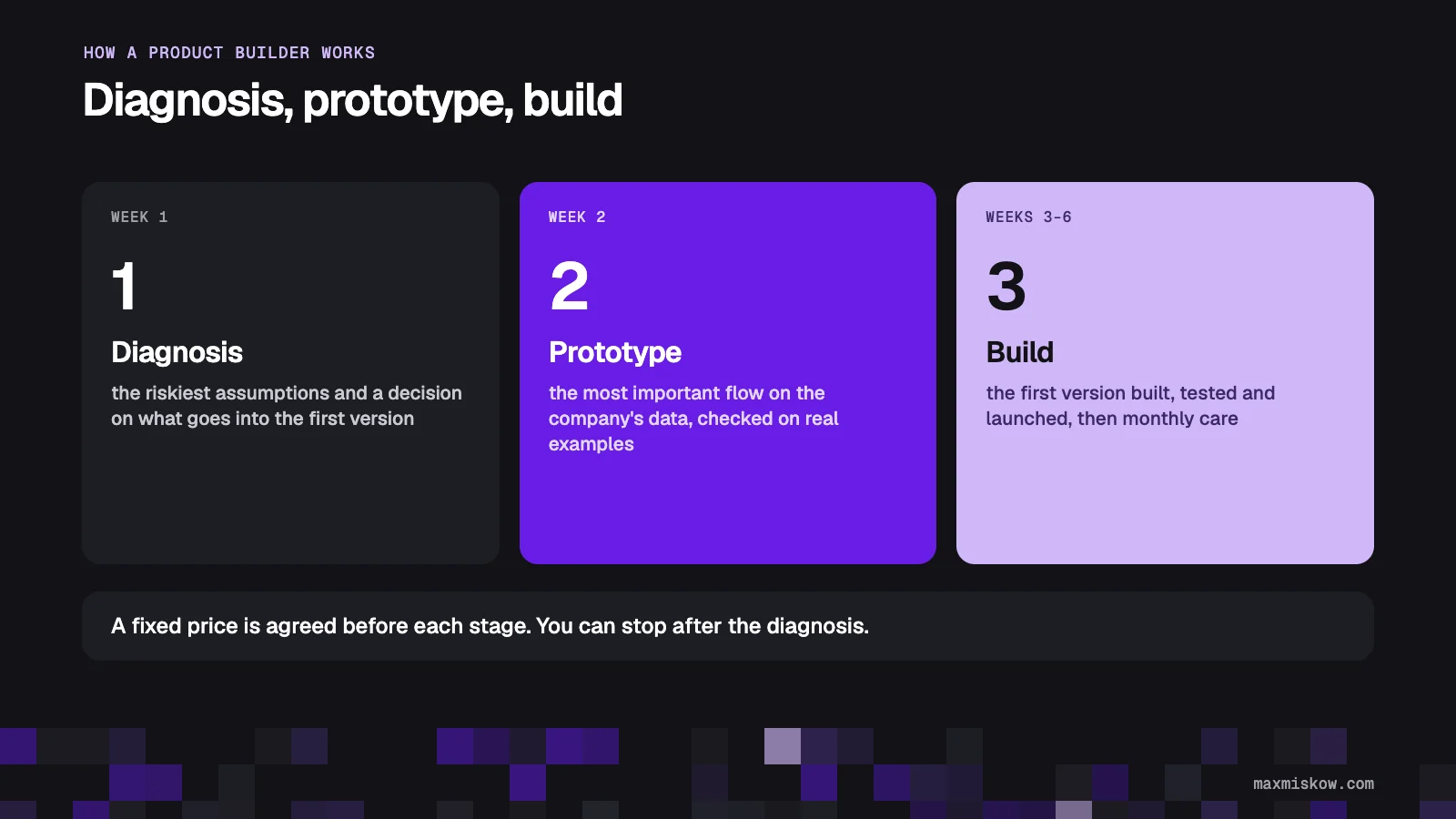
Pricing is a range after the first call and a fixed price agreed before each stage. That way you can stop after the diagnosis if it turns out the app makes no sense, or that an off-the-shelf tool is enough. Accounts, code and data belong to the client.
An example from practice: we work with a US home-services company that had been thinking about its own app for its customers for a long time. We started by checking whether, and in what form, an app would solve a concrete problem, before the first line of code. The lesson is simple: your first conversation with a vendor should be about the problem and how to test a solution, and only then about technology.
A product builder is not right for every project: a large system with many parallel modules needs more hands, and a development company or an in-house team will serve it better.
No-code agency vs in-house development team: when to choose each
A no-code agency builds apps in visual tools such as Bubble, Webflow or FlutterFlow instead of writing all of the code. An in-house development team means developers on your payroll. They sit at opposite ends of the same scale: the fastest start and the most control.
| No-code agency | In-house development team | |
|---|---|---|
| Time to first version | usually the shortest, the platform provides ready-made parts | the longest, you have to hire first |
| Fixed cost | a platform subscription paid monthly | salaries and benefits (in the US, benefits are 30% of employer cost per BLS) |
| Flexibility | limited to what the platform allows | full |
| Moving away later | hard, part of the logic stays in the platform | not an issue, the code is yours |
| When to choose | a prototype, an internal tool, a simple app with forms and a database | a product you will grow for years that is your main source of revenue |
The BLS projects employment of software developers, QA analysts and testers to grow 10% from 2025 to 2035, much faster than the average for all occupations. For a small business building its first product, an in-house team is rarely the first step. It usually follows the first version, once the product is known to earn money.
How to choose the right software development company or alternative
Choose a vendor by three questions: how well defined the scope is, how much you can spend, and who on your side will make product decisions. The table below pairs common situations with the option that usually wins in them.
| Your situation | Usually the best option | Why |
|---|---|---|
| You have an idea but do not know if customers will pay | product builder | the idea is tested first, then built, with a fixed price before each stage |
| You have a ready specification for months of work and a budget above the 10,000 USD threshold | software development company | a working process, testing and backup within the team |
| You need one feature or integration in an existing system | freelancer | small scope, no entry threshold |
| You want to test a simple process with forms and a database within weeks | no-code agency | the fastest start, ready-made platform parts |
| The product earns money and will be developed for years | in-house team, often with a development company to start | knowledge stays in the company |
| Nobody on your side can manage a developer's work | development company or product builder | someone else runs the project and owns the result |
The most common mistake is choosing by hourly rate. A cheaper hour buys nothing if half the hours go into features nobody uses, and Pendo's finding that 80% of features are rarely or never used shows how often that happens. The second mistake is hiring a freelancer for a large product with no one to lead it. Project management then lands on the business owner anyway, just without the experience.
12 questions to ask a software development company or freelancer before you sign
Before signing, ask questions that test the vendor's process rather than the portfolio alone. Good answers are specific. Bad ones sound like lines from a sales deck.
- Who exactly will work on my project, and can I talk to that person before we start?
- How will we check that the first version solves the problem before we build the rest?
- What is in scope and what is not, and how do you price changes along the way?
- How often will I see a working version, not a progress report?
- Who tests, and what happens to bugs found after launch?
- Who owns the code, accounts, domain and data, during and after the project?
- What happens if the lead person gets sick or leaves?
- What does a handover look like if I switch vendors or move the work in-house?
- Is the price fixed, hourly or mixed, and what can raise it?
- What are the ongoing costs after launch: hosting, subscriptions, maintenance?
- What similar project have you done, and can I speak with that client?
- When would you advise me not to build an app? An honest vendor has an answer ready.
Question twelve tells you the most. A vendor who never advises against building is selling hours, not a solution to your problem. If you want to test the idea itself first, read what an MVP is and how product discovery works.
Software development company vs freelancer vs product builder: the short version
Choose a software development company for a large, defined scope and a budget above its entry threshold. Choose a freelancer for a small, clear task if you have time to manage it. Choose a product builder for a first product version, when you first need to find out what to build. A no-code agency fits a simple process and a quick test, and an in-house team fits only a product that earns money and will be developed for years.
| Option | When yes | When no |
|---|---|---|
| Software development company | large scope, a specification, a budget from about 10,000 USD | an untested idea, a small budget |
| Freelancer | one feature, fixes, an integration | a whole product with no one to lead it |
| Product builder | a first version, an uncertain scope, a need to decide what to build | a large system with many parallel modules |
| No-code agency | a prototype, an internal tool | a product that must grow beyond the platform's limits |
| In-house team | a product developed for years | a first version with uncertain demand |
If you want to talk about your idea, start with a free report with a few ideas for your business or book a 30-minute call. You will find how a first version gets built in the MVP section, and the whole path from idea to app in our guide on how to build an app.
Frequently asked questions
What is a software development company in simple terms?
A software development company is a firm that writes software to order for other businesses. Instead of hiring developers, you contract a team with a project manager, developers and a tester, who build the app to an agreed scope and hand you the finished product.
Is a software development company or a freelancer cheaper?
A freelancer usually has a lower rate and no entry threshold, so a small task costs less. On Clutch, US development companies mostly list 50 to 199 dollars an hour, and most take projects from 10,000 dollars. On a large project, the gap shrinks once you count the time you spend managing a freelancer yourself.
How much does a software development company charge per hour in the US?
On the first page of the Clutch US directory (November 2026), 23 of 58 companies list 50 to 99 dollars an hour, 13 list 100 to 149 dollars and 9 list 150 to 199 dollars. Check the minimum project size too: 57 of the 61 listings start at 10,000 dollars.
What is a software house?
Software house is the term used in Poland, the UK and much of Europe for a software development company: a firm that builds custom software for clients. If a US buyer hires a nearshore team in Poland, the vendor will often call itself a software house.
What is a product builder?
A product builder is a vendor who helps you decide what to build and then builds it. It combines the product manager and the builder role, and on bigger jobs works with a trusted developer. It works best for a first product version, when the scope is still uncertain.
How do I choose the best software development company?
Check who exactly will work on the project, how often you will see a working version, who owns the code and accounts, and what a handover to another vendor looks like. Ask to talk to a client from a similar project, and ask when the firm would advise you not to build.
Is a no-code agency a good choice for an MVP?
Yes, if the MVP is a simple process with forms, a database and a few screens, and the goal is to test demand quickly. Less so if you already know the product will be complex, because moving it from a no-code platform to your own code can take a lot of work.