Product discovery: process, techniques and questions for a first product
Product discovery is the work a team does to decide what to build, before and while it builds, by testing ideas with real customers. In practice it means retiring four risks early (value, usability, feasibility and business viability) with the cheapest test that gives an answer. A small company can run a first round in about two weeks: 6 to 10 customer interviews, a clickable prototype tested with 5 people and a feasibility check of the riskiest integration, followed by a written build or don't build decision.
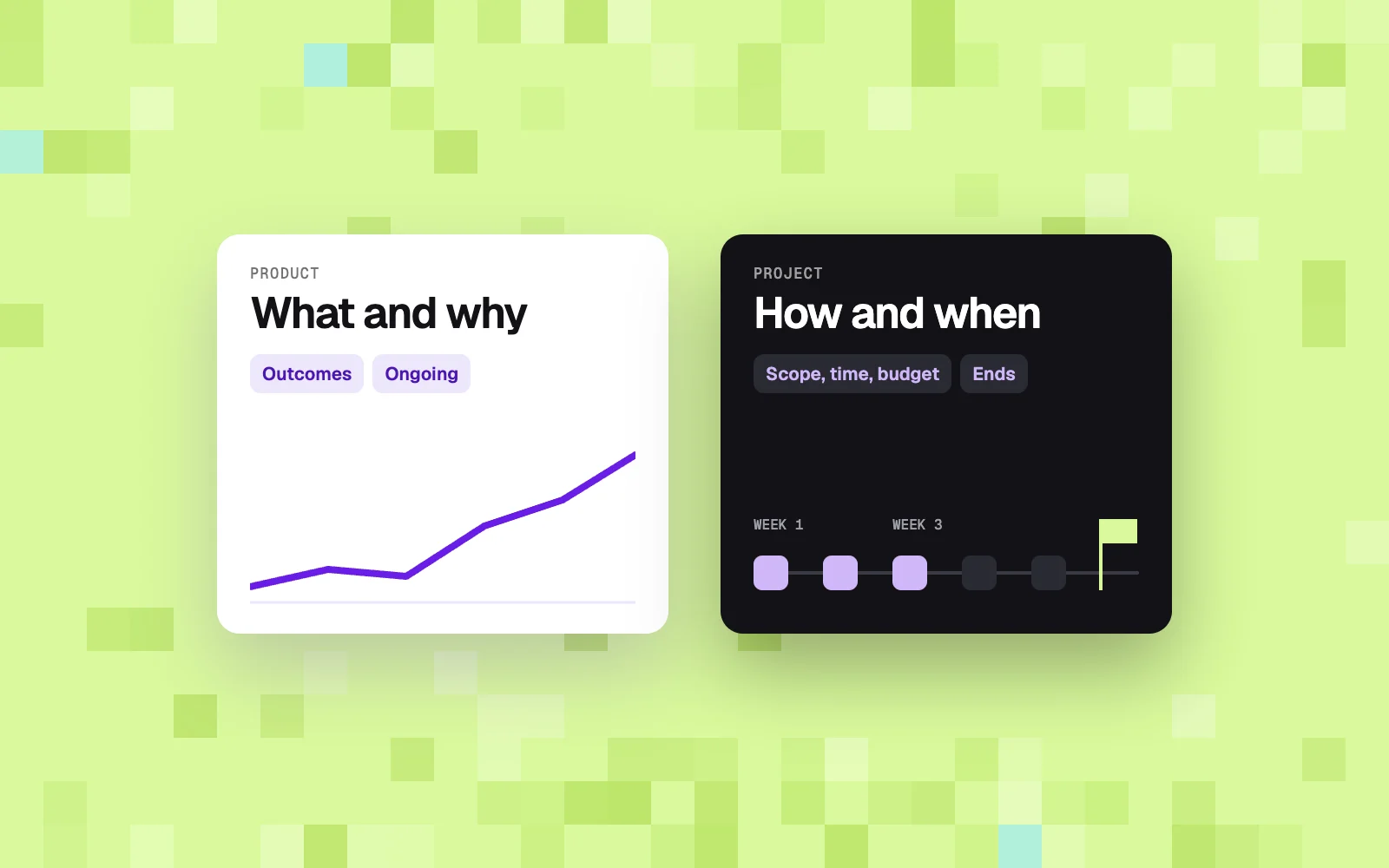
Product discovery is the part of product work that decides what to build. Product delivery is the part that builds it. Teresa Torres, who coaches product teams, puts it this way in Product Talk: discovery is the work we do to make decisions about what to build, and delivery is the work to build, ship and maintain it.
For a founder or an owner-led company, discovery answers one practical question: should we spend money building this, and in what form? We read the five pages that rank highest for this term in the US: Atlassian, Amplitude, Product Talk, Maze and Product School. They define the term well and list techniques. None says how long a first round takes, how many people each test needs, or how a two-person team should plan it. Almost none cites a number with a source.
We've been on both sides: founders who had to validate our own product ideas, and the team that designs and builds products for clients. Max Miskow co-founded Skillsbite, an AI tool for analysing CVs, in 2021, and later built Podium, his own product, from zero. This guide uses sources you can check and two real examples from that work.
What is product discovery
Product discovery is a decision-making process: the team tests whether a problem is worth solving and whether a proposed solution works, with real customers, before committing engineering time to it. Torres describes good discovery as decisions about what to build that include the customer throughout. The output is a decision with evidence. The code comes later.
Three things follow.
- Discovery produces decisions, not documents. A note that says "we build the booking flow first and skip the loyalty program" is a discovery result. A research deck nobody opens is not.
- It runs before and during the build. Torres contrasts project-based discovery, where a team interviews half a dozen to a dozen customers at the start and stops, with continuous discovery. She writes that good discovery teams engage with customers at least weekly.
- It covers the problem and the solution. First you check that the problem is real and painful. Then you check that your answer is wanted, usable and buildable.
Why product discovery is important
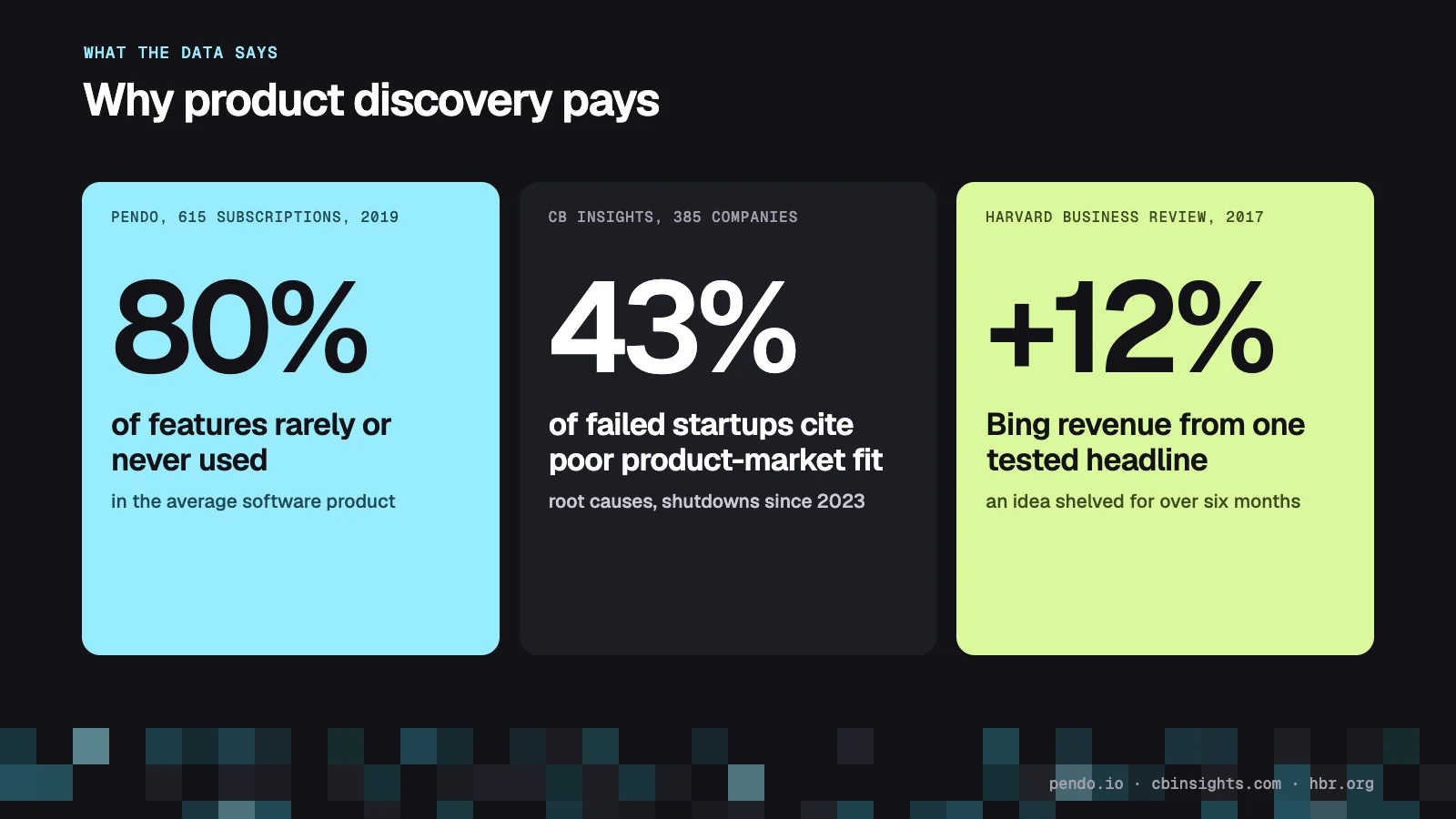
Discovery is important because much of what teams build without it goes unused, and missing the market is a leading root cause of failure. Pendo found that 80% of features in the average software product are rarely or never used. CB Insights found poor product-market fit behind 43% of the startup failures it analysed.
The sources:
- Unused features. Pendo's 2019 Feature Adoption Report analysed feature usage across 615 subscriptions of customers who had used Pendo for more than a year. It estimates that public cloud software companies spent up to $29.5 billion building such features.
- Failed startups. CB Insights studied 431 venture-backed companies that shut down since 2023. Running out of capital tops the list at 70%, which the report calls the final cause, not the root one. Among root causes, in the 385 companies with known reasons, poor product-market fit was cited by 43%, bad timing by 29% and unsustainable unit economics by 19%.
- Ideas that look small. In Harvard Business Review (September 2017), Ron Kohavi and Stefan Thomke describe a Bing headline change that sat shelved for more than six months. Once tested, it raised revenue by 12%, worth more than $100 million a year in the US alone.
Discovery kills bad ideas, and it also rescues good ones that opinions would have buried.
Product discovery vs product delivery
Discovery decides what to build and delivery builds it well. A discovery mistake costs a few days of interviews; building the wrong idea costs months of engineering and maintenance.
| Product discovery | Product delivery | |
|---|---|---|
| Main question | Should we build this, and in what form? | How do we build and ship it reliably? |
| Typical output | Interview notes, a tested prototype, a written decision | Working, tested software in production |
| Unit of work | An assumption and the test that checks it | A feature, a story, a release |
| Cost of being wrong | Days and a few conversations | Weeks or months of engineering |
| Done when | The riskiest assumptions have evidence for or against | The feature works for real users and is measured |
In a small company the same people do both, and the usual mistake is skipping discovery because building feels like progress. A roadmap comes after the first round; our guide to a product roadmap for a first app shows how to turn the decision into a Now, Next, Later plan.
The four risks product discovery has to test
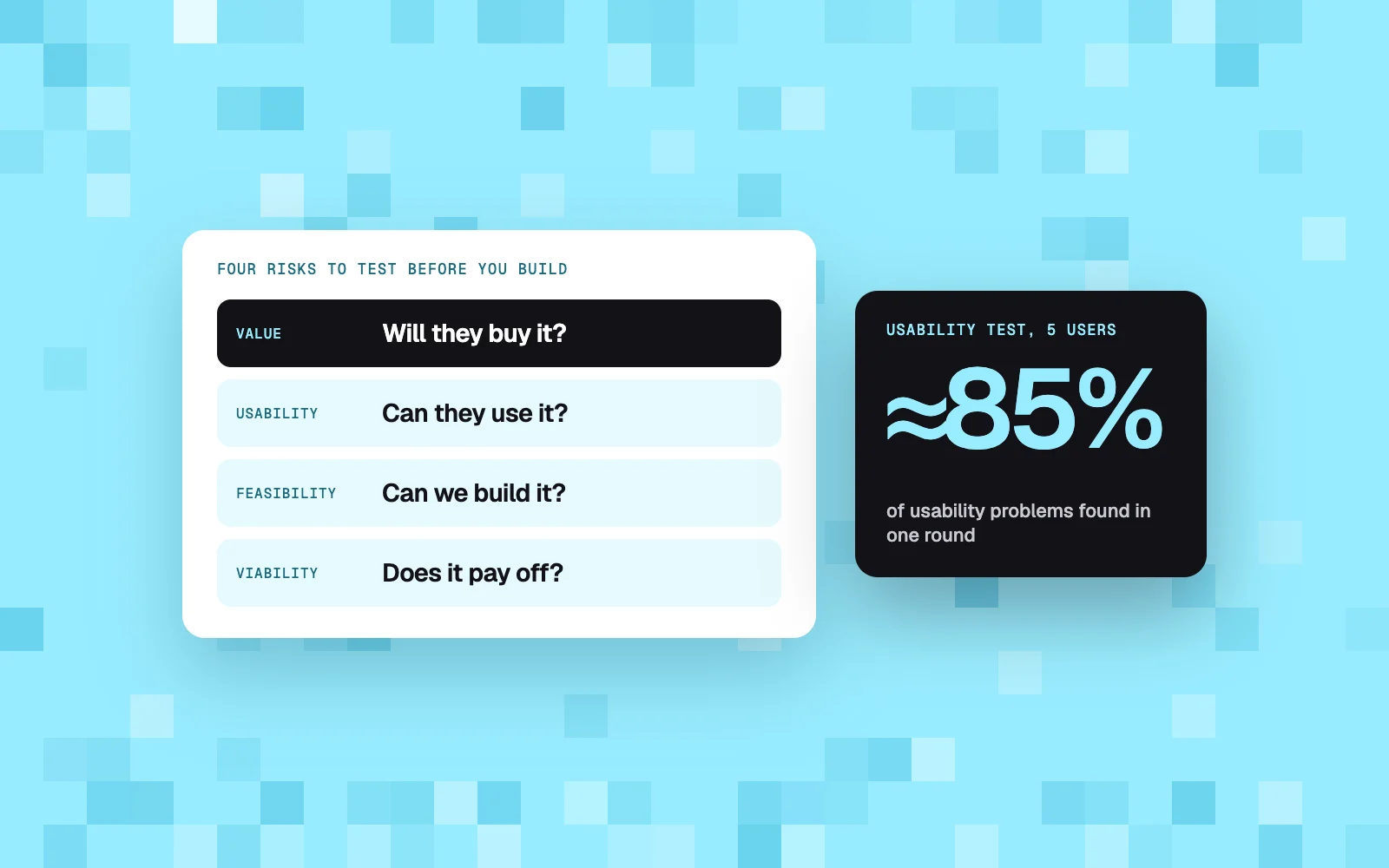
Marty Cagan of the Silicon Valley Product Group names four big risks: value risk (will customers buy it or choose to use it), usability risk (can users figure it out), feasibility risk (can engineers build it with the time, skills and technology available) and business viability risk (does it work for the business). He writes that value risk is usually the toughest.
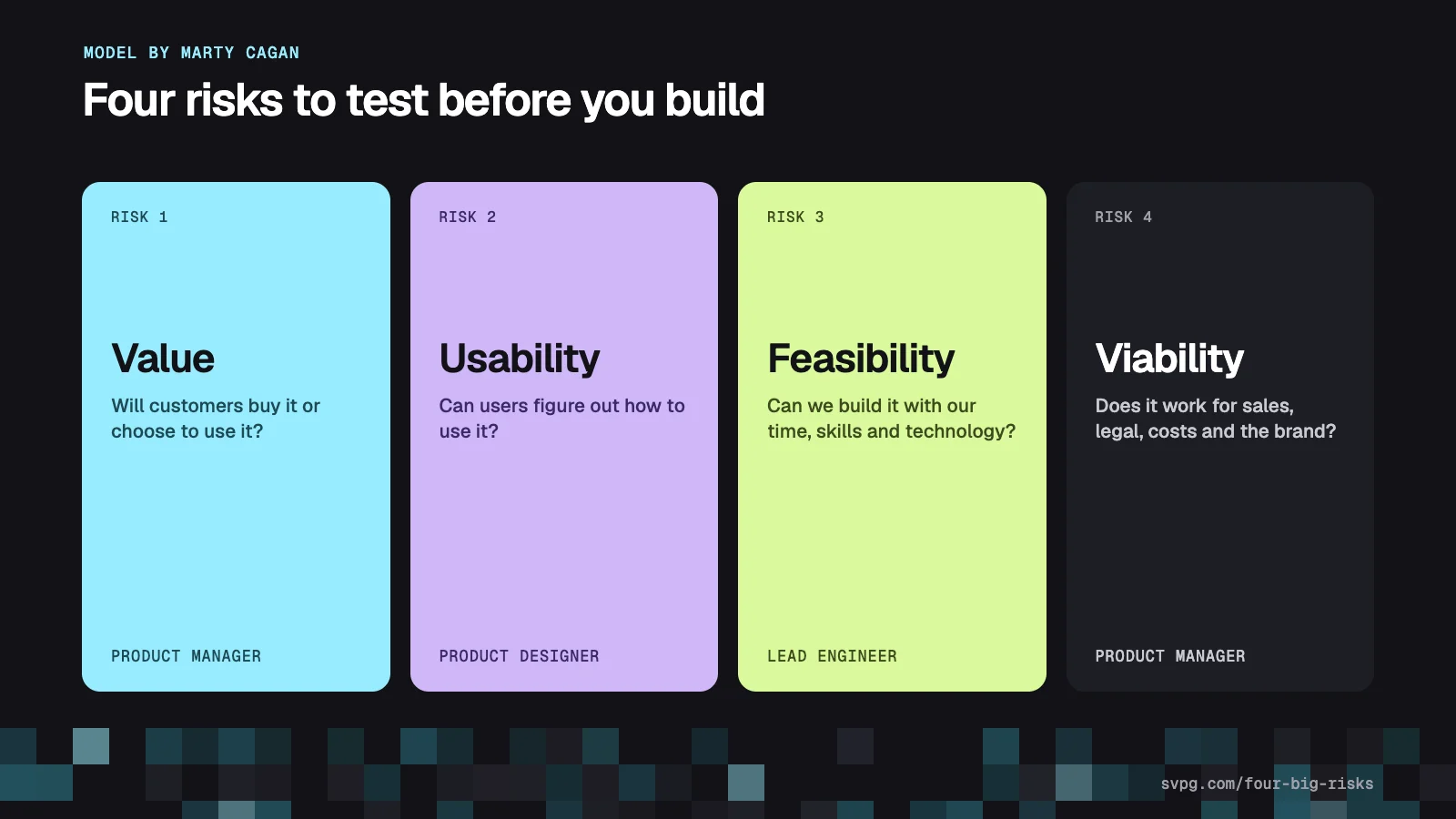
In a two-person team, one person owns the customer and the business (value and viability), the other owns what can be built.
| Risk | Cheapest test that answers it | Evidence that settles it |
|---|---|---|
| Value | 6 to 10 interviews about past behaviour, then a demand test (landing page, pre-order, paid pilot) | People describe the problem unprompted and take a step that costs them time, data or money |
| Usability | A clickable prototype tested with 5 users | Most testers finish the main task without help |
| Feasibility | A technical spike: one to five days on the riskiest integration or model | A working call to the real API, a measured cost or speed |
| Business viability | A one-page unit economics sheet and a check of contracts, data rules and channels | The price covers the cost to serve and to win a customer, and nothing blocks you legally |
The product discovery process in six steps
A discovery process for a small team has six steps: set the outcome, talk to customers, map the opportunities, list the assumptions, test the riskiest ones cheaply and write down the decision. One round takes about two weeks when customers are reachable. Larger teams repeat the cycle continuously.
- Set one outcome. Write the business result you want, as a number. "Cut booking a job from two phone calls to one form" is an outcome. "Build an app" is not.
- Talk to customers. Run customer discovery interviews with people who have the problem now. Ask about the last time it happened and what it cost them.
- Map the opportunities. Torres's opportunity solution tree puts the outcome at the top, the needs and pain points under it, and solutions under each need, so everyone sees why a solution exists.
- List assumptions. For the favourite solution, write every belief that must be true. Sort them by the four risks and by how little evidence you have.
- Test the riskiest ones. One cheap test per assumption, with a pass mark agreed before you run it.
- Decide and write it down. Build, change the solution or stop. If the answer is build, keep the first version small; our guide on when a small business needs a custom app covers that step.
Product discovery and the Double Diamond
The Double Diamond is the UK Design Council's picture of the same process. Its official description has four phases: Discover helps people understand, rather than simply assume, what the problem is; Define reframes the challenge; Develop explores different answers; Deliver tests solutions at small scale and rejects those that will not work. Steps 1 to 3 above are the first diamond, steps 4 to 6 the second.
Product discovery techniques compared
The techniques fall into four groups: talking to people (interviews), watching them (usability tests), asking them to commit (demand tests and pilots) and measuring behaviour (analytics and A/B tests). Each answers a different risk and needs a different number of people.
| Technique | Risk it answers | Typical size | Time for a small team |
|---|---|---|---|
| Customer interview | Value | 6 to 12 people per round | 1 to 2 weeks with recruiting |
| Usability test on a prototype | Usability | 5 users per round | 2 to 4 days |
| Demand test (landing page, pre-order) | Value, viability | Enough visits to judge against a pass mark | 1 to 2 weeks |
| Concierge or manual pilot | Value, viability | 3 to 10 real customers | 2 to 6 weeks |
| Technical spike | Feasibility | One integration or model | 1 to 5 days |
| Design sprint | Value, usability | One team, a handful of test users | 5 days |
| A/B test | Value, usability | Large live traffic | Days to weeks |
Two figures come from primary sources. The design sprint developed at GV is, in GV's own words, a five-day process for answering critical business questions through design, prototyping and testing ideas with customers. The five-user rule comes from Jakob Nielsen.
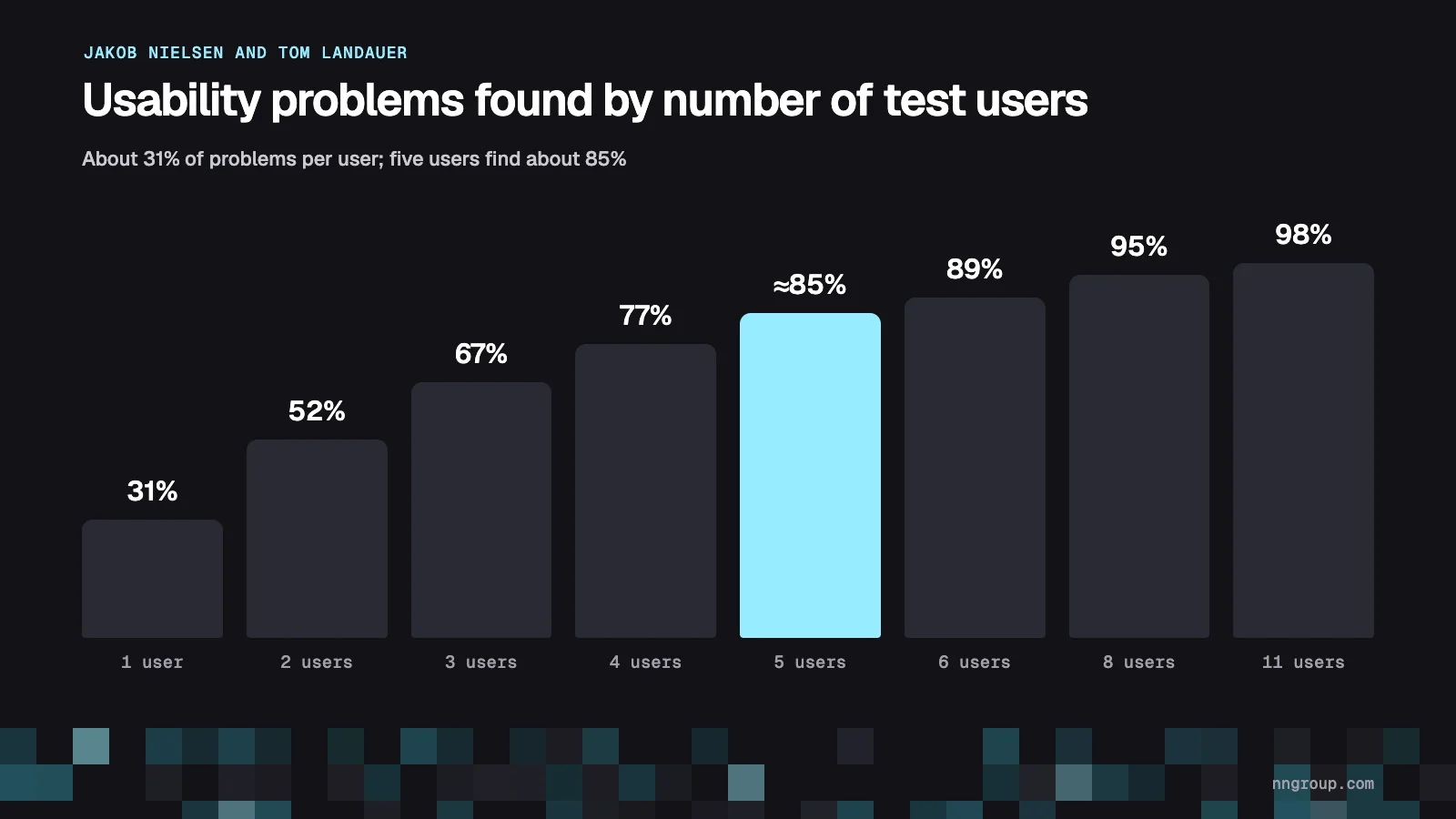
In Why You Only Need to Test with 5 Users, Nielsen explains that one user reveals about 31% of usability problems on average across the projects he and Tom Landauer studied, and that a first study with five participants finds about 85%. After that the curve flattens, so fix what five people found and test again. The rule covers usability only. Questions about value need more conversations, because one opinion is not a market.
Product discovery frameworks: which one to use
Frameworks give the work a structure. Four are used most: the Double Diamond (a process map), the opportunity solution tree (why each solution exists), the design sprint (a fixed five-day format) and Cagan's four risks (a checklist of what must be true).
| Framework | Origin | Best for | Time |
|---|---|---|---|
| Double Diamond | Design Council, UK | Explaining the process to a client or a board | Weeks, flexible |
| Opportunity solution tree | Teresa Torres, Product Talk | Teams that discover every week and need to stay aligned | Ongoing |
| Design sprint | GV (Google Ventures) | One high-stakes question, decision makers in the room | 5 days |
| Four big risks | Marty Cagan, SVPG | Checking nothing important was skipped before a build | At every decision |
Jobs to be done is often added to the list, but it is a lens for interviews and fits inside step 2. For a first product, a one-page opportunity tree plus the four risks is enough.
Product discovery questions to ask customers
Good discovery questions ask about past behaviour, not about the future or your idea. "Tell me about the last time this happened" gets facts. "Would you use an app that…" gets polite guesses. Keep your solution out of the first half of the conversation.
About the problem:
- Tell me about the last time this happened. What were you trying to do?
- What did you do about it, step by step, and what was the hardest part?
- How often does it happen in a normal month?
About what they use today:
- What do you use for this now: a tool, a spreadsheet, a person?
- Have you paid for anything to solve it? How much, and was it worth it?
About the decision:
- Who else is involved when you choose a supplier or a tool for this?
- What would have to be true for you to switch?
Write answers down in the customer's words: "I call three companies and two never call back" beats any summary.
Product discovery examples from real projects
Two examples from Max Miskow's work show the idea from two sides. In a client project in the US, discovery decides whether and in what form to build. In his own product, a cost test on the first live day changed a technical decision before any customer was affected.
Example 1: a booking app for a home services business
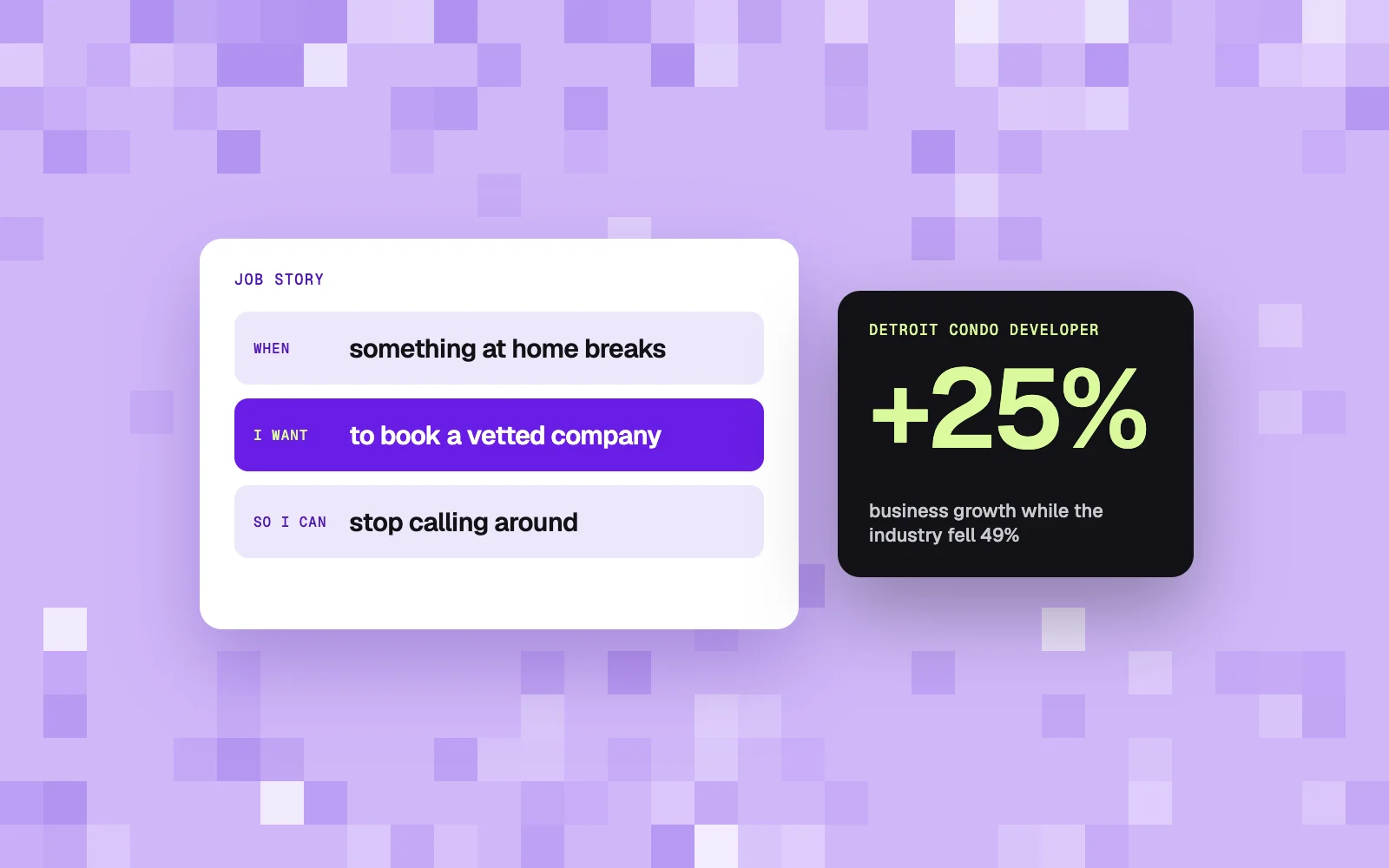
Our current client in the US runs a home services business and wants an app for homeowners. Before anything gets built, discovery has to answer whether the app makes sense and in what form. The lesson so far: the idea sounded like one product, and on paper it turned into four separate bets, one per risk.
| Risk | What has to be true | How it can be tested |
|---|---|---|
| Value | Homeowners want one place for these services and will pay for it | Interviews with current customers, then a pilot with a real price |
| Usability | Booking a second service is as easy as the first | A clickable prototype of the booking flow tested with 5 homeowners |
| Feasibility | The tools the business already uses can share jobs and customer data with the app | A technical spike on the integration before the full build |
| Business viability | Revenue covers support and the cost of winning customers | A one-page unit economics sheet |
The practical takeaway: the riskiest assumption here is not the screens, it is whether existing systems connect cleanly. Testing that first is cheaper than finding out halfway through the build. Pricing follows the same logic as the work: a range after the first call and a fixed price before each stage, so discovery is a separate, small decision.
Example 2: a feasibility and cost check on Podium
Podium is Max's own product. It tracks how a website shows up in AI answers and writes articles for it. Its first live test worked as a feasibility and viability check, and it surfaced things no planning document would have: some AI providers failed under real load, and the most capable model was far more expensive per article than the rest of the pipeline.
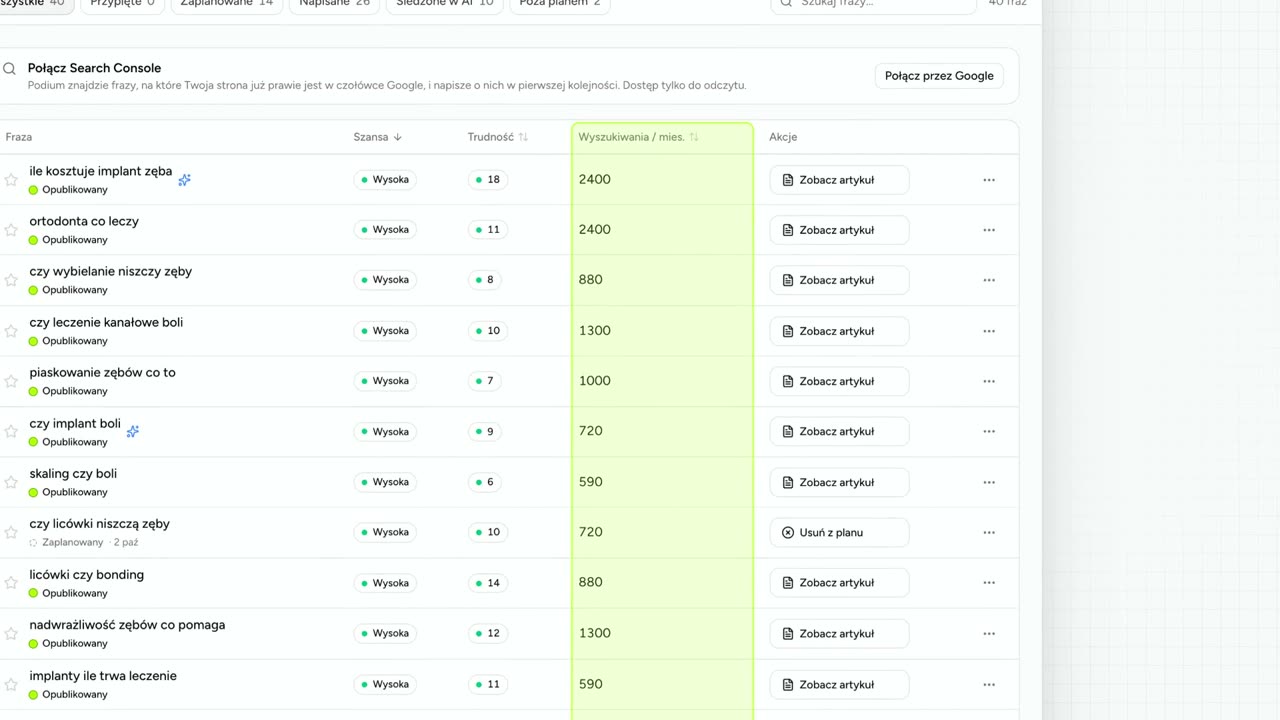
The decision came the same day and is recorded in the project's architecture notes. Articles moved to a cheaper default model, with the expensive one allowed back only if quality scores show a real difference, and each site got a daily cost limit with an alert. The conclusion for any founder: run one cheap, real test early. It replaces a guess about cost and reliability with something you have actually seen.
Product discovery template: a two-week plan
A discovery template for a small team fits on one page: the outcome, who to talk to, the assumptions by risk, the tests with pass marks, and the decision. The plan below is the two-week round we use as a starting point, for one person on product and one on engineering.
| Days | Activity | Output |
|---|---|---|
| 1 | Write the outcome and the target customer; list who to interview | One-sentence outcome, 10 to 15 people to contact |
| 2 to 5 | 6 to 10 customer interviews; engineer starts a spike on the riskiest integration | Notes in customers' words, a first feasibility answer |
| 6 | Map opportunities, pick one, list assumptions by the four risks | An opportunity tree and ranked assumptions |
| 7 to 8 | Build a clickable prototype of the main task | A prototype people can click through |
| 9 to 10 | Test with 5 users; finish the spike and the cost sheet; write the decision | Build, change or stop, with the first version's scope |
Before you call the round done:
- The outcome is a number the whole team agrees with.
- At least six interviews were with people who had the problem in the last few months.
- Each of the four risks had one test with a pass mark set in advance.
- The riskiest integration was called for real, not only read about in the docs.
- The decision is written down, including what you will not build.
If you want a second opinion on a plan like this, the MVP section shows how we scope a first version. You can also book a 30-minute call or ask for a short report on your idea.
Tools for product discovery
A small team needs a document, a spreadsheet, a video call tool and a prototyping tool. Dedicated software helps once several teams share ideas and evidence. The best known is Jira Product Discovery from Atlassian. On its pricing page, checked on November 25, 2026, with monthly billing, the Free plan is $0 for up to 3 creators, Standard is $10.50 per creator per month and Premium is $26.25 per creator per month. The tool keeps the work in one place. The interviews, tests and the decision are still yours to do.
When to stop discovery and start building
Start building when the riskiest assumptions have evidence, the first version fits on one page and the next test would cost more than a small version. Discovery then continues alongside the build. Good signs: customers took a costly step (a pilot, real data, a payment), the spike called the real API, and the scope shrank. Bad signs: the evidence is mostly "people said they would use it", nobody tried the integration, or the scope grew.
Frequently asked questions
What is product discovery in simple terms?
It is finding out what to build before you build it. The team talks to customers, tests ideas with prototypes and small experiments, and checks whether the solution can be built and sold. The result is a decision backed by evidence.
How long does product discovery take?
A first round for a small product takes about two weeks: one for interviews and a technical spike, one for a prototype test and the decision. A GV design sprint compresses one question into five days. Teams that discover continuously never stop; Teresa Torres recommends contact with customers at least weekly.
What is the difference between product discovery and customer discovery?
Customer discovery checks that a customer and a problem exist and are worth serving; it is the interview part. Product discovery also tests whether your solution is usable, buildable and viable. Customer discovery interviews are usually its first step.
Who is responsible for product discovery?
The product manager, or the founder in a small company, leads it and owns the value and viability risks. Marty Cagan assigns usability to the designer and feasibility to the lead engineer.
How many customer interviews do you need for product discovery?
Teresa Torres describes six to twelve interviews as typical for project-based research. Usability tests need fewer: Nielsen Norman Group shows that five users find about 85% of usability problems in a round. Stop when new interviews stop telling you anything new.
Is product discovery part of agile?
Discovery runs alongside agile delivery. Agile organises how a team builds and ships; discovery decides what is worth putting into the backlog. Many teams run both at once: discovery for the next problem, delivery for the current one.
What is Jira Product Discovery?
Jira Product Discovery is Atlassian's tool for collecting and scoring ideas and linking evidence to delivery work in Jira. It is free for up to 3 creators, and the Standard plan costs $10.50 per creator per month as of November 2026.
Does a small company need product discovery before building an app?
Yes, even more than a large one, because one wrong build can use the whole budget. A two-week round with interviews, a prototype test and a check of the riskiest integration costs far less than a version nobody uses.