Product roadmap: examples and a template that works for a first app
A product roadmap is a short, shared plan that says what problem the product solves next, in what order, and how you will know it worked. For a first app, use a Now, Next, Later roadmap with three to five items in Now, each with one success metric, a budget and a decision date. Keep dates only where a real deadline exists, revise it every month while you build the MVP, and keep the detailed task list in a separate backlog.
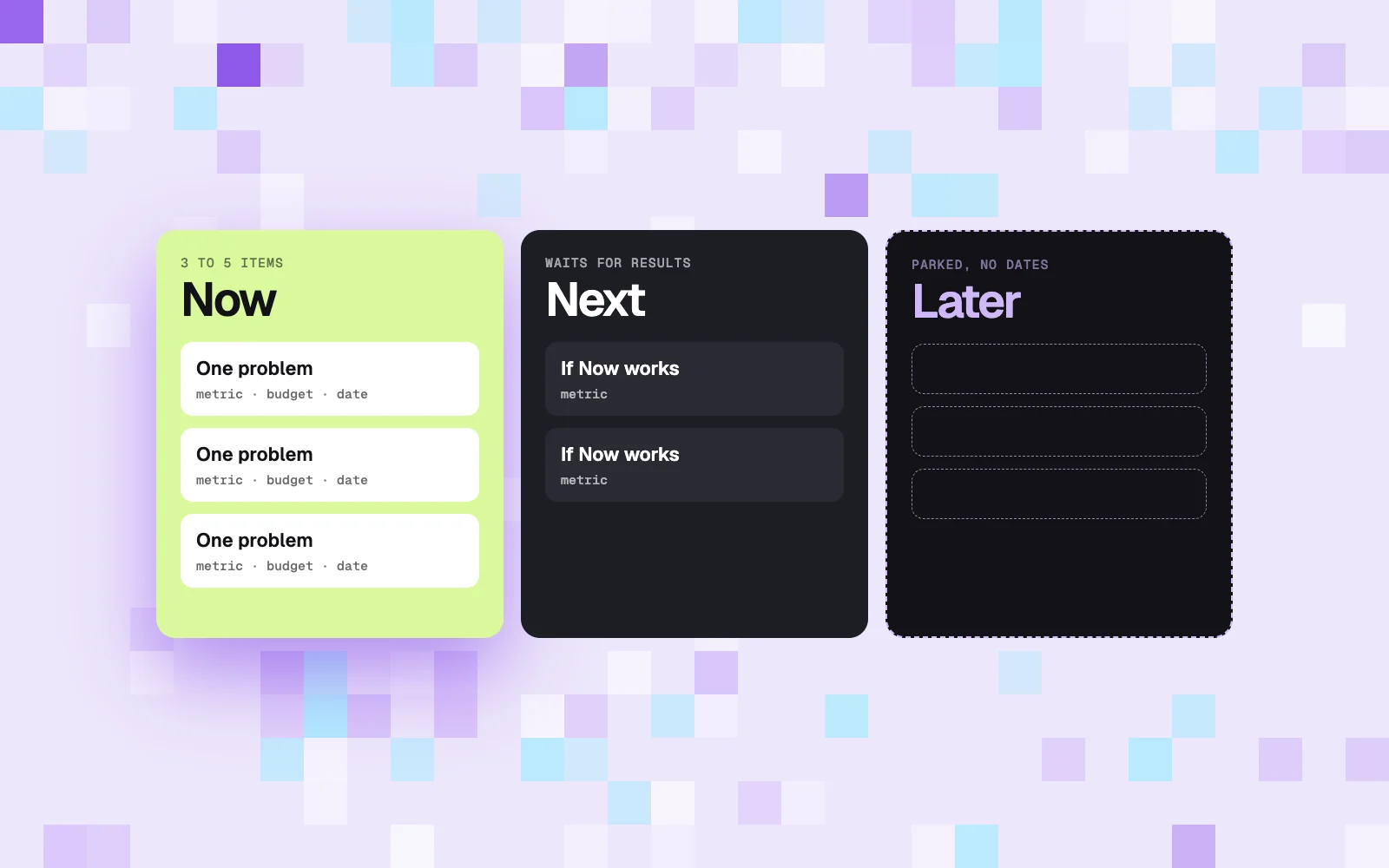
A product roadmap is the one page that tells your team, your developer and your investors what the product will do next and why. For a first app, the best version is short: three columns called Now, Next and Later, a handful of items in each, and one number per item that says whether it worked. Below is a template you can copy, a real example with dates, and the tool prices as of November 2026.
Most guides on this topic are written by companies that sell roadmap software, for large product teams. Of the five that rank highest in the US, none ties a roadmap item to a budget, and none shows a roadmap for a company building its first app with an outside team.
A note on where this comes from. We've been on both sides: founders who had to validate our own product ideas, and the team that designs and builds products for clients. Max Miskow co-founded Skillsbite, an AI tool for screening CVs, in 2021, and later built Podium, a product for writing and publishing company blog articles, from zero. The Podium plan is the worked example further down.
What a product roadmap is
A product roadmap is a shared plan that shows what a product will change for its users over the coming months, in what order, and why. Atlassian defines it as "a shared source of truth that outlines the vision, direction, and progress of a product over time." It is a plan of outcomes, not a list of tasks.
That last point is where most first roadmaps go wrong. A founder writes down every feature they can imagine, puts a month next to each, and calls it a roadmap. Three weeks later the dates are wrong and nobody opens the file.
The product roadmap meaning that works in practice is narrower. It answers four questions for anyone who reads it:
- What problem are we solving right now?
- What comes after that, if the first part works?
- What have we decided not to do yet?
- How will we know each part worked?
Everything else, such as screens, tickets, bugs and technical tasks, belongs in other documents. The table below shows how the roadmap differs from the two documents it is most often confused with.
| Document | What it answers | Typical length | Who updates it | How often |
|---|---|---|---|---|
| Product roadmap | Which problems we solve next, in what order, and why | One page, 10 to 20 items | Product owner or founder | Monthly while building an MVP, then quarterly |
| Product backlog | Every piece of work needed to improve the product, in order | Dozens to hundreds of items | Product owner with the developers | Weekly or every sprint |
| Release plan | What ships in the next release and when | One release, a few weeks | Developers and product owner | Each release |
The backlog definition comes from Scrum.org, which calls it "an emergent, ordered list of what is needed to improve the product." The roadmap sits above it. One roadmap item, such as "customers can book a service without calling us", might turn into thirty backlog items.
Product roadmap and strategy
Strategy says which customers you serve and why they will pick you. The roadmap says what you will build next to make that true. If you cannot connect a roadmap item to the strategy in one sentence, it probably does not belong on the roadmap.
For a small company the strategy can be a single line: "Homeowners who use more than one of our services should be able to book all of them in one place." Every item in Now should move that line forward.
Why a first app needs a short roadmap
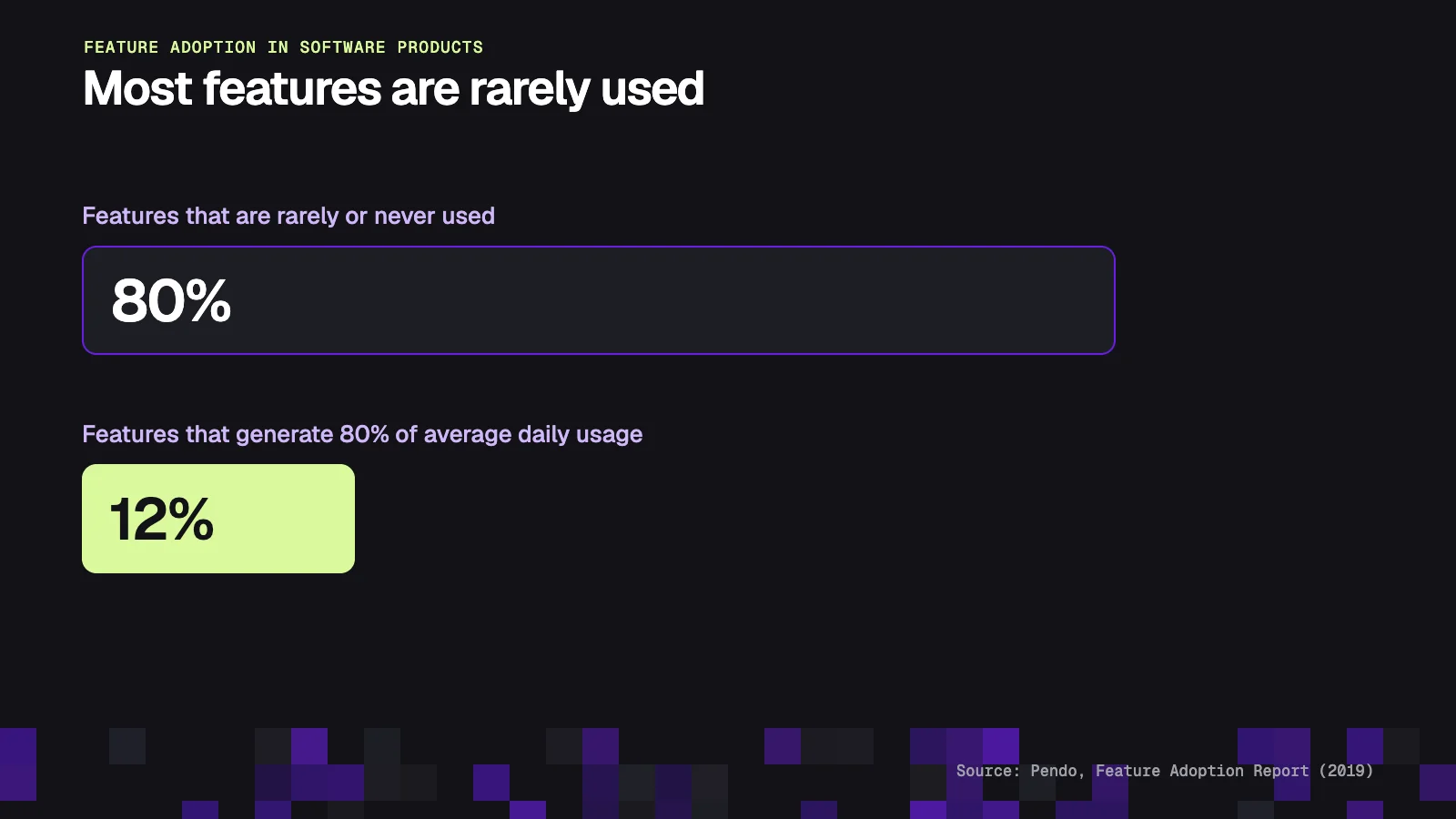
A first app needs a short roadmap because most of what founders plan at the start never gets used. In the Pendo feature adoption report, "80% of features are rarely or never used," while about 12% of features generate 80% of daily usage. A long roadmap mostly schedules the 80%.
The second reason is risk. CB Insights looked at 431 venture-backed companies that shut down since 2023. Running out of capital was the top reason at 70%, and poor product-market fit came second at 43%. Those two are linked. Money runs out faster when months go into features that the market did not ask for.
A short roadmap protects you from both. It forces you to name the riskiest assumption first and test it before you pay for the rest.
There is also a people reason. The ProductPlan State of Product Management report found that "over 60% of prioritization frameworks are overridden by leadership escalations." In a small company the founder is the leadership. A written roadmap with a reason for every item makes it harder to add a feature because someone mentioned it at dinner.
Which roadmap format to choose
For a first app, use a Now, Next, Later roadmap. Use a timeline only for items with a real external deadline, such as a contract, a season or a trade show. Use a Gantt chart only when many teams depend on each other's dates, which is rare in a company of 10 to 50 people.
The Now, Next, Later format comes from Janna Bastow of ProdPad, who wrote that she invented it so teams would "stay focused on discovery" instead of deadline-based delivery. The UK Government Digital Service uses a similar approach and asks for roadmaps written in "clear language and free of jargon."
Here is how the three common formats compare for a small company.
| Format | What it shows | Good for | Weak spot | Use it when |
|---|---|---|---|---|
| Now, Next, Later | Three columns of problems by priority, no exact dates | First apps, MVPs, small teams | Investors and partners may still ask "when?" | You are still learning what users need |
| Timeline (by month or quarter) | Items placed on a calendar | Fixed launch dates, seasonal businesses | Dates look like promises and age fast | A date is set from outside: a contract, a season, an event |
| Gantt chart | Tasks with start and end dates and dependencies | Large projects with many teams | Too detailed for a roadmap, belongs in project planning | Several teams wait on each other |
| Goal or theme based | Items grouped under goals (OKRs) | Products after launch with clear metrics | Hard before you have any usage data | You already measure retention or revenue per feature |
You can mix them. A common setup for a first app is Now, Next, Later on the main page, plus a single date on the one item that has a real deadline.
Product roadmap visualization
The picture matters less than people think. Three columns in a spreadsheet, a whiteboard or a shared slide work as well as a paid tool for the first year. What matters is that everyone looks at the same version. Pick one place, link it in your team chat, and delete the old copies.
A product roadmap template you can copy
This template has three columns and five fields per item. Copy it into a spreadsheet or a document. Keep three to five items in Now, up to five in Next, and anything else in Later. If Now has more than five items, you have not prioritized yet.
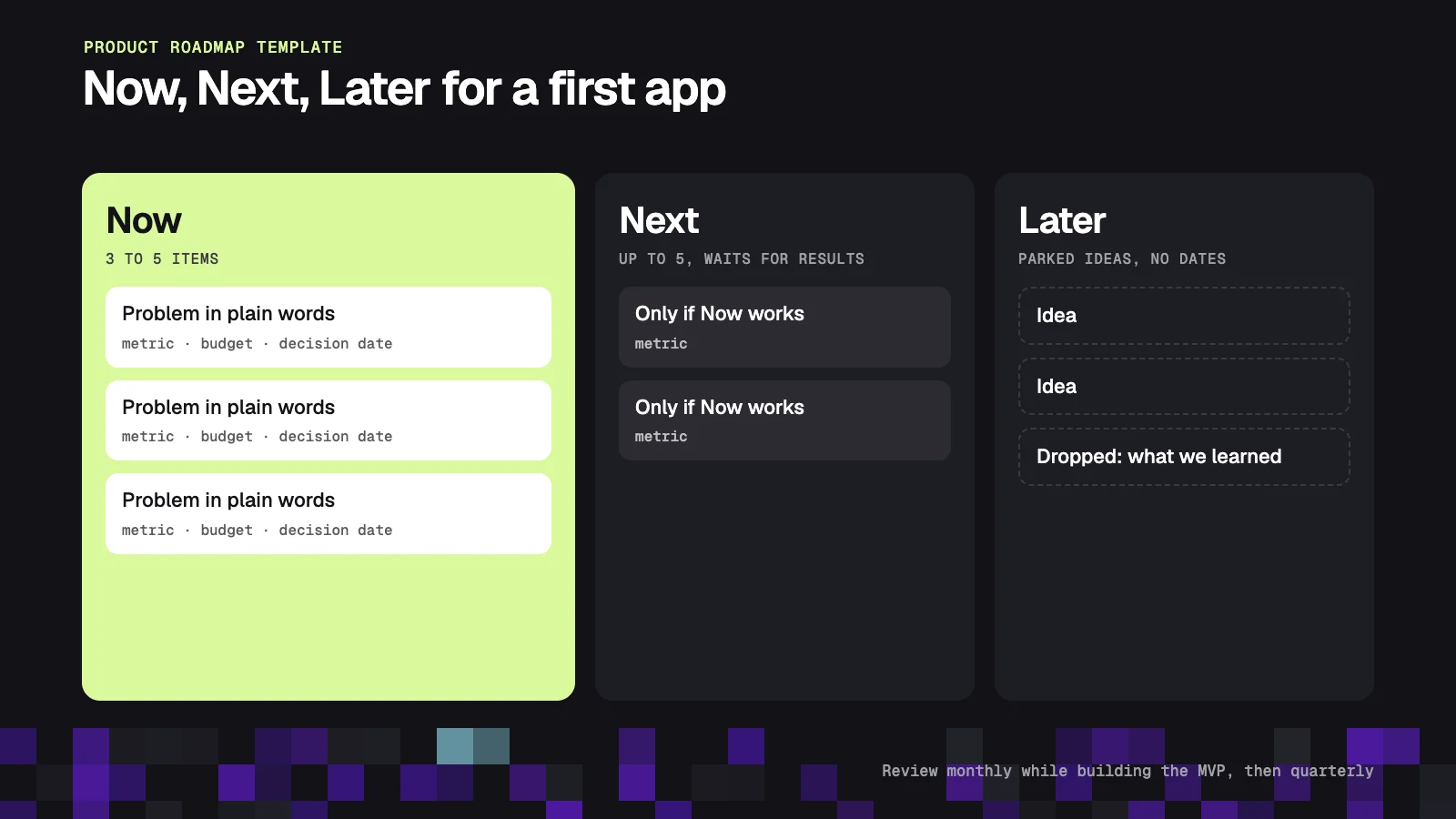
The fields for each item:
| Field | What to write | Example |
|---|---|---|
| Problem | The user problem in plain words, not a feature name | "Customers have to call to book a second service" |
| Outcome metric | One number that shows it worked | "30% of active customers book through the app within 8 weeks" |
| Budget or stage price | What this item may cost before you decide again | A fixed price for the stage, agreed before work starts |
| Decision date | When you will look at the metric and decide | End of week 6 |
| Status | Not started, in progress, testing, done, dropped | In progress |
The "dropped" status is there on purpose. A roadmap that never drops anything is a wish list. When an item fails its metric, mark it dropped, write one line on what you learned, and leave it visible so nobody proposes it again next month.
A filled-in Now column for a first booking app might look like this. The thresholds are illustrative, set before the build, not results:
| Now | Metric | Decision |
|---|---|---|
| One customer account across all services | 100 customers create an account in 6 weeks | Week 6: continue to Next or rethink the offer |
| Book any service from one screen | Half of the bookings from account holders go through the app | Week 6 |
| Service history with photos and invoices | Customers open their history at least once a month | Week 8 |
Next would hold items like a subscription plan or a mobile app, which only make sense if the Now items work. Later would hold everything else: loyalty points, referrals, a partner portal.
Product roadmap example: how we planned Podium
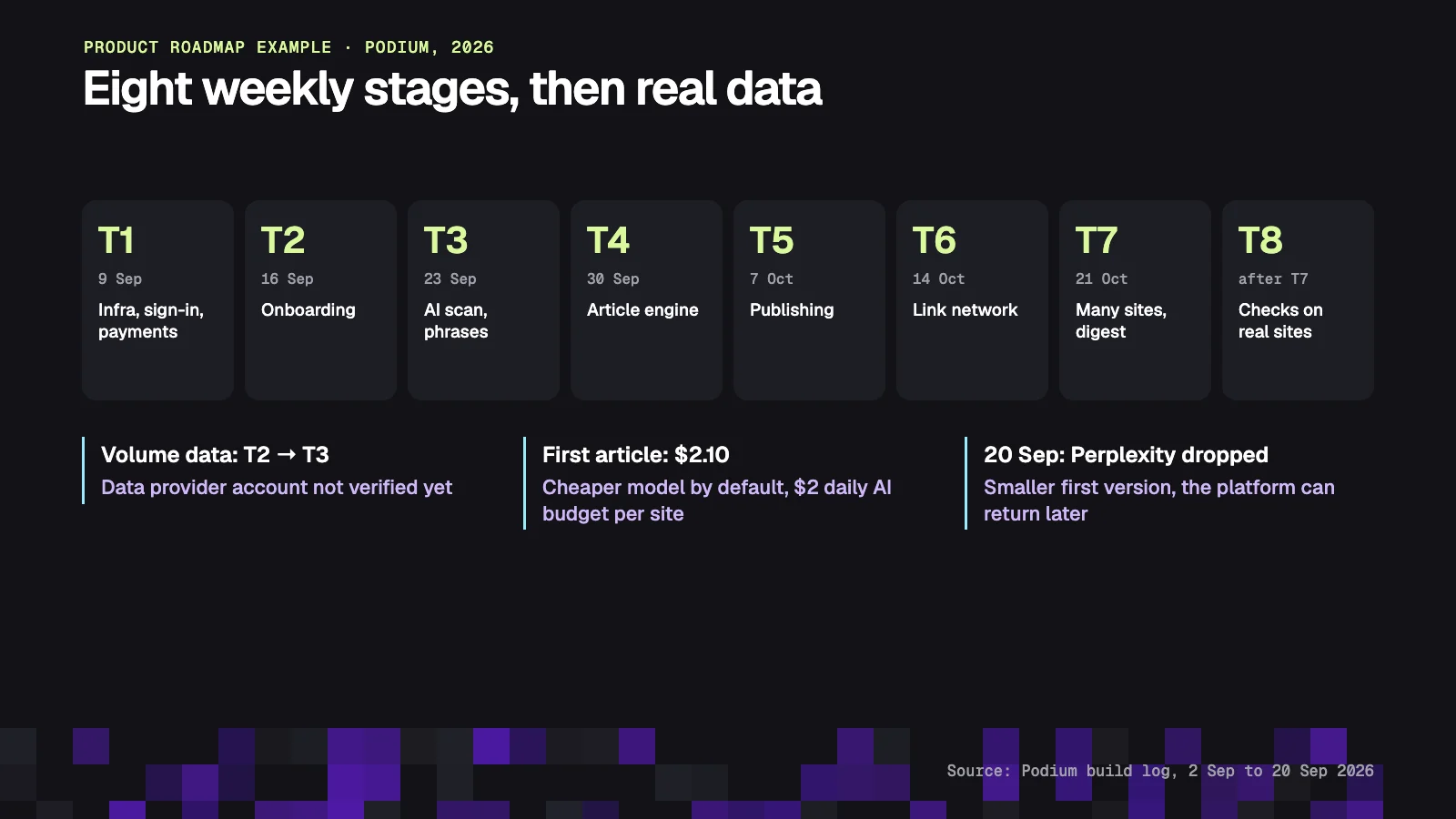
Podium is a product Max built from zero for writing and publishing articles on company blogs. Its first plan had eight weekly stages, from early September to late October 2026, and each stage had a clear finish line. The interesting part is what changed after the first live run.
The plan, as written in the build log on 2 September 2026:
| Stage | Deadline | Scope |
|---|---|---|
| T1 | 9 September | Infrastructure, database, sign-in, payments, alerts |
| T2 | 16 September | Onboarding |
| T3 | 23 September | AI visibility scan, scoring, search phrases |
| T4 | 30 September | Article engine |
| T5 | 7 October | Publishing to the customer's CMS |
| T6 | 14 October | Internal link network |
| T7 | 21 October | Several sites per account, settings, digest email |
| T8 | After T7 | Quality checks on two or three real sites |
Each stage had a definition of done, and the first one was very concrete: a customer can enter a card, go through a three-day trial and receive an invoice. That is a good roadmap item. It is a user outcome, it can be checked in five minutes, and nobody can argue about whether it is finished.
Then the first live test on 3 September changed several items. Search volume data had already been moved from T2 to T3, because the data provider account was not verified yet. A scan of 22 search phrases cost $0.10. The first article, written on the largest AI model in three attempts, cost $2.10. That led to two decisions: a cheaper model by default and a daily AI budget of $2 per site. On 20 September one AI platform, Perplexity, was dropped from the scan entirely.
None of those numbers were in the plan. They came out of running the product on a real site. A roadmap is useful exactly because it lets you absorb that kind of news without rewriting everything: the stages stayed, the scope inside them moved.
How to build a product roadmap in six steps
To build a product roadmap for a first app, start from one problem and one metric, not from a feature list. The six steps below take about a day of focused work for a founder, or one workshop with the team that will build the product.
- Write the goal in one sentence. Who is the user, what problem disappears, and how you will measure it. Example: "Homeowners who use two or more of our services book them without calling."
- List every idea, then cut. Put all feature ideas in one list. For each, ask whether the goal can be tested without it. If yes, it goes to Later.
- Pick three to five items for Now. These are the smallest set that tests the goal. Usually one main user flow from start to finish, sign-in, and a way to measure what users do.
- Give each item a metric and a decision date. Decide the threshold before you start. If you set it after you see the data, you will move the bar to match the result.
- Attach a budget to Now. Agree a fixed price for the stage before it starts, so a slipping item becomes a decision, not a surprise invoice.
- Set the review rhythm. Monthly while you build the MVP. After launch, every quarter is enough. GOV.UK's service manual says its roadmaps are "iterated on at least a quarterly basis."
How to prioritize the product roadmap
For a small company, a full scoring framework is usually overkill. Two questions do most of the work: how risky is the assumption behind this item, and how much does it cost to test. Put the riskiest cheap test first. Expensive items with low risk can wait, because they will still be needed later and you will know more by then.
If you want a formula, RICE (reach, impact, confidence, effort) and MoSCoW (must, should, could, won't) are the two most common. Use them to argue less, not to look more scientific. Whatever the method, the founder still has the final word in a company this size, and the roadmap should say why each item was chosen.
Product roadmap tools and software: what they cost
For a first app you do not need paid product roadmap software. A spreadsheet, a free Trello board or the free plan of a planning tool covers a roadmap with three columns and twenty items. Paid tools start to pay off when several people edit the roadmap and you want it linked to development tickets and customer feedback.
Prices below are from the vendors' pricing pages, checked on 16 November 2026, per user per month with yearly billing unless noted.
| Tool | Free plan | Paid plans | Good fit for |
|---|---|---|---|
| Spreadsheet (Google Sheets, Excel) | Usually already paid for | None extra | A first roadmap, any team size |
| Trello | Up to 10 collaborators and 10 boards per workspace | Standard $5 ($6 monthly), Premium $10 ($12.50 monthly) | Simple Now, Next, Later boards |
| Linear | $0, 2 teams, 250 issues | Basic $10, Business $16 | Teams that also track development work |
| Jira Product Discovery | Free for 3 creators | Standard $10.50, Premium $26.25 per creator | Companies already on Jira |
| Aha! Roadmaps | Trial only | From $59 | Product teams with several products |
| Productboard | Trial | No public price, sales contact | Larger product teams |
In a small company the roadmap usually has a few editors and many readers. The calculation below assumes three editors. Check each tool's terms for read-only users before you buy.
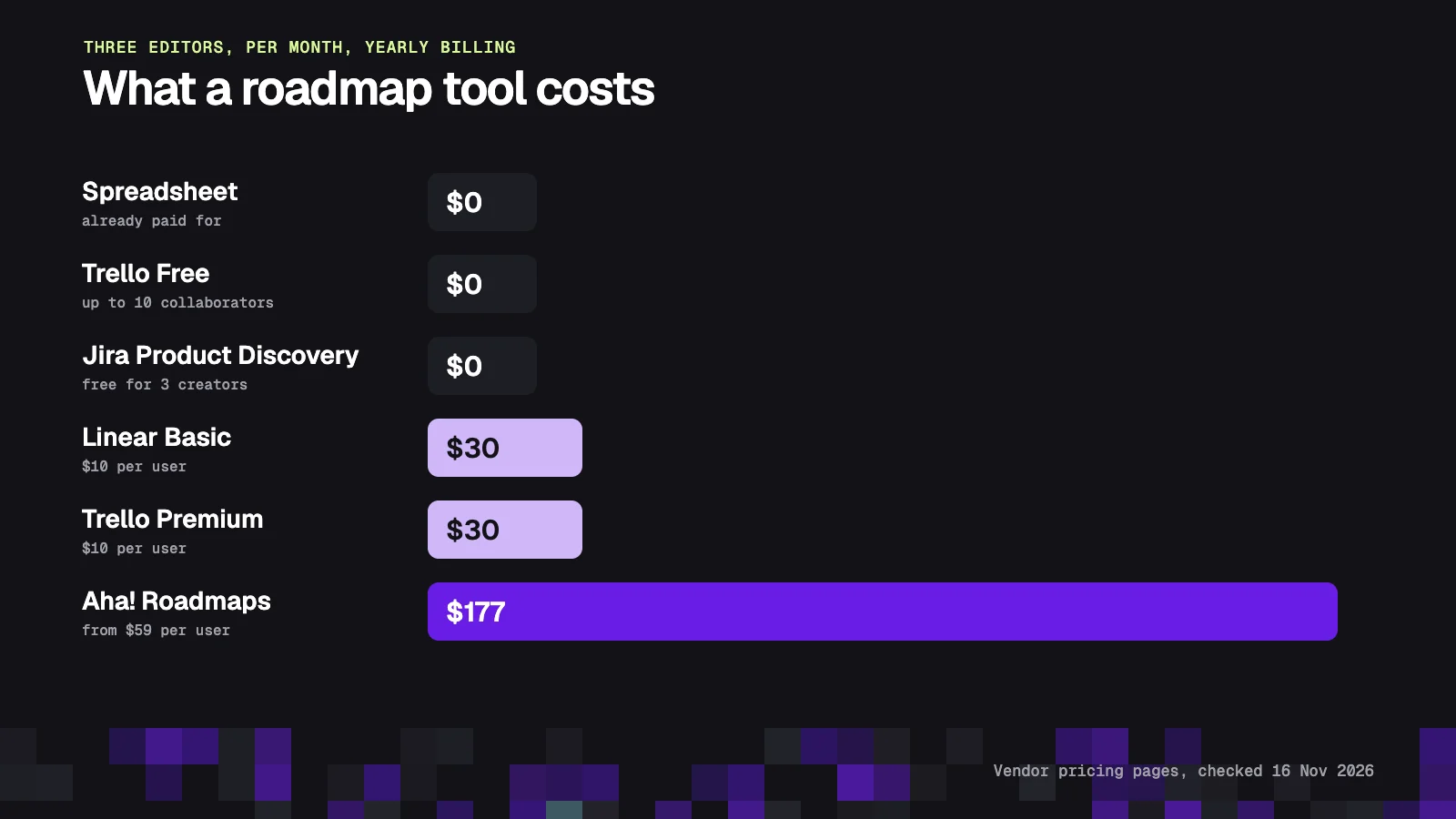
| Tool and plan | Price per editor | Three editors per month | Three editors per year |
|---|---|---|---|
| Trello Free | $0 | $0 | $0 |
| Jira Product Discovery Free | $0 | $0 | $0 |
| Trello Standard | $5 | $15 | $180 |
| Linear Basic | $10 | $30 | $360 |
| Trello Premium | $10 | $30 | $360 |
| Aha! Roadmaps | $59 | $177 | $2,124 |
Move to a paid tool when the roadmap and the development work drift apart, usually to the one your developers already use.
Product roadmap best practices for small companies
The best practices that matter most for a small company fit on one card: few items in Now, one metric per item, a single owner, a fixed review date and plain language. The table below lists what to put on the roadmap and what to keep somewhere else.
| On the roadmap | Somewhere else |
|---|---|
| User problems and outcomes | Screens and design details (design files) |
| One metric per item | Bug reports (issue tracker) |
| The order of work and the reason for it | Technical tasks such as upgrades and refactors (backlog) |
| A real external deadline, if one exists | Invented dates more than a quarter ahead |
| Items you dropped and why | Every idea anyone has mentioned (an ideas list) |
| The budget or stage price for Now | Hourly time tracking |
A few more habits that save time:
- One owner. Usually the founder or the person closest to customers. Others suggest, one person decides and updates.
- One version. A single link that everyone uses. Old copies get deleted.
- Dates only where the world sets them. A spring season for a landscaping company is a real date. "Feature X in March" usually is not.
- Review on a calendar date. Put the monthly review in the calendar now, before the first item is late.
Roadmaps when an outside team builds the app
When an outside team builds your app, the roadmap becomes the contract between you, in plain words. Each item in Now should map to a stage with a fixed price and a finish line both sides can check. That way scope changes show up as a roadmap decision, not as a bigger invoice at the end.
This is how we work on MVP projects. Discovery comes in week one, a prototype on the client's real data in week two, and the build in weeks three to six. We give a range after the first call and a fixed price before each stage, once it is clear what the stage contains.
An example from current work: a client in the US runs several home-services businesses, including cleaning, plumbing, electrical, painting and moving. The idea is a subscription platform where a homeowner can book any of their services in one place and keep the home's service history with photos and invoices. The 12-month goal is an MVP with paying subscribers.
The roadmap for that kind of product puts very little in Now. The companies keep their existing field service software (Jobber), so scheduling and invoicing are not rebuilt. Now holds only what no tool gives them today: one customer account across all the businesses and one place to book. Subscriptions, history and support follow once those work. For more on when a custom app makes sense at all, see custom app for a small business.
A checklist before you share a roadmap with a development team:
- Every Now item has a metric and a decision date.
- Every Now item has a stage price or a budget limit.
- Later is visible, so the team knows what you have already parked.
- There is one owner on your side who can say yes or no within a day.
- The first review date is in both calendars.
Frequently asked questions
What is a product roadmap in simple terms?
A product roadmap is a short plan that says what a product will do next for its users, in what order, and why. It lists problems and outcomes, not individual tasks. For a first app it usually fits on one page with three columns: Now, Next and Later.
What should a product roadmap include?
Each item should have the user problem, one success metric, a priority (Now, Next or Later), a decision date and a status. For small companies, add a budget or stage price to the Now items. Leave out bugs, design details and technical tasks; those belong in the backlog.
What is a product roadmap in agile?
In agile teams, the product roadmap sets direction for several months, while the backlog and sprints handle the detailed work in one to four week cycles. The roadmap is revised regularly as the team learns. A Now, Next, Later roadmap fits agile work well because it sets order without fixing exact dates.
What is the difference between a product roadmap and a product backlog?
The roadmap shows which problems you will solve and why. The backlog is the ordered list of all work needed to get there, which Scrum.org describes as an emergent, ordered list of what is needed to improve the product. One roadmap item usually becomes many backlog items.
How often should you update a product roadmap?
Monthly while you are building a first version, because you learn fast in that period. After launch, quarterly is enough for most small companies. The UK Government Digital Service revises its roadmaps at least every quarter. Put the review dates in the calendar in advance.
How do you prioritize a product roadmap?
Start with the riskiest assumption that is cheapest to test, and move expensive, low-risk items later. Frameworks such as RICE or MoSCoW can help a team argue less. In a small company the founder makes the final call, and the roadmap should record the reason for each choice.
What is the best product roadmap software for a small business?
For a first roadmap, a spreadsheet or a free plan is enough: Trello's free plan covers up to 10 collaborators, and Jira Product Discovery is free for 3 creators (November 2026). Paid tools such as Linear from $10 or Aha! Roadmaps from $59 per user per month make sense when the roadmap must link to development work.
Should a product roadmap have dates?
Only where a date is set from outside, such as a contract, a season or an event. Other items are better shown as Now, Next or Later, because invented dates look like promises and become wrong quickly. If investors ask for dates, give ranges by quarter for Next and keep Later undated.
If you are planning a first app and want a second opinion on the roadmap before anyone starts building, book a 30-minute call. We will go through the Now column together and tell you what we would cut.