What is an MVP: definition, types and how to build the first version of a product
An MVP (minimum viable product) is the smallest version of a product you can put in front of real users to test your most important assumption with the least effort. It does not have to be an app: it can be a sign-up page, a video or a service done by hand. In sports the same abbreviation means something else: most valuable player, the best player of a game or season.
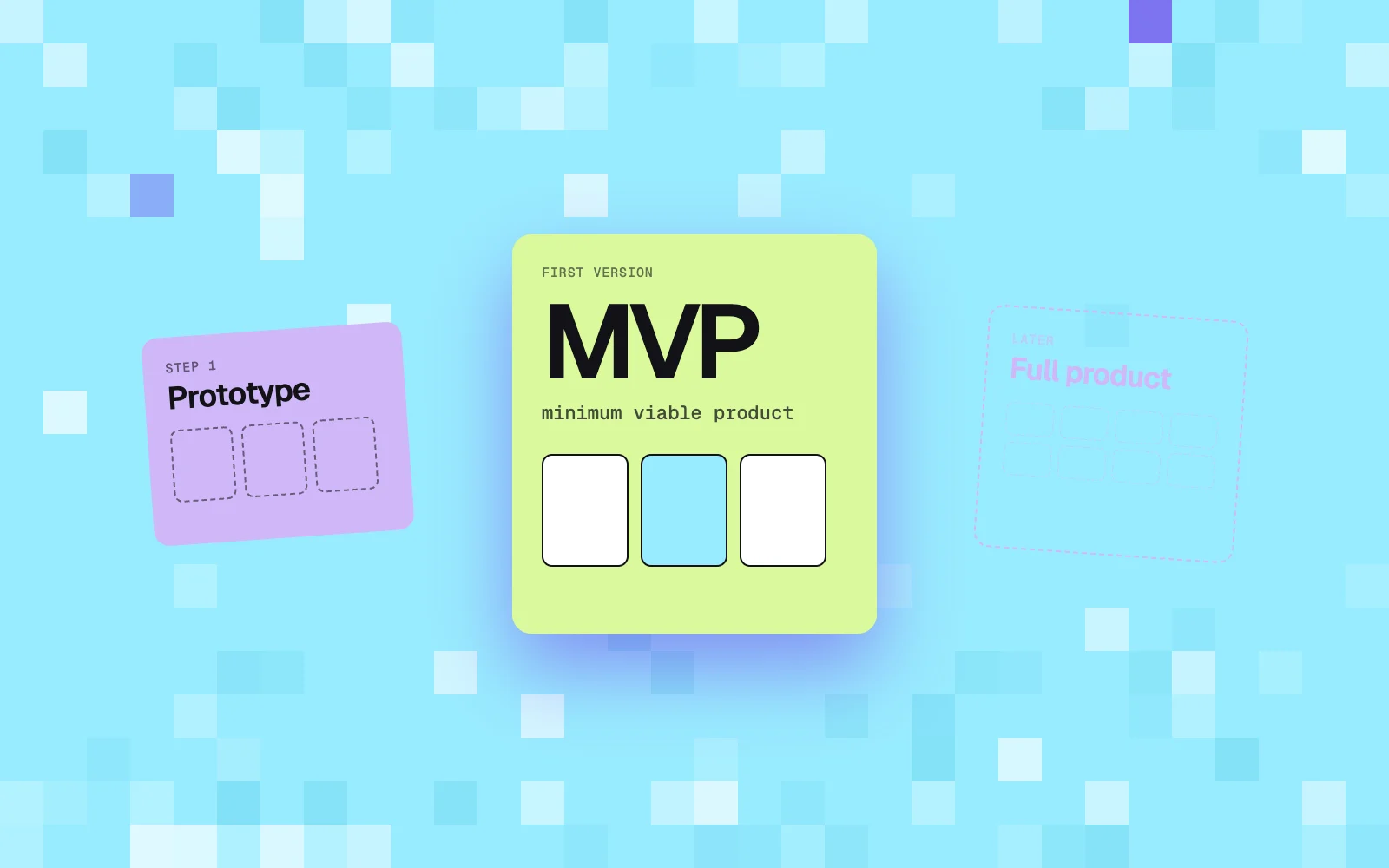
MVP stands for "minimum viable product". In business and in software, it means the first, deliberately stripped-down version of a product that real users get to use. Its job is not to make money or to impress anyone. It has to answer one question: do people really need this?
Many explanations of the term repeat the same examples without sources, or come from agencies that sell MVP development. Below you will find a sourced definition, comparison tables, the main types of MVP and an example from building a real product, with numbers.
A few words on where this comes from. In 2021 Max Miskow co-founded the startup Skillsbite (AI for analyzing CVs), where we had to test our own idea and change direction. After that he designed and built products for clients, and built his own product, Podium, from scratch. We've been on both sides: founders who had to validate our own product ideas, and the team that designs and builds products for clients.
What is an MVP: the definition
An MVP is the version of a new product that lets a team collect the maximum amount of validated learning about customers with the least effort. That is the definition from Eric Ries, author of "The Lean Startup", who made the term popular. The key word is "learning": you measure an MVP by what you learned, not by the number of features.
In his original 2009 post Ries writes that, despite the name, an MVP is not about building minimal products. It is about the first version you can learn something from. He also gives two examples from his own work. The first version of his product IMVU reached the market after six months, while at his previous company it took almost five years to launch. In another case, his team spent two weeks building a feature nobody wanted. Ries concluded that even that was too long: a simple search ad test would have taught them the same thing.
Let's break the term down:
- Minimum means only what you need to test the most important assumption. Everything else waits.
- Viable means it works well enough that a real user can use it and get something out of it. A mockup that nobody can use is not an MVP.
- Product means something a user receives, not a document or a slide deck for the board.
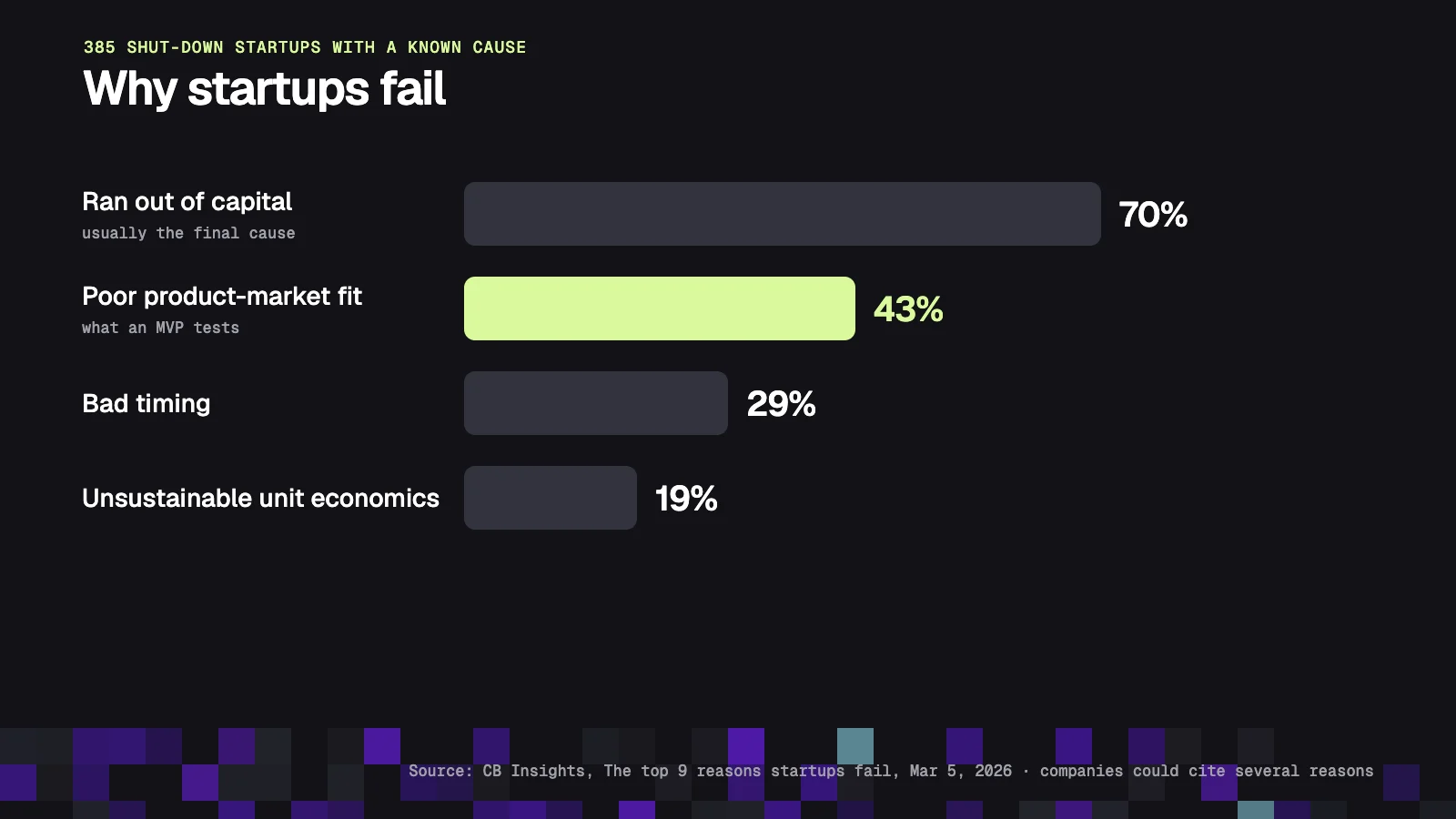
The data shows why this matters. CB Insights analyzed (report from March 5, 2026) 431 venture-backed startups that shut down since 2023. Among the 385 companies where the reasons could be identified, 70% cited running out of capital. The report notes, though, that this is usually the final cause, not the root of the problem. The deeper causes were poor product-market fit (43%), bad timing (29%) and unsustainable unit economics (19%). Two thirds of the failures caused by poor product-market fit were early-stage companies that never found their market. An MVP is the tool meant to catch that early and cheaply.
What does MVP stand for: in business, in software and in sports
The abbreviation MVP has two main meanings. In business and software it stands for minimum viable product, the first version of a product built to test an idea. In sports and games it stands for most valuable player, the best and most valuable player of a game or a season. The Cambridge Dictionary lists both meanings.
| Context | Stands for | What it means | Example |
|---|---|---|---|
| Business and startups | minimum viable product | the smallest product worth testing with customers | "Let's show the MVP to ten customers before we build the rest." |
| Software development | minimum viable product | the first version with a minimal scope | "The app MVP has three screens and a login." |
| Project management | minimum viable product | the smallest scope that delivers value | "What goes into the project MVP and what goes into phase two." |
| Sports | most valuable player | the most valuable player | "Finals MVP." |
| Video games | most valuable player | the best player of the match | "After the match the game picked him as MVP." |
What MVP means in software development
In software, an MVP is the first version of an app or system with the smallest scope that lets someone complete one important task. It is usually a few screens, a login and one core feature, connected to tools the user already works with. Anything that does not help test the main assumption goes on the "later" list.
What MVP means in sports
In sports, MVP is the title for the most valuable player: of a game, a tournament or a whole season. It is best known from American leagues, but it is also used in volleyball, basketball and video games. This meaning has nothing to do with products. If this is what you were looking for, you have your answer, and the rest of this article is about MVP in business.
What an MVP is and what it is not: MVP vs prototype, PoC and beta
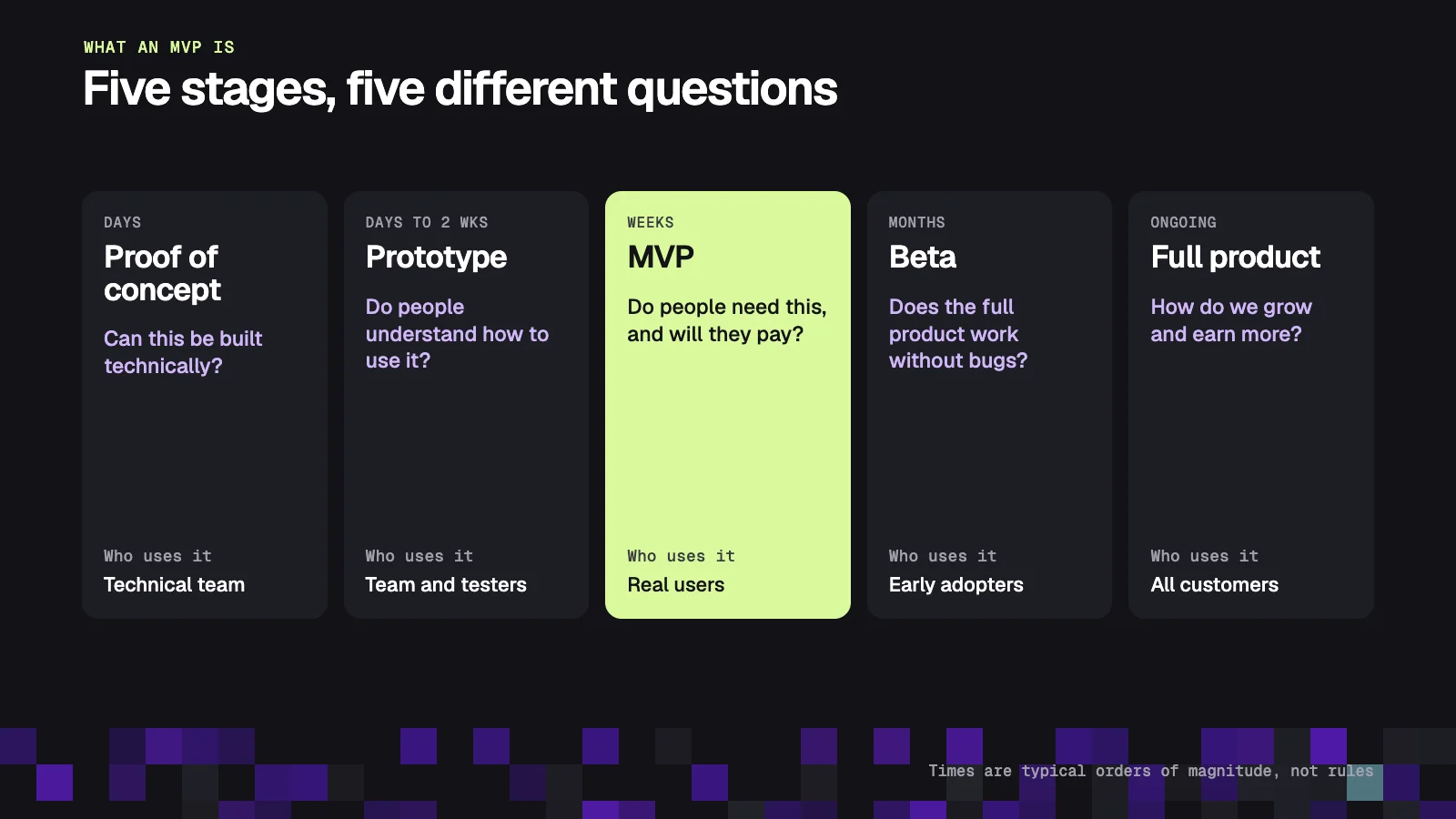
An MVP is a product that real users use in a real situation. A prototype shows what a product could look like. A proof of concept checks whether something is technically possible. A beta is an almost finished product that you test for bugs. People often mix these up, and each one answers a different question.
| Term | Question it answers | Who uses it | Does it really work | Typical time |
|---|---|---|---|---|
| Proof of concept (PoC) | Can this be built technically? | The technical team | Partly, often only in tests | Days |
| Prototype | What will it look like, and do people understand how to use it? | The team and a few testers | No, it is a clickable mockup | Days to 2 weeks |
| MVP | Do people need this, and will they pay? | Real users | Yes, within a narrow scope | Weeks |
| Beta | Does the full product work without bugs? | Early adopters | Yes, almost in full scope | Months |
| Full product | How do we grow and earn more? | All customers | Yes | Ongoing |
The times in the table are typical orders of magnitude, not rules. The most important difference is in the fourth column: only the MVP and later versions have real users. That is why only an MVP can tell you whether anyone wants the product. A prototype can tell you, at most, whether people understand how to use it.
You will also come across the term MLP, minimum lovable product. It is an MVP polished enough that users want to use it, not just that they can. It makes sense in a market where customers already have good alternatives and will not give a rough product a chance.
Types of MVP: 6 approaches that do not require building a whole app
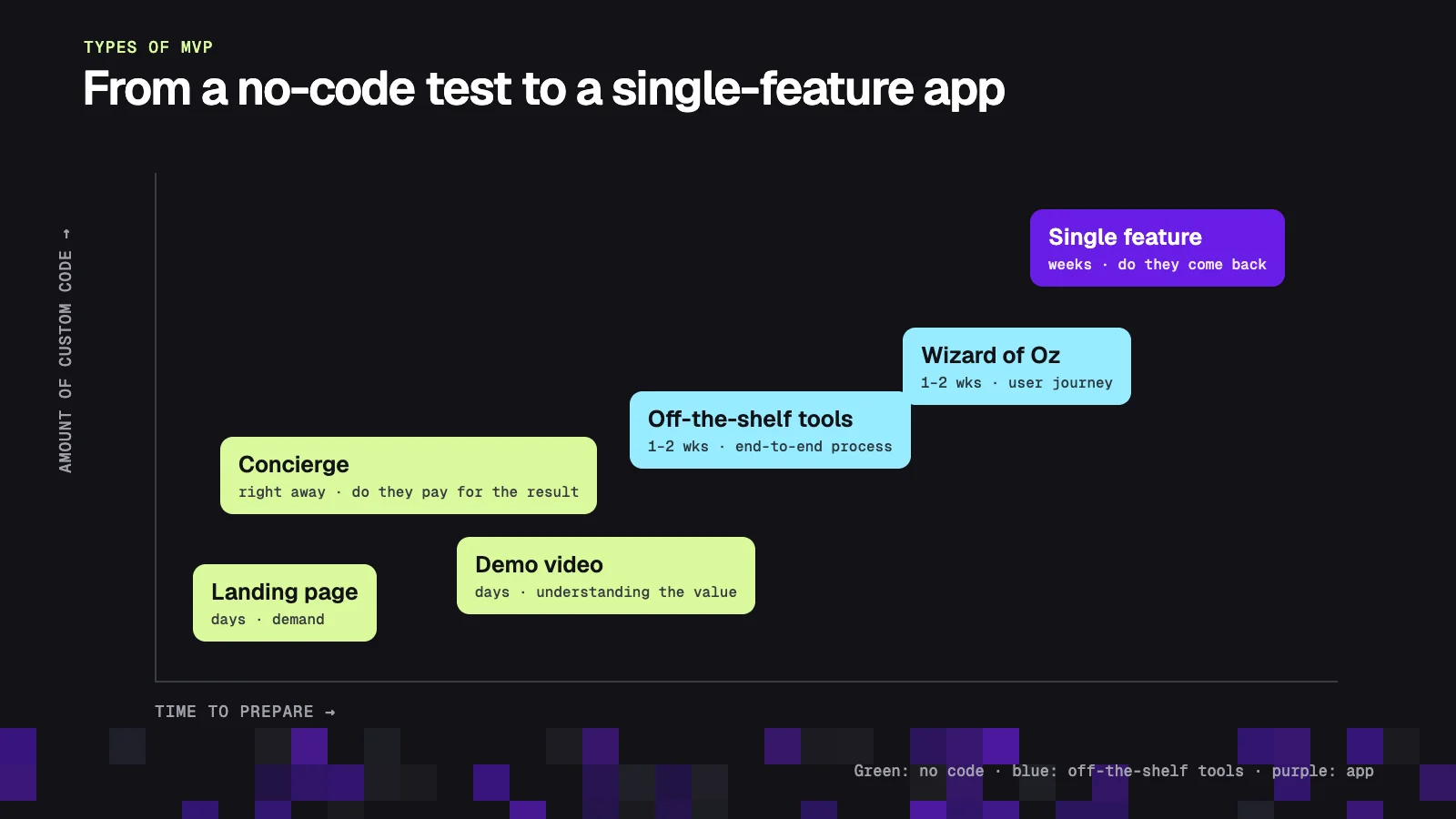
An MVP does not have to be an app. The cheapest MVPs test demand before any code exists: a sign-up page, a video showing the product, or a service done by hand for a few customers. Only when people want the manual version is it worth building the automated one. The right type depends on which assumption is the riskiest.
| Type of MVP | How it works | What it tests | Time to prepare | When to choose it |
|---|---|---|---|---|
| Landing page with sign-up | Product description, price, a "sign up" or "buy" button | Whether someone wants it enough to leave an email or pay | Days | A new product for new customers |
| Demo video | A recording of how the product works before it is fully built | Whether people understand the value and want to join the list | Days | A product that is hard to describe in words |
| Concierge (manual service) | You do by hand for the customer what the app will do later | Whether customers pay for the result | Right away | Services, quotes, consulting |
| Wizard of Oz | The customer sees a product, while a person does the work behind it | Whether the user journey works | 1–2 weeks | When automation is expensive |
| Single feature | An app that does only one thing, but does it well | Whether that one thing is enough to keep people coming back | Weeks | When demand is already confirmed |
| Built from off-the-shelf tools | A form, a spreadsheet, an automation and payments instead of custom code | Whether the process works end to end | 1–2 weeks | Internal tools, first sales |
The best-known demo video example is Dropbox. Before the product was ready, founder Drew Houston recorded a short video showing how file sync worked. As Eric Ries described in a 2011 piece for TechCrunch, the beta waiting list grew from 5,000 to 75,000 people overnight after that video. It was proof of demand that no survey could have given.
In companies that are not tech companies, the concierge MVP or an MVP built from off-the-shelf tools usually works best. If you want to give customers a portal for ordering services, you can first spend a month taking orders through a form and handling them by hand. If nobody uses the form, a portal will not help either.
How to build an MVP: from assumption to first version
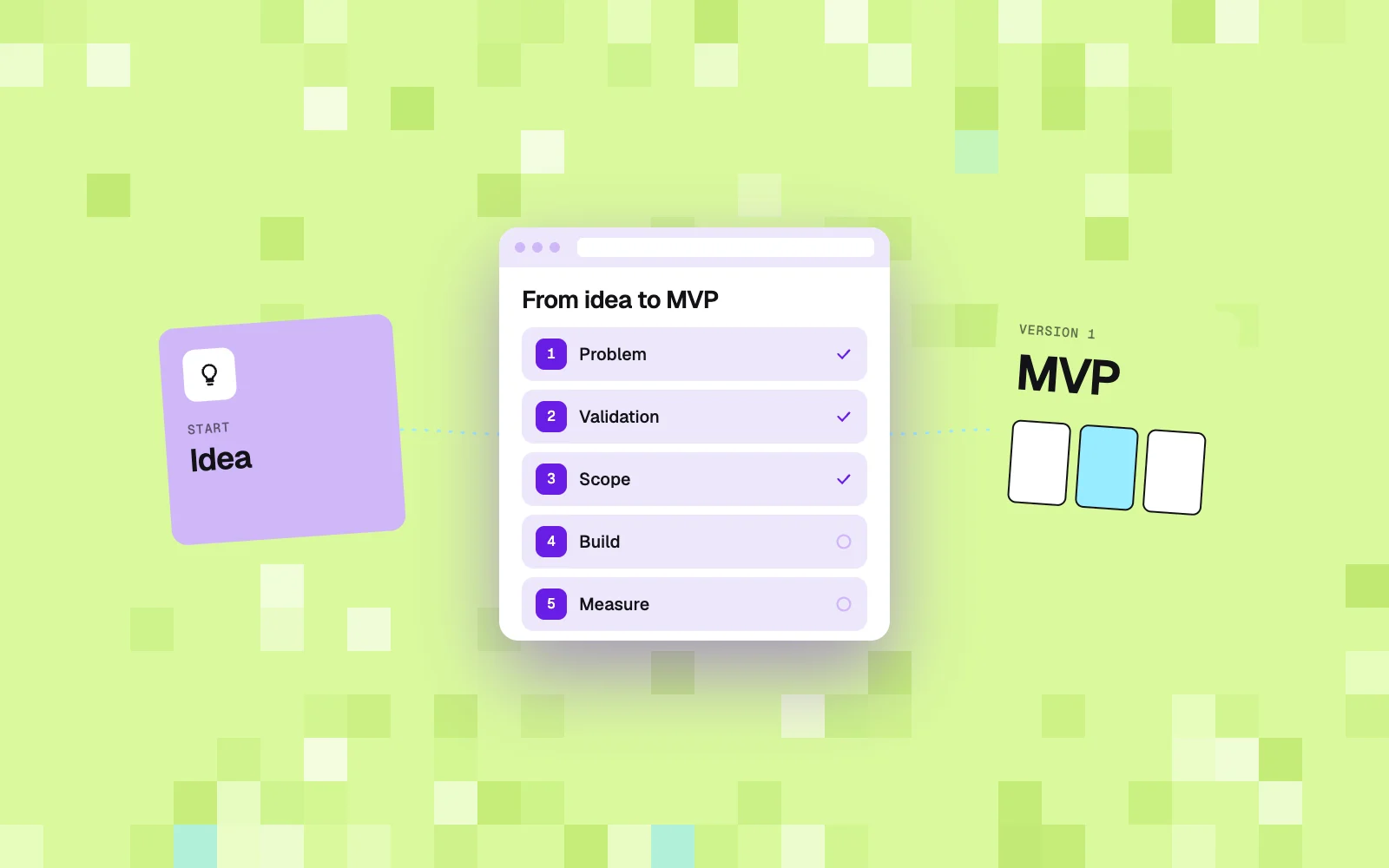
You build an MVP starting from an assumption, not from a feature list. First you name the riskiest assumption, then you pick the cheapest way to test it, decide what result counts as success, and only then decide what has to be in the first version. Everything else goes on the "after the MVP" list.
In practice it takes five steps:
- Write down the assumption. One sentence: "Homeowners will pay a subscription for one place to order all their services" or "The office will cut order re-entry in half".
- Choose the type of MVP. From the table above: the cheapest one that answers the question from step 1.
- Set the success threshold before you start. For example: 20 sign-ups in two weeks, 5 paying customers, 3 people on the team using the tool every day.
- Build the smallest scope. Only what the test cannot work without. Leave login, payments and invoices to off-the-shelf tools if you can.
- Measure and decide. Keep building, change direction or stop. Each of these decisions is a good outcome.
We described building an app step by step, with examples for businesses, in how to build an app for your business. Here, let's focus on the hardest part: deciding what goes into the first version.
What goes into the MVP and what waits
A simple test for every feature: can you test the main assumption without it? If yes, the feature waits. The things that usually wait are the ones off-the-shelf tools already do well, and the ones that "someone will definitely ask for".
| Usually in the MVP | Usually after the MVP |
|---|---|
| One main user journey from start to finish | A second and third journey for other user types |
| Login, often from an external service | A custom system of roles and permissions |
| Payment or sign-up, if the test is about paying | Discounts, promo codes, multiple plans |
| A basic email notification | A mobile app and push notifications |
| A manual admin panel for the team, even a simple spreadsheet | Advanced reports and charts |
| Measurement: who started, who came back, who paid | "Just in case" integrations with systems nobody needs yet |
Example: what building the Podium MVP showed
An MVP reveals problems you cannot see in a mockup or on a developer's laptop. That was the case with Podium, a tool for writing and publishing articles on company blogs that Max built from scratch. The first version had a plan in seven weekly stages, and the first run on a real website changed several decisions within a single day.
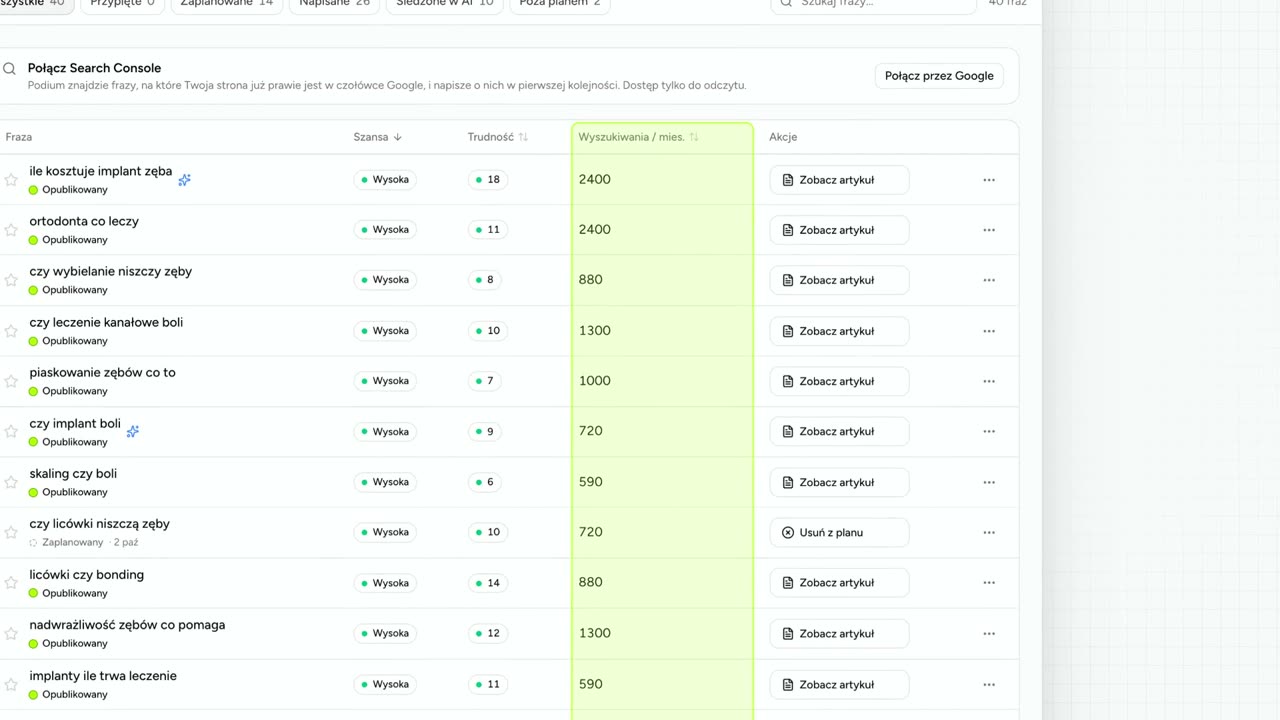
The plan for the first version had seven stages: infrastructure and payments, onboarding, a visibility scan in AI assistants, the article engine, publishing, links, and settings for multiple sites. Even the first stage had a clear definition of done: you can enter a card, go through a three-day trial and receive an invoice.
The first live test, on September 3, 2026, looked like this:
| What we tested | Plan | What happened | Decision |
|---|---|---|---|
| Scan of 22 keywords in AI assistants | Four platforms | Claude: cost USD 0.10; Perplexity: rate limit; Gemini: deprecated model; OpenAI: no credits | Perplexity in a single thread with retries, Gemini on a newer model |
| First article | A cheaper, mid-size model | On the largest model, USD 2.10, 3 attempts | Cheaper model by default, a larger one only when evaluations show a difference |
| Cost control | Cost recorded with each job | Article cost higher than planned | Daily budget of USD 2 per site, then pause and alert |
| Keyword volume data | In the first version | Account with the data provider not verified | Volume and difficulty moved to later, keywords from other sources |
A couple of weeks later, on September 20, another scope decision was made: Perplexity was dropped from the scan completely. The first version stays smaller, and any platform can come back when it is needed.
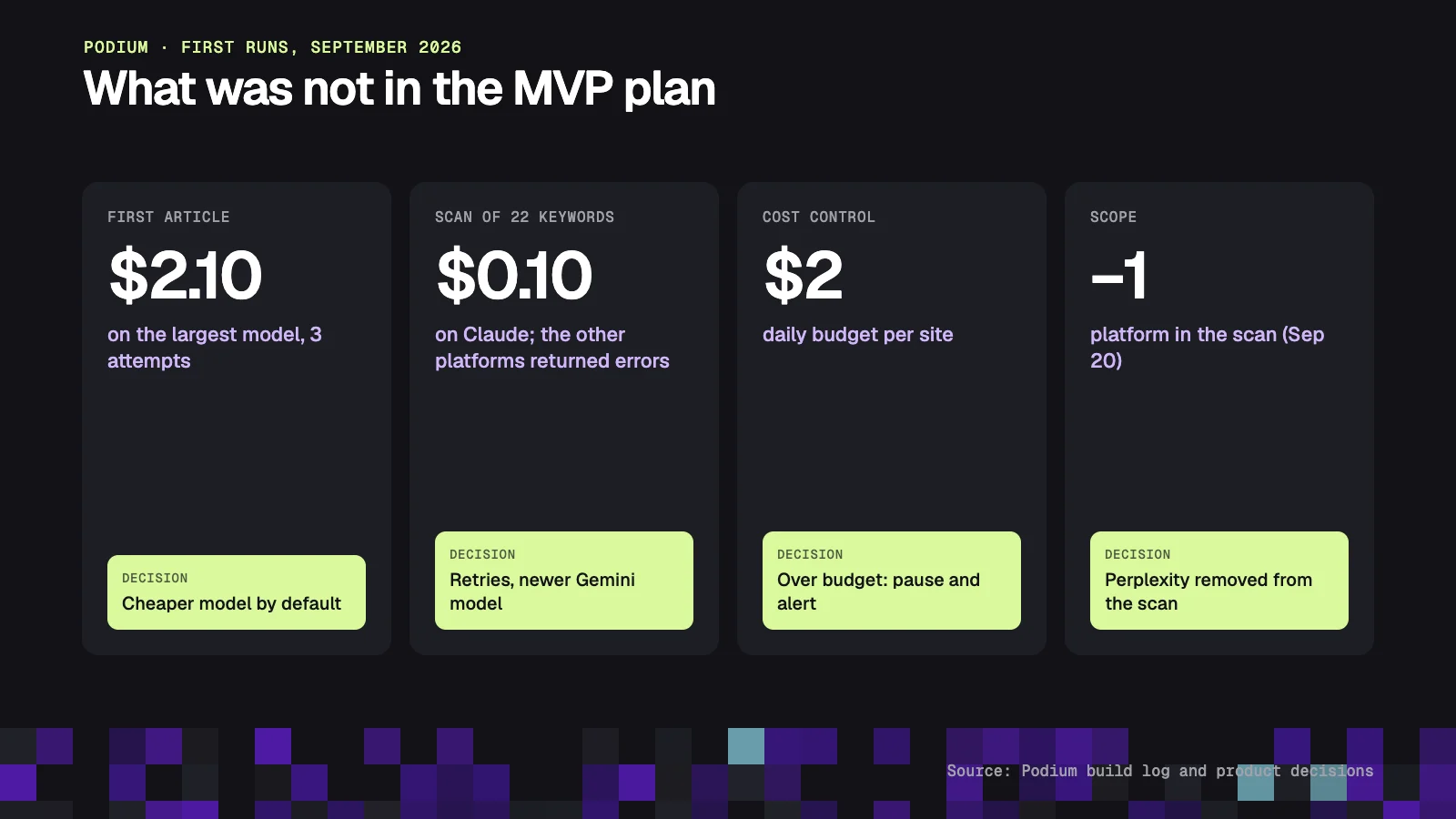
This example shows clearly what an MVP is for. None of these numbers were in the plan. The USD 2.10 cost per article, the provider limits and the deprecated model only surfaced during a real run. If the full product had been built over six months without a test like this, these problems would have come up at the end, when change is most expensive.
How much an MVP costs and how long it takes
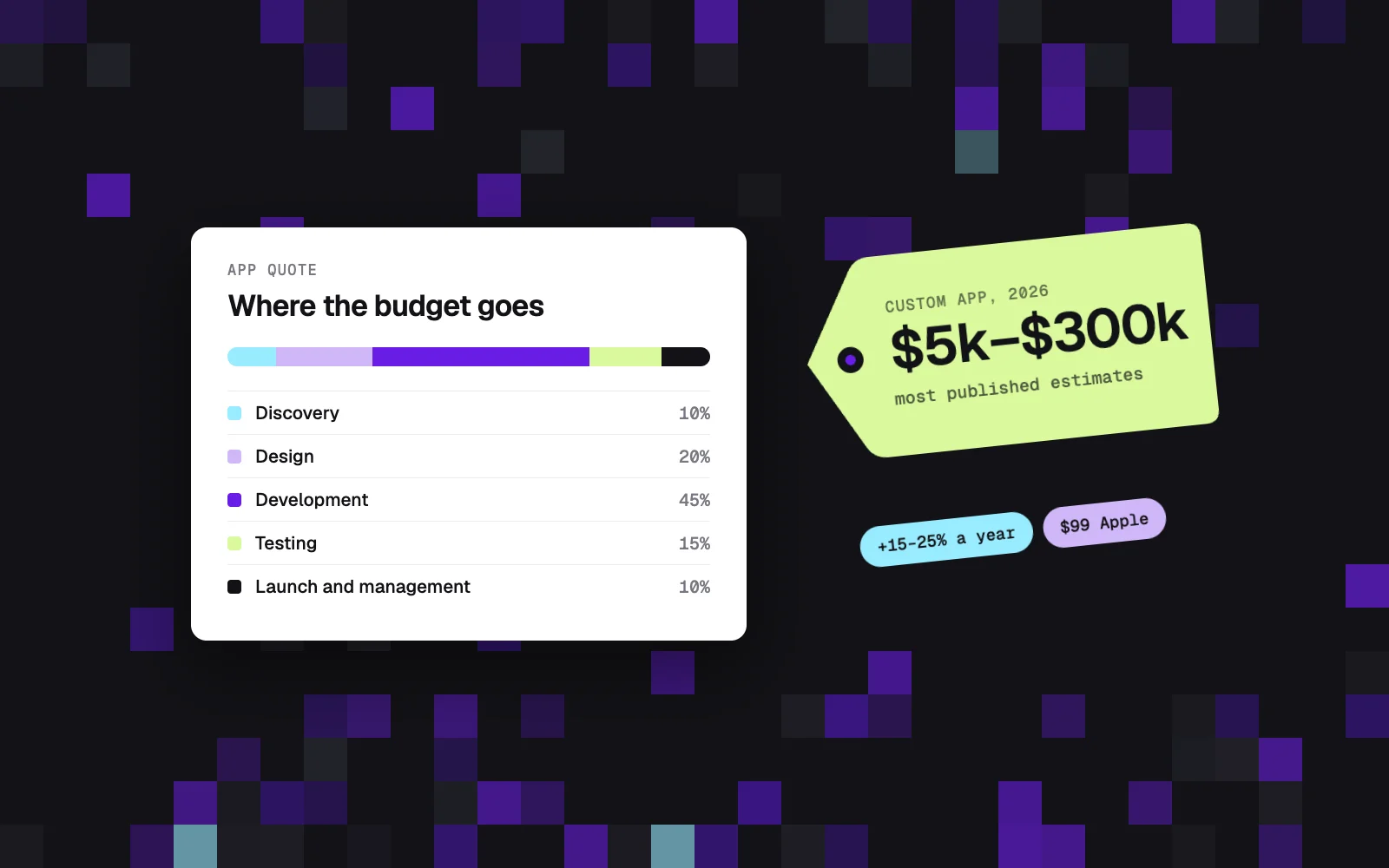
An MVP can cost almost nothing and take a few days if it is a sign-up page or a service done by hand. An app with a single feature and integrations usually takes a few weeks of work. The cost depends mainly on how much the first version has to build from scratch and how much it can take from off-the-shelf tools.
| MVP option | Typical time | What drives the cost |
|---|---|---|
| Sign-up page or video | Days | Mostly time for copy, design and possibly ads |
| Concierge, manual service | Right away, test over a few weeks | Team time spent serving customers by hand |
| MVP from off-the-shelf tools | 1–2 weeks | Tool subscriptions and setup |
| Single-feature app on existing systems | A few weeks | Number of screens and integrations, API access |
| Full system from scratch | Months | Everything: that is why it rarely makes a good MVP |
Here is how we build an MVP: diagnosis in the first week, a prototype on the client's real data in the second, and implementation in weeks three to six. We give a range after the first call and a fixed price before each stage, once it is clear what that stage will include. If the product uses AI, we also calculate its monthly running cost from the start.
An example of a narrow scope from our work: a client in the US runs several home-services companies and wants to give homeowners one place to order all their services. The 12-month goal is an MVP with paying subscribers. The first version does not rebuild scheduling or invoicing, because the companies keep their job management software (Jobber). It starts with what no tool does: a shared customer account and service history across all the companies.
How to measure whether an MVP worked
An MVP worked if it gave a clear answer to the question you started with, even if that answer is "no". You measure behavior, not stated intentions: how many people started, how many came back, how many paid, and whether the problem that was supposed to go away actually got smaller. Feedback like "nice" is pleasant, but it is not a result.
Choose metrics to fit the type of MVP. Below are the ones that most often make sense in the first weeks. Set the thresholds yourselves, before launch, based on how much has to happen for further building to pay off.
| Metric | What it tells you | How to measure it | Fits |
|---|---|---|---|
| Sign-ups or orders | Whether someone wants it enough to take the first step | A counter in the form or the payment system | Landing page, video, concierge |
| Activation | Whether people complete the first important task | Share of people who did something after signing up | Single-feature app |
| Retention | Whether the product is needed more than once | How many people use it in the second and third week in a row | Any MVP with a user account |
| Payment | Whether the value is higher than the price | How many people pay or convert from trial to paid | Products sold to customers |
| Time spent | Whether the problem in the company got smaller | Hours per week on the task, before and after | Internal tools |
| Running cost | Whether the product can pay off at scale | Cost of services and AI per user or per task | Products with paid services or AI |
The last row is easy to skip, and in AI products it can be decisive. In Podium, it was the first run that revealed the cost per article and led to a daily budget per site.
The most common MVP mistakes
The most common mistake is an MVP that is not minimal: the team builds for six months and calls the result an MVP, even though nobody tested the assumption along the way. The second is an MVP without a success threshold, after which nobody knows whether the test worked. The third is an MVP shown only to friends, who praise it out of politeness.
| Mistake | How to spot it | What to do instead |
|---|---|---|
| Scope too wide | The feature list has more than a dozen items and the deadline keeps slipping | One user journey, the rest after the MVP |
| No success threshold | After the test, any result can be called good | Write down the number before launch |
| Wrong people in the test | Friends and the team are the testers | Real customers, ideally paying ones |
| Building what off-the-shelf tools already do | Custom invoices, calendar and login from scratch | Integrate with what the company already uses |
| MVP as a promise, not a test | After launch nobody looks at the numbers | A decision meeting scheduled in advance |
| Running costs calculated after the fact | The first bill for services comes as a surprise | Calculate the monthly cost before building |
Frequently asked questions
What does MVP stand for?
In business and software, MVP stands for minimum viable product: the first, deliberately stripped-down version of a product, built to test whether people need it. In sports and games, MVP stands for most valuable player. The meaning depends on the context.
What does MVP mean in sports?
In sports, MVP means most valuable player. The title goes to the best player of a game, a tournament or a season, for example in basketball, volleyball or video games. This meaning has no connection to MVP in business.
What is the MVP of a project?
The MVP of a project is the smallest scope that gives users real value and lets you test the project's most important assumption. You define it at the start to separate what must be in the first version from what can wait for later stages.
What is the difference between an MVP and a prototype?
A prototype shows what the product will look like and usually does not really work. An MVP works and reaches real users, although within a narrow scope. A prototype tests whether people understand the product. An MVP tests whether they need it and will pay for it.
Does an MVP have to be an app?
No. An MVP can be a sign-up page, a video showing the product, a service done by hand or a combination of off-the-shelf tools. The best MVP is the cheapest way to test the most important assumption. It is worth building an app only once demand is confirmed.
How long does it take to build an MVP?
A sign-up page or a manual test takes a few days. A single-feature app connected to tools the company already uses usually takes a few weeks. With us, diagnosis takes one week, the prototype the second week, and implementation weeks three to six.
How much does an MVP cost?
It depends on the type. A sign-up page test costs mostly time. An app costs as much as the screens and integrations that have to be built from scratch. An honest quote requires a conversation about scope, which is why we give a range after the first call and a fixed price before each stage.
What comes after the MVP?
After the MVP you look at the numbers you set before launch and make a decision: build on what people use, change direction or stop. The feature list from the start of the project is a hypothesis, not a plan. You build the next stage around the feature users keep coming back to.
If you have an idea for a product or an app and want to work out what your MVP should look like, book a 30-minute call. You can also read how we build MVPs.