How much does it cost to build an app in 2026?
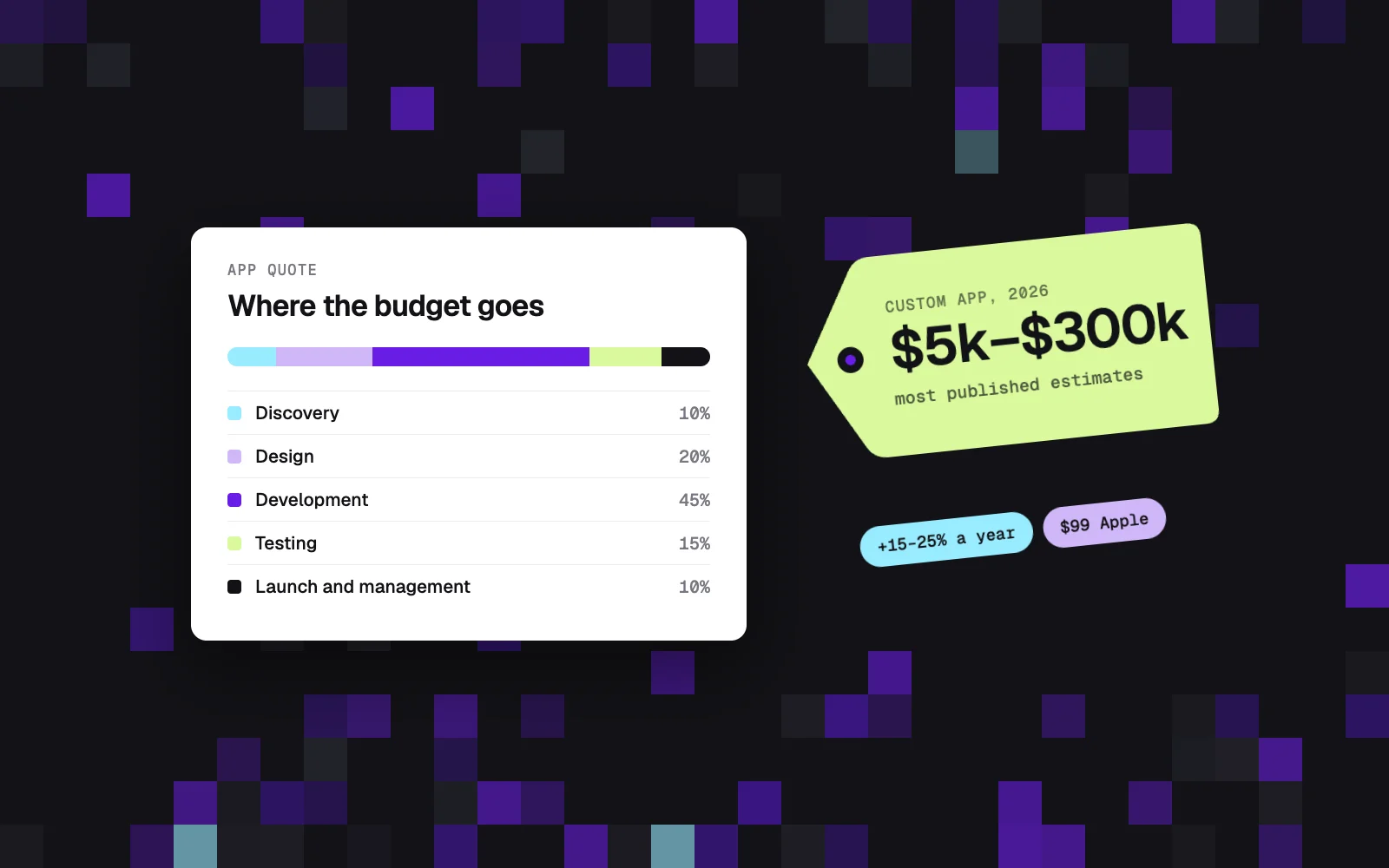
In 2026 most published estimates put a custom app between $5,000 and $300,000. A simple app or MVP usually lands between $5,000 and $50,000, a mid-size app with accounts and payments between $35,000 and $120,000, and Clutch data puts the average project at $90,780. After launch you pay $99 a year for Apple's developer program, $25 once for Google Play, and roughly 15 to 25 percent of the build cost each year for upkeep. The cheapest app is the one scoped to a single problem and built on top of the tools you already use.
Every guide to app costs gives you the same answer: somewhere between five and six figures. That range is honest, and it is useless until you know which part of it applies to you. Below are the numbers from the main 2026 sources side by side, the fees nobody puts in the quote, and the way we narrow the price before anyone writes code.
How much does an app cost in 2026
A custom app costs between $5,000 and $300,000 in most 2026 estimates, and the spread comes from three things: how many features the first version has, how many platforms it runs on, and who builds it. A simple app with a few screens sits at the bottom of the range. A multi-platform product with payments, real-time data and an admin panel sits at the top.
Here is how four widely read 2026 guides split the range by complexity:
| Source (2026) | Simple app or MVP | Medium app | Complex app |
|---|---|---|---|
| Bubble | $5,000–$50,000 | $50,000–$120,000 | $120,000–$300,000+ |
| Alex Cloudstar | $8,000–$35,000 | $35,000–$85,000 | $85,000–$200,000+ |
| Sticklight | $1,000–$15,000 | $15,000–$75,000 | $75,000–$250,000+ |
| Scand | $30,000–$80,000 | $80,000–$200,000 | $200,000–$500,000+ |
The sources disagree by a factor of two or three at every level. That is normal: they count different things. Some include design and testing, some only development hours, and the agency guides price in a full team. Keep that in mind when you compare two quotes. Ask each one what is inside the number.
For the middle of the market, Lovable's 2026 guide cites Clutch pricing data from June 2026: an average project of $90,780 over an 11-month build.
What an MVP is and what it should cost
An MVP (minimum viable product) is the smallest version of an app that real users can use to solve one real problem, built to learn whether the product is worth more investment. It is not a cheaper copy of the full app. It is a different product: fewer features, one main flow, and a clear question it has to answer.
That is why MVP prices sit at the low end. The same Lovable guide cites a GoodFirms 2026 survey in which 78.2% of mobile app companies quote MVPs at $50,000 or less. With a freelancer or a small team, a focused MVP often costs a fraction of that.
The cost of an MVP depends less on the technology and more on what you leave out. Every feature you postpone (a second user role, an admin panel, offline mode, a native app on both stores) cuts weeks from the build.
Freelancer, agency or no-code: who builds it and what it costs
Who builds your app changes the price more than any single feature. A US freelancer charges around $61 an hour on average, an established US agency $150 to $200, and an AI app builder or no-code platform costs a monthly subscription instead of a project fee. The trade-off is how much of the work you do yourself.
| Build path | Typical price | Hourly rate | Best when |
|---|---|---|---|
| AI app builder | $0–$50 a month | none | You want a prototype to test an idea this week |
| No-code platform | $0–$500 a month | none | Internal tool or simple app, someone on your team can maintain it |
| Freelancer | $5,000–$50,000 | about $61 (US average) | One clear problem, small first version, you can make decisions fast |
| Small product team | between freelancer and agency | varies | You need discovery and build from the same people |
| Agency or dev shop | $60,000–$300,000 | $150–$200 (US agencies) | Large scope, several platforms, compliance, a big team on your side |
Price bands per path come from Lovable, hourly rates from Adalo's 2026 guide. Both companies sell app-building tools, so treat their numbers as a reference point, not a quote.
A practical rule: the less clear your problem, the more you need someone who will help you define it before building. Cheap builders do exactly what you ask. That is a good deal only when what you ask for is right.
Where the money goes inside a project
Development is usually less than half of the budget. In a typical split, development takes about 45%, design 20%, testing 15%, discovery 10%, and deployment and project management 5% each. A quote that shows only development hours is either missing the rest or hiding it.
| Phase | Share of budget | What it covers |
|---|---|---|
| Discovery | 10% | User stories, stack decisions, early prototypes |
| Design | 20% | Wireframes, mockups, interaction details |
| Development | 45% | Front end, back end, integrations |
| Quality assurance | 15% | Manual and automated testing |
| Deployment | 5% | Store submission, release setup |
| Project management | 5% | Planning, check-ins, coordination |
Source: Bubble, August 2026. The percentages vary by team, but the shape holds. If a quote has no line for discovery or testing, ask who does that work and when.
What you pay after launch
An app keeps costing money after launch. Plan for store fees, store commission on digital sales, hosting, and upkeep of about 15 to 25 percent of the build cost per year. Apps that use AI add a usage bill on top, which grows with every user.
| Cost after launch | Amount | Source |
|---|---|---|
| Apple Developer Program | $99 per year | Apple |
| Google Play developer account | $25 one-time | Google Play Console Help |
| App Store commission for small businesses | 15% on paid apps and in-app purchases, up to $1 million in yearly proceeds | Apple Small Business Program |
| Upkeep: OS updates, fixes, servers | 15–25% of build cost per year | Sticklight, Alex Cloudstar |
| AI usage (if the app uses AI) | per request, depends on the model | your AI provider's price list |
Store fees apply only to apps in the App Store and Google Play. A web app that runs in the browser skips both, which is one reason many business tools start as web apps.
What AI costs inside a real product
AI usage is small per request and easy to underestimate in total. In Podium, our own product built end to end, the first article written on Claude's top model cost $2.10 across three attempts, while a scan of 22 search phrases cost $0.10. We moved article writing to a cheaper model and added a default daily AI budget of $2 per site, so one bad job cannot run up the bill. Every job records its own cost.
The lesson for any app with AI: decide the model per task, cap the spend per customer, and measure the cost of each action from day one.
How we narrow the price before building
The fastest way to lower an app's cost is to agree on one problem before anyone writes code. We start every project with discovery, test the riskiest idea cheaply, and only then build a narrow first version on top of the tools the business already uses. We give a range after the first call and a fixed price before each stage.
An example from current work: a client in the US runs several home-services businesses (cleaning, plumbing, electrical, painting, moving and more). The idea is a subscription platform where a homeowner can book any of their services in one place and keep the home's service history with photos and invoices. The expensive version of that app would rebuild scheduling, dispatch and invoicing. The first version does not. The companies keep their field service software, and the new app connects to it and handles only what no tool gives them: one customer account across all the businesses.
We've been on both sides: founders who had to validate our own product ideas, and the team that designs and builds products for clients. Both sides teach the same thing about cost. The money is lost on features nobody uses, not on hourly rates.
For more on when a custom app makes sense at all, see custom app for a small business. For the build itself, see how we approach MVP projects.
Checklist: 7 questions that cut the cost before you ask for a quote
Answer these before you contact any builder. Each one removes a range of uncertainty, and uncertainty is what builders price in.
- Which one problem does the first version solve? One sentence, with the person who has it.
- What does that problem cost you now? Hours per week, lost orders, or customers who leave.
- Which tools stay? List the software your team keeps using. The app should connect to it, not replace it.
- Web, iOS, Android or all three? Each extra platform adds design, testing and store work. Start with one.
- Who are the users in version one? Customers only, staff only, or both. Every extra role adds screens and permissions.
- How will you know it works? One number you will check a month after launch.
- What is the yearly budget after launch? If 15 to 25 percent of the build per year is out of reach, the first version is too big.
Frequently asked questions
How much does it cost to build a simple app?
A simple app with a few screens and no complex back end costs about $5,000 to $50,000 in most 2026 estimates. Sticklight puts the simplest apps, with static content and no back end, at $1,000 to $15,000. The price grows with each user role, integration and platform you add.
How much does an MVP cost in 2026?
Most MVPs cost under $50,000. A GoodFirms 2026 survey, cited by Lovable, found that 78.2% of mobile app companies quote MVPs at $50,000 or less. A focused MVP built by a freelancer or a small team often costs much less.
How much does it cost to maintain an app per year?
Plan for 15 to 25 percent of the original build cost per year for OS updates, bug fixes, servers and small improvements. Add $99 a year for Apple's developer program if the app is in the App Store, and AI usage fees if the app uses AI.
Is it cheaper to build a web app or a mobile app?
A web app is usually cheaper to start. It runs on any device in the browser, needs one code base, and skips store fees and store review. A native mobile app makes sense when you need phone features such as push notifications, the camera or offline use.
How much does an app developer charge per hour in the US?
According to Adalo, the average US freelance app developer charges about $61 an hour, while established US agencies charge $150 to $200 an hour. Rates outside the US are often lower.
Can I build an app with AI for free?
You can build a prototype with an AI app builder on a free or low-cost plan, often $0 to $50 a month. That is enough to test an idea with real users. A product that handles payments, customer data and integrations still needs someone to review, secure and maintain the code.
If you are pricing an app for your business, a 30-minute call is usually enough to tell which part of the range applies to you and what the first version should leave out. Book a call.
