Product management vs project management: the difference, and which one your first app needs
Product management decides what to build and why, and judges success by outcomes: whether customers use the product and whether it pays off. Project management decides how and when a defined piece of work gets delivered, and judges success by scope, schedule and budget. A product lasts as long as people use it, while a project ends on a set date. A small business building its first app needs both jobs done, but often by one or two people, with the product decisions made first.
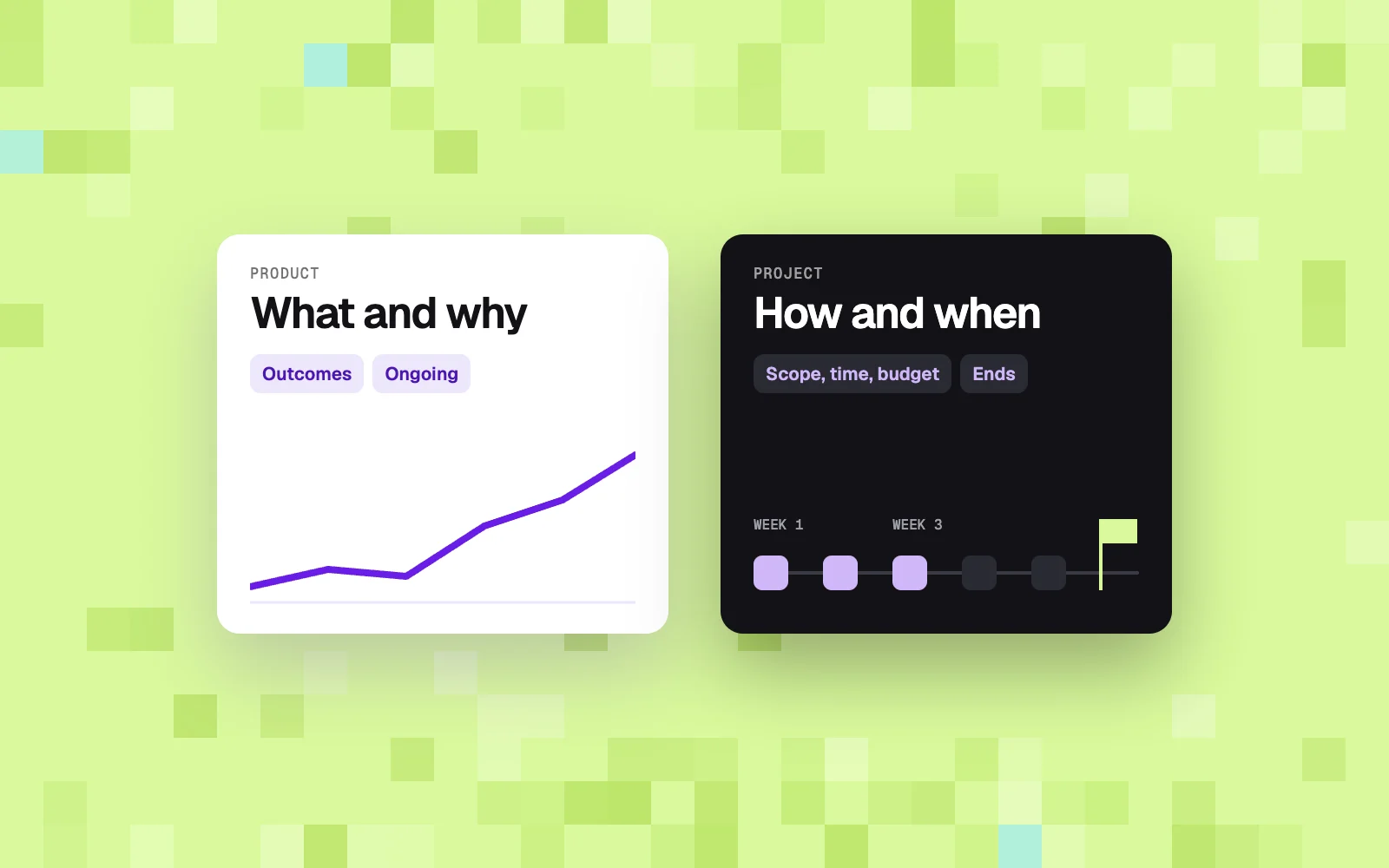
Product management vs project management comes down to one question each. Product management asks: what should we build, and is it worth it? Project management asks: how do we deliver this defined piece of work on time and on budget? A product keeps going as long as people use it. A project has a start date, an end date and a finish line. Below you will find the difference explained with official data, a table of who decides what, pay and certifications from US government and PMI sources, and a practical answer for a company building its first app.
I read the five articles that rank highest in the US for this phrase, from Nulab, Maven, Craft.io, ProductPlan and Plaky. Four of them are written by companies that sell product or project software. None of them cites the US Bureau of Labor Statistics, and none answers the question a small business owner actually has: if I am building one app with a small outside team, which of these two jobs do I need, and who does it?
How we know this: Max Miskow co-founded Skillsbite (an AI tool for screening CVs) in 2021, then designed and built products for clients, and later built his own product, Podium, from zero. We've been on both sides: founders who had to validate our own product ideas, and the team that designs and builds products for clients. On Podium, Max did both jobs at once, and that example comes later in this article.
Product management vs project management: the short answer
Product management owns the problem and the outcome: which customers, which problem, what to build first and how to know it worked. Project management owns the delivery: scope, schedule, budget, risks and coordination of the people doing the work. PMI, the main professional body for project managers, defines project management as "the application of knowledge, skills, tools, and techniques to project activities to meet project requirements."
The table puts the two side by side.
| Product management | Project management | |
|---|---|---|
| Main question | What should we build, and why? | How and when do we deliver it? |
| Time frame | Ongoing, as long as the product lives | Temporary, with a start and an end |
| Success looks like | Customers use it, it solves the problem, it pays off | Delivered in scope, on schedule, within budget |
| Main documents | Product goal, roadmap, backlog, metrics | Project plan, schedule, budget, risk log |
| Typical tools | Roadmap and feedback tools, analytics | Gantt charts, task boards, time tracking |
| Biggest risk | Building something nobody needs | Missing the date or blowing the budget |
| Answers to | The market and the business owner | The sponsor or client who ordered the work |
Marty Cagan of Silicon Valley Product Group named the tension in an article from October 2026: the real trade-off is "the relative priority of outcomes versus predictability." Project management makes work predictable. Product management makes work matter. Trouble starts when a company has one and needs the other.
What is product management
Product management is the work of deciding what a product should do, for whom and in what order, so that it solves a real problem and earns its keep. The product management meaning is easiest to see in its output: not a finished task, but a change in what customers do, for example how many of them book a service through the app instead of calling.
A product manager usually spends time on four things:
- Understanding the problem. Talking to customers, reading support tickets, looking at usage data.
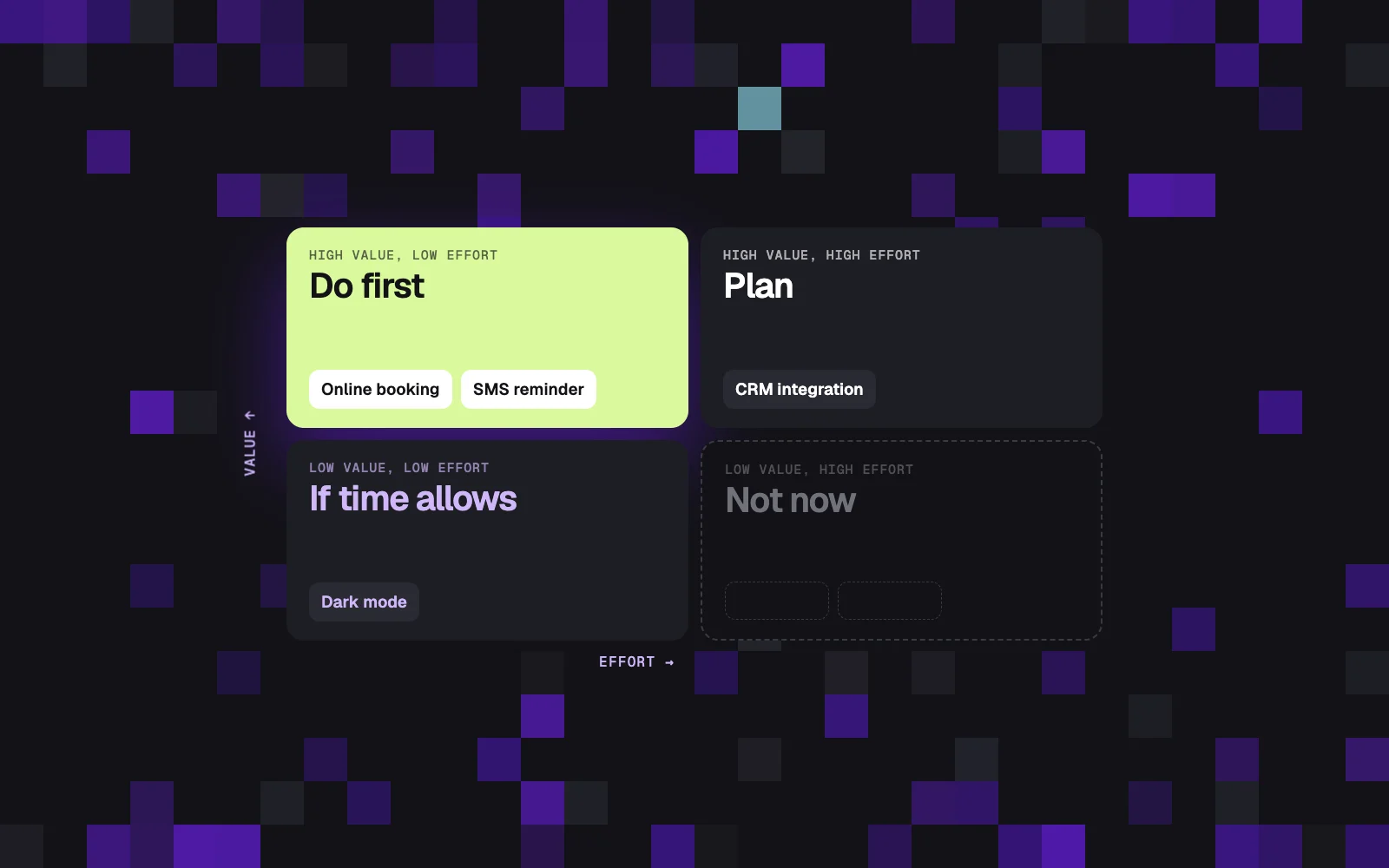
- Choosing what to build. Turning that knowledge into a goal and a short list of features, and saying no to the rest.
- Setting the order. Keeping a roadmap and a backlog that the developers can work from.
- Checking the result. Looking at whether the release changed anything, then deciding what comes next.
In Scrum, the framework many software teams use, the role that does this work is called the product owner, and the Scrum Guide says that person "is accountable for maximizing the value of the product resulting from the work of the Scrum Team." The guide names only three accountabilities in a team and has no project manager role at all. That says a lot about how software teams split the work.
Why this job exists at all is clear from usage data. Pendo analyzed anonymized usage data over three months in its 2019 feature adoption report: on average, 12% of features generate 80% of daily usage, and 80% of features are rarely or never used. A project can be delivered perfectly on time and still add to that unused 80%. Preventing that is the product manager's job.
What is project management
Project management is the planning, organizing and running of a temporary piece of work so that it delivers an agreed result within an agreed scope, schedule and budget. The US Bureau of Labor Statistics describes the job in one line: project management specialists "coordinate the budget, schedule, staffing, and other details of a project."
PMI lists the key aspects of the job as defining project scope, identifying deliverables, managing risks and communicating across teams. It also describes three approaches a project manager can choose from:
| Approach | When it fits, according to PMI | Example in an app project |
|---|---|---|
| Predictive | Requirements are well defined and stable at the start | Moving an existing booking form to a new system with the same fields |
| Adaptive | Requirements are uncertain and likely to change | A first version of a customer app where nobody knows yet what customers will use |
| Hybrid | Some parts are fixed, others will change | Fixed integration with existing software, open design of the customer screens |
The examples in the third column are ours, not PMI's. For a first product, most of the work is adaptive by nature, because the requirements are exactly what you are trying to find out. That is where project management alone stops being enough.
Product manager vs project manager: who decides what
The clearest way to tell a product manager vs project manager apart is to list the decisions in a real app project and ask who owns each one. The product manager owns decisions about value: what goes in, what stays out, what counts as success. The project manager owns decisions about delivery: dates, budget tracking, dependencies and who works on what this week.
| Decision in an app project | Product manager | Project manager |
|---|---|---|
| Which customer problem the first version solves | Decides | Is informed |
| Which features go into the first release | Decides | Checks what fits in budget and time |
| The launch date | Proposes what must be ready | Builds the schedule and owns the date |
| A new request in the middle of a stage | Judges whether it is worth it | Says what it costs in time and money |
| Budget for the stage | Argues for value | Tracks spending and flags risk |
| What success means after launch | Sets the metric and reads it | Closes the project once the scope is delivered |
| Who talks to customers | Leads interviews and tests | Rarely |
| Who talks to the developers every day | Explains the why | Coordinates the when |
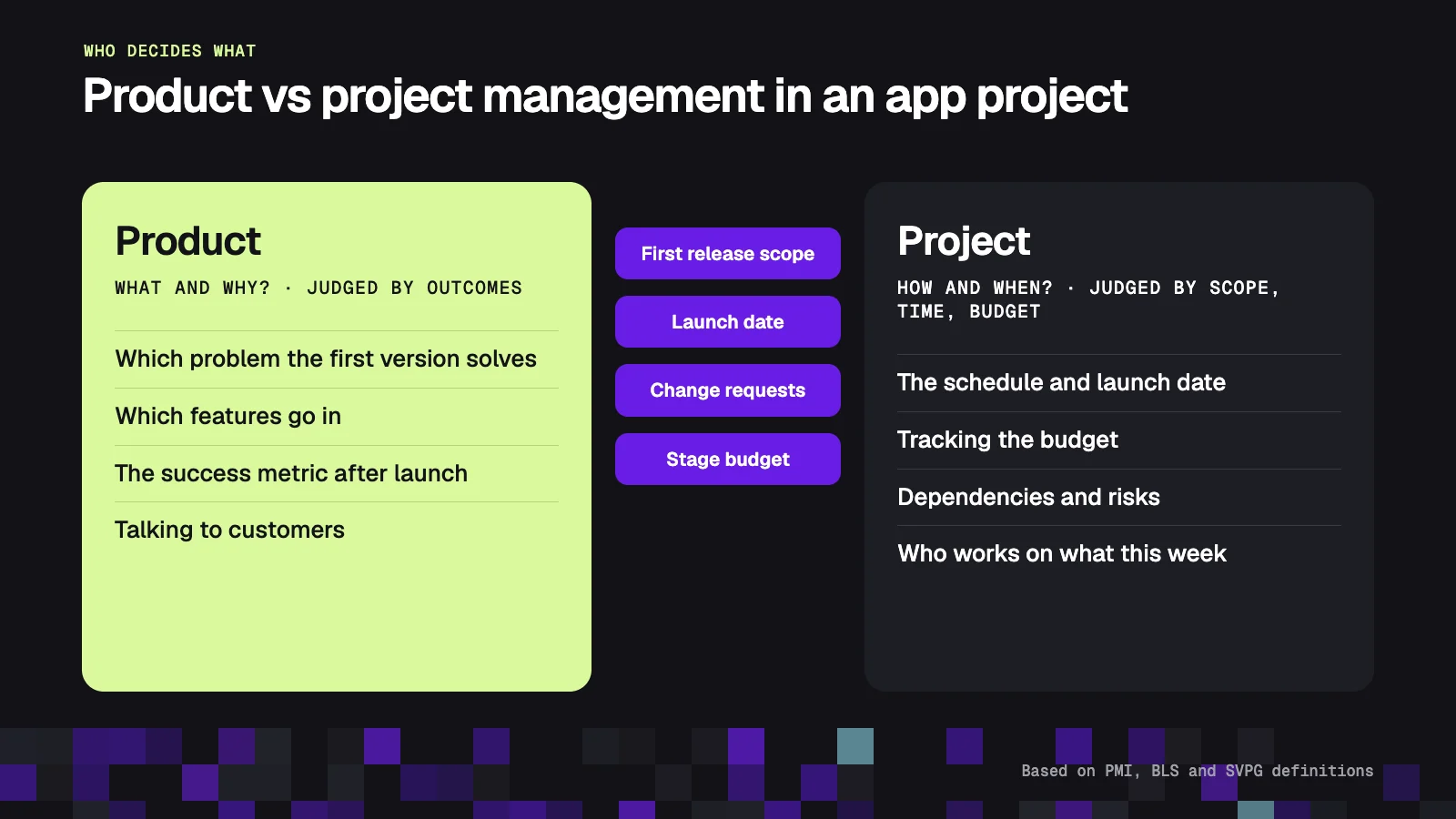
A scope change shows the split best. A customer asks for a loyalty program halfway through the build. The project manager answers "this adds two weeks and this much budget." The product manager answers "this is or isn't worth two weeks, given what we are trying to prove." You need both answers.
Where the two roles overlap, and where they clash
Product and project management overlap in daily coordination: both work with the same developers, both keep lists in order, both report progress. They clash over the same thing Cagan named: predictability versus outcomes. A project manager is rewarded for keeping promises about dates. A product manager is rewarded for changing the plan when evidence shows the plan is wrong.
Atlassian's first State of Product report, a survey of more than 1,000 product professionals in the US and Europe, shows how often the product side gets squeezed by delivery. According to the summary by Mind the Product:
- 84% of product teams worry their products won't succeed in the market;
- 80% of teams don't involve engineers during ideation, problem definition or roadmap creation;
- 49% report too little time for strategic planning, roadmap work or deep analysis;
- only 31% of organizations prioritize rapid experimentation and iterative learning.
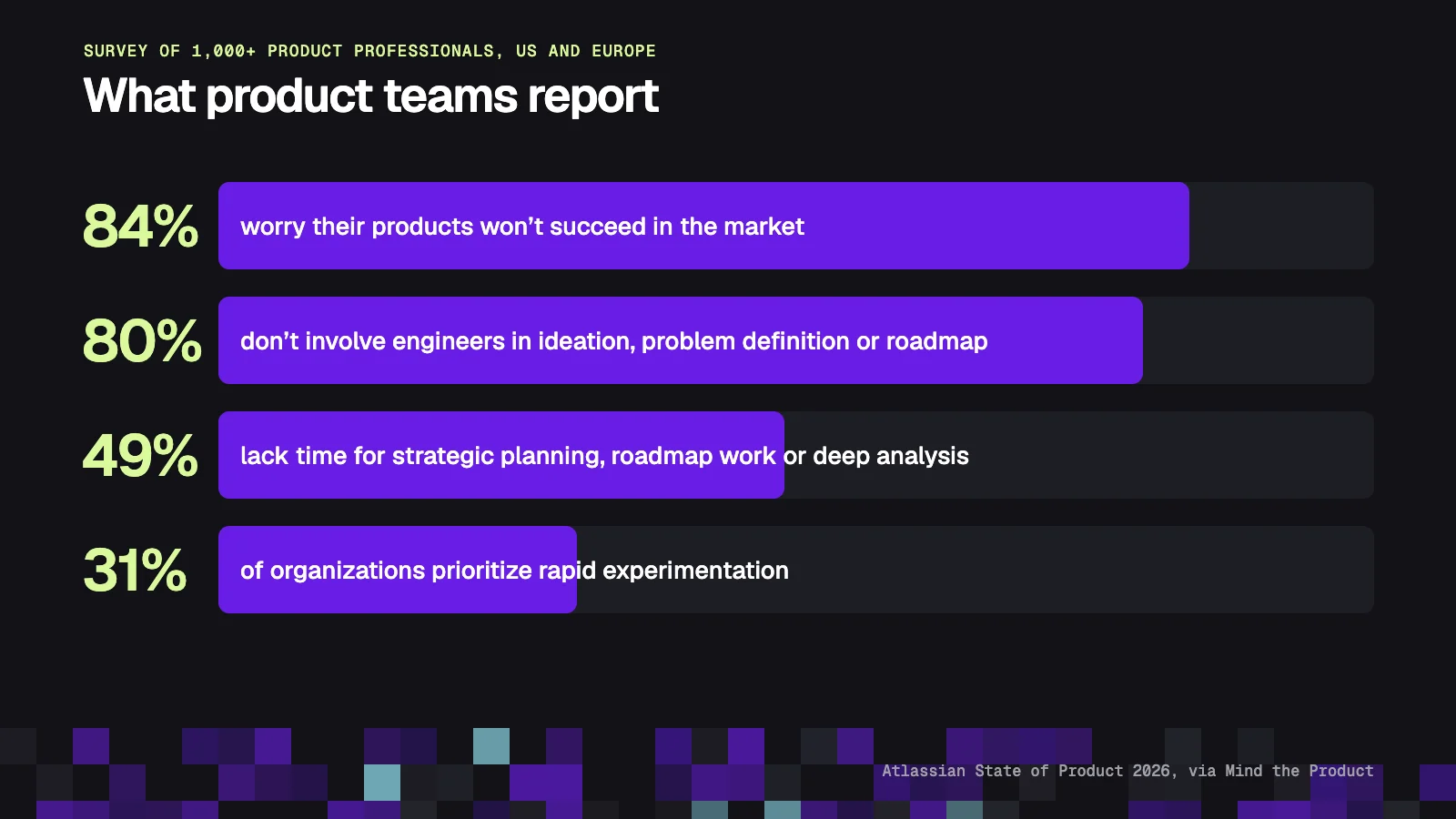
Read those numbers as a symptom of delivery eating product work. When the calendar runs everything, product questions get skipped and nobody has time to test whether the idea works. Give each question its own owner and its own time slot, even in a team of two.
Salary, jobs and certifications
Project management has an official US occupation, a large job market and a dominant certification. Product management has none of these in official form. The BLS tracks "project management specialists" as an occupation, but it has no separate occupation for product managers, so any product management salary figure you see comes from private salary surveys, not government data.
Here are the official numbers for project management, from the BLS Occupational Outlook Handbook (2025 data) and PMI's certification page (both checked on 18 November 2026):
| Metric | Value | Source |
|---|---|---|
| Median pay, project management specialists, May 2025 | $102,320 a year ($49.19 an hour) | BLS |
| Number of jobs, 2025 | 1,094,300 | BLS |
| Projected growth, 2025 to 2035 | 7%, much faster than average | BLS |
| Openings per year, on average | About 76,500 | BLS |
| Median salary of PMP holders in the US | $135,000 | PMI |
| PMP holders worldwide | 1.7 million | PMI |
| Project leaders needed worldwide by 2030 | 25 million | PMI |
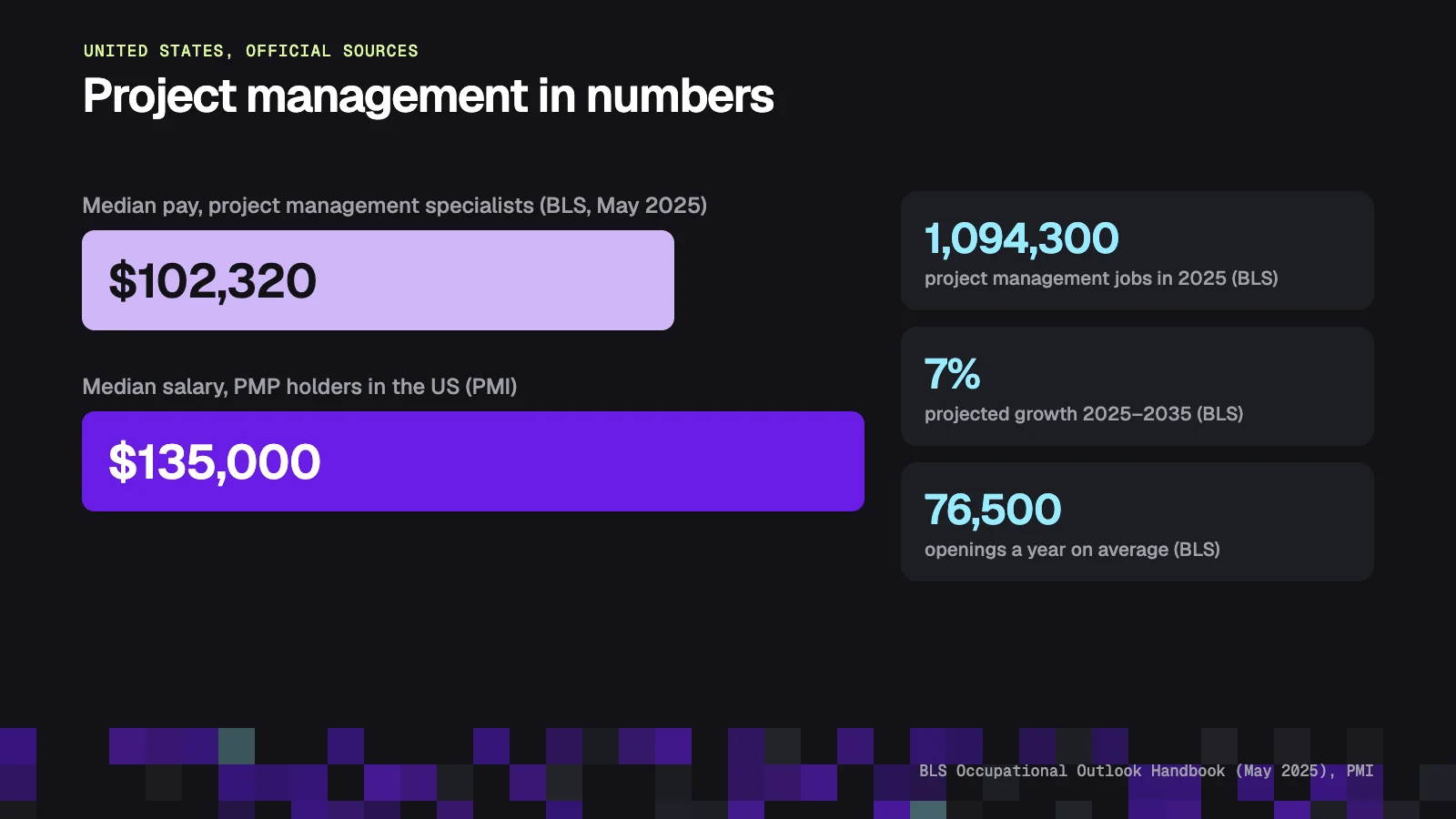
The two pay figures cover different groups of people, so treat the gap as a direction. PMI itself states that people with a PMP report 17% higher median salaries than those without.
The certification picture is uneven. For project managers there is one clear standard, the PMP. According to PMI, you need a bachelor's degree plus 3 years of experience managing projects (or 4 years with an associate's degree, 5 with a high school diploma), 35 hours of project management training, and then a 180-question exam in 4 hours. For product management certification there is no equivalent single standard. There are many courses and certificates, and no government or professional body that defines the occupation the way PMI does for projects. Product management jobs are usually filled on the strength of products you have shipped, not a certificate.
Product management vs program management
Program management sits one level above project management: it coordinates several related projects that serve one bigger goal, for example a website rebuild, a new app and a CRM migration that have to land in the same quarter. A product manager owns one product's value, a program manager owns the timing between many projects. For a small business building one app, it is rarely a separate job.
Which one a small business needs when building its first app
A small business building its first app needs the product questions answered first and the project questions answered second, and it rarely needs two separate full-time people for that. What it needs is a clear owner for each question. In most small projects, the owner of the business makes the final product calls, the outside team does the discovery work and runs delivery, and one person keeps the plan.
| Your situation | What you need most | Who usually does it |
|---|---|---|
| You have an idea but no proof customers want it | Product management: discovery, a narrow first version | Founder plus an outside product builder |
| You know exactly what to build (for example, rebuild an existing tool) | Project management: scope, schedule, budget | The development team's lead |
| You are adding the app to running businesses with existing software | Both: product decisions on what not to rebuild, project control of integrations | One person for product, one for delivery, often the same team |
| The app is live and used every day | Product management on a monthly rhythm | The owner or a part-time product manager |
| You run several related projects at once | Program management on top of both | Rarely needed under 50 staff |
The table reflects how we see small projects, not a published standard. When the main risk is building the wrong thing, you need product management. When the main risk is delivering late or over budget, you need project management. A first app carries both, and the first is more expensive: nothing saves an unwanted product delivered on time.
Example: one person doing both jobs on Podium
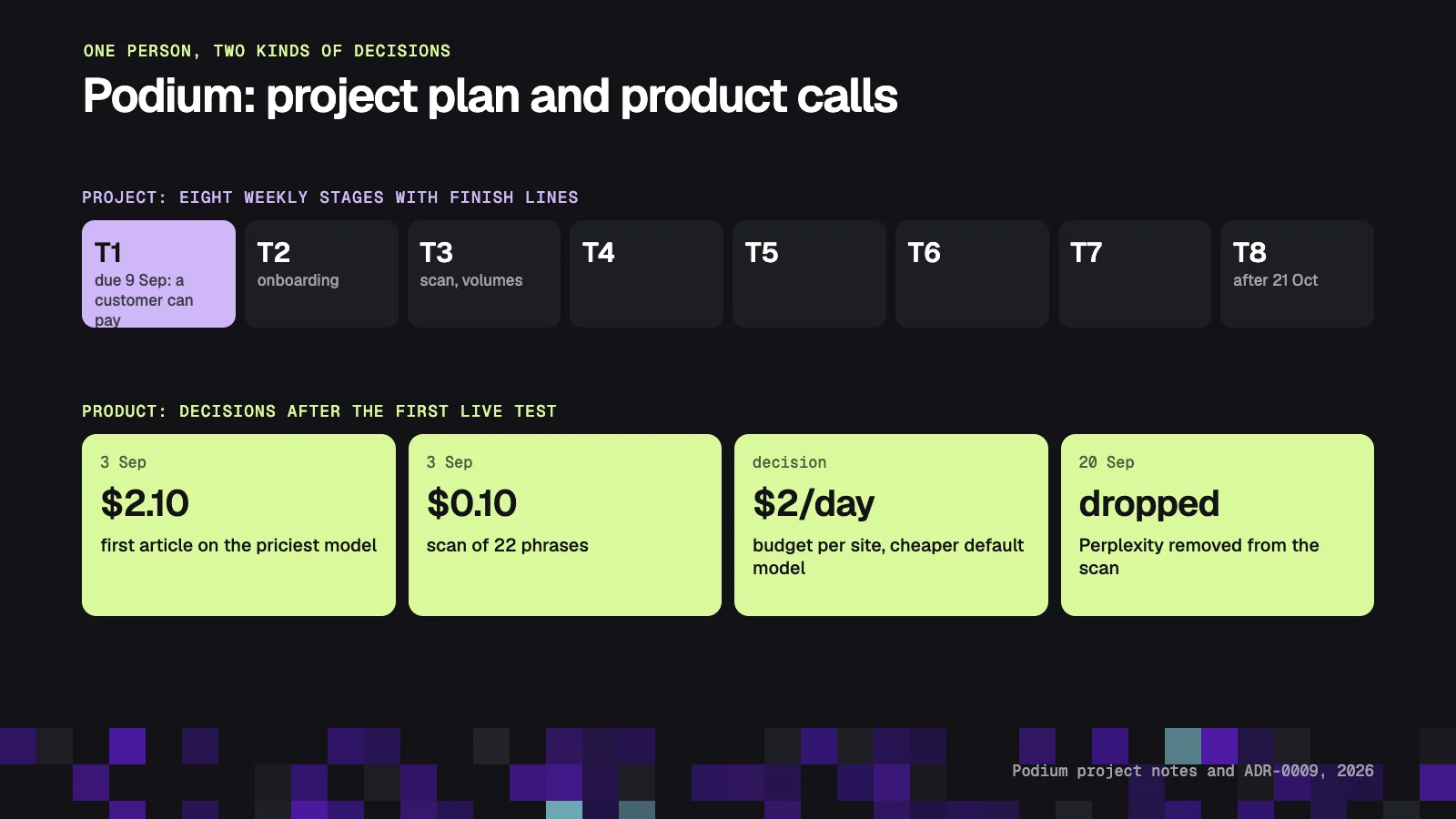
Podium is a tool for writing and publishing articles on company blogs, which Max built from zero. On that product he was product manager and project manager at the same time, and the project notes show both kinds of decisions side by side.
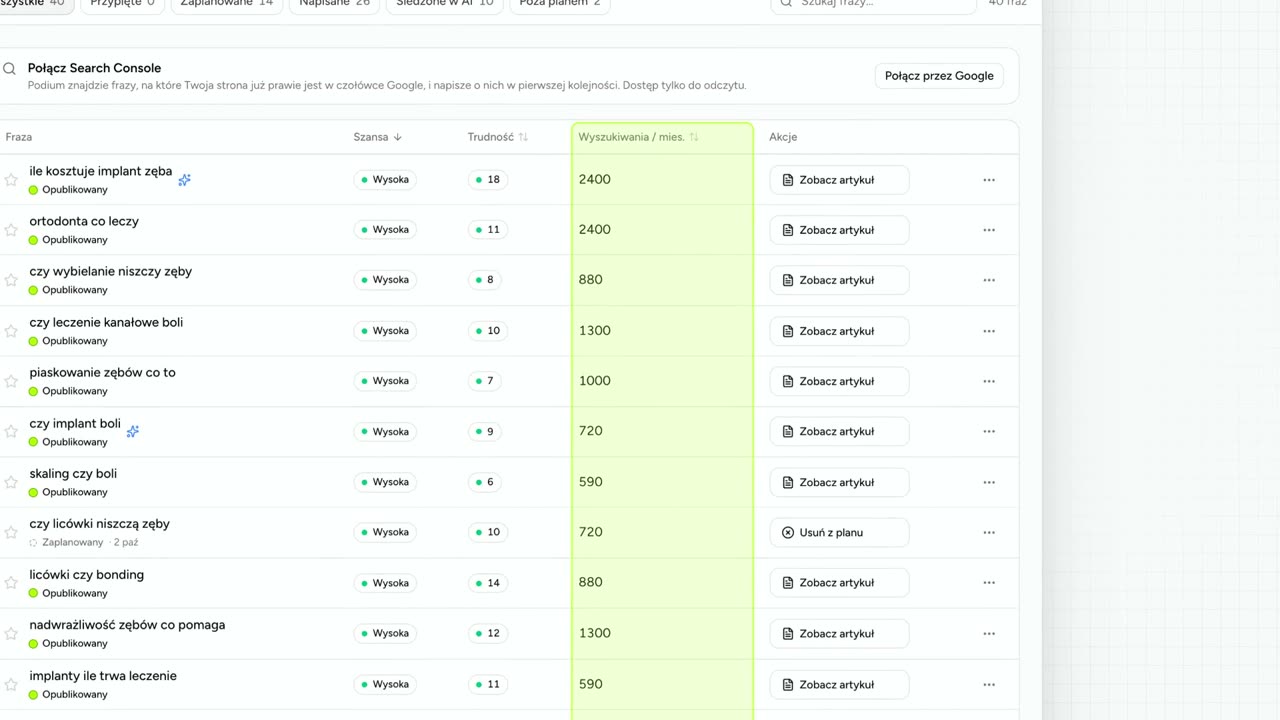
The project side was a plan of eight weekly stages, from early September to late October 2026, each with a clear finish line. The first stage, due 9 September, was defined as "done" when a user could enter a card, go through the trial and get an invoice after three days. That is a project finish line written in product terms: not "payments module coded", but "a customer can actually pay".
The product side showed up after the first live test on 3 September. The first article cost $2.10 to generate on the most expensive model, while the plan had assumed a cheaper one. A scan of 22 search phrases cost $0.10. Those numbers led to three decisions that no schedule would have produced:
- switch the default article model to a cheaper one and bring the expensive one back only if quality scores show a real difference;
- add a daily budget per site, $2 by default, so that one customer can't burn through the margin;
- on 20 September, drop Perplexity from the citation scan entirely.
The lesson for anyone doing both jobs: keep them in separate moments. Once a week, look at the plan as a project manager: what is late, what blocks what. After every contact with real users or real costs, ask as a product manager whether the plan still makes sense.
How we split the roles on client projects
On client projects, Max takes the product side: discovery, deciding what the first version contains, and keeping the roadmap. When a project needs it, a trusted developer joins for the technical side. The project side stays small, because the work is cut into short stages with a fixed price.
The rhythm we use on MVP projects: discovery in week one, a prototype on the client's real data in week two, and the build in weeks three to six. We give a range after the first call and a fixed price before each stage, once it is clear what the stage contains. A fixed price per stage is a project management tool. Deciding what goes into each stage is product management, and it happens before any money is spent on delivery.
An example from current work: a client in the US runs several home-services businesses, such as cleaning, plumbing, electrical, painting and moving. The idea is a subscription platform where a homeowner books any of their services in one place and keeps the home's service history with photos and invoices. The companies keep their existing field service software (Jobber), so the first product decision was what not to rebuild: scheduling and invoicing stay where they are. The project work then centers on the integration with Jobber, which is the part with real deadlines and dependencies. If you are weighing a build like this, our article on a custom app for a small business covers when it makes sense at all, and how to build a product roadmap shows how to plan the stages.
Checklist: signs you are missing one of the two roles
Missing product management and missing project management look different. Go through both lists before you hire anybody: three or more yes answers on one side mean that side has no real owner.
Signs you are missing product management:
- the feature list keeps growing and nobody can say which item matters most;
- nobody has talked to a customer since the project started;
- success is defined as "launched", with no number to check after launch;
- the team can't explain in one sentence what problem the first version solves.
Signs you are missing project management:
- nobody knows the date of the next release;
- the budget is checked only when the invoice arrives;
- developers wait for answers for days because nobody owns the questions;
- scope changes are agreed in chats and never written down.
Best product management tools and project management tools
The best product management tools hold goals, ideas, customer feedback and a roadmap. Project management tools hold tasks, dates, owners and dependencies. Many teams use one tool for both, and that is fine for a small team, as long as the roadmap and the task list stay two separate views.
| Need | Product management side | Project management side |
|---|---|---|
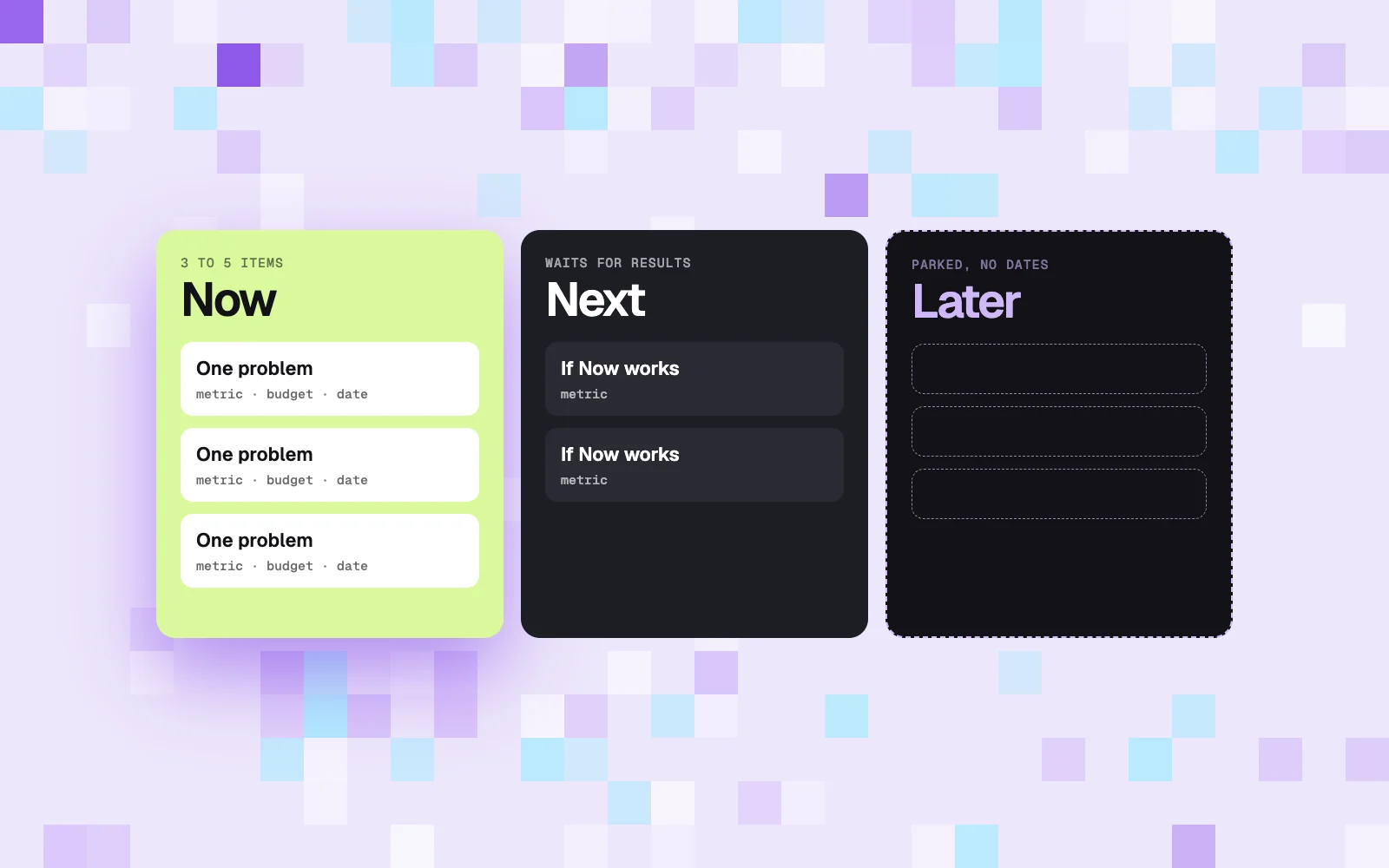
| Plan | Roadmap with Now, Next, Later | Schedule or Gantt chart with dates |
| Daily list | Backlog in order of value | Task board with owners |
| Input | Customer interviews, feedback, usage data | Status updates, time and cost tracking |
| Typical software | Jira Product Discovery, Productboard, a spreadsheet | Jira, Asana, Trello, a spreadsheet |
| Review rhythm | After each release and monthly | Weekly |
For a first app, a spreadsheet and one task board are enough. The best product management software won't help if nobody owns the decisions it records.
Frequently asked questions
Is product management the same as project management?
No. Product management decides what to build and why, and is judged by outcomes such as usage and revenue. Project management delivers a defined piece of work within scope, schedule and budget, and ends when the work is done. The two often work together on the same app.
Which pays more, product management or project management?
The BLS reports a median of $102,320 a year for project management specialists in May 2025, and PMI reports a median of $135,000 for PMP holders in the US. The BLS has no separate occupation for product managers, so there is no official product management salary figure to compare against.
Can one person be both product manager and project manager?
Yes, and in small teams it is common. The risk is that deadlines crowd out product questions. Keep the two in separate moments: a weekly project check on dates and blockers, and a product review after each release or customer test.
Do I need a certification to work in product management?
No. There is no single official product management certification comparable to the PMP for project managers. Employers usually look at products you have helped ship. For project management, the PMP requires 3 to 5 years of experience, 35 hours of training and a 180-question exam.
How to get into product management without experience?
The common way in is from a neighboring role, such as engineering, design, support, sales or project management, by taking on product decisions in your current job. If you are asking how to break into product management with no such role, build or run a small product yourself and show what you learned from real users.
What comes first in an app project, product or project management?
Product management comes first. Before anyone plans a schedule, someone has to decide which problem the first version solves and what is left out. Project management then turns that scope into stages, dates and a budget.
What is the difference between product management vs program management?
Product management owns the value of one product. Program management coordinates several related projects that serve one bigger goal, such as a new app, a website rebuild and a CRM migration landing in the same quarter. Small businesses rarely need a separate program manager.
If you are planning a first app and want to settle the product questions before anyone writes a schedule, book a 30-minute call. You can also request a free report with ideas for your business, sent by email.