Jobs to be done framework: how to find out what customers really pay for
The jobs to be done framework (JTBD) looks at customers through the progress they are trying to make in a given situation, and treats a product as something they hire for that job. In practice you do three things. You interview 5 to 10 people who recently bought or switched. You write the job down in one sentence. You score which needs are important and poorly served. A Detroit-area condo developer used it to raise prices by $3,500 and grow business by 25% while industry sales fell 49%.
The jobs to be done framework is one of those methods nearly everyone in product has heard of and few people apply all the way through. Most articles stop at the milkshake story and the line about people wanting a hole and not a drill. For a founder who has to decide what to build and what to charge, that is not enough.
We read the pages that rank for this term in the US: Built In, Aha!, SurveyMonkey and Coursera. Only one compares the schools of JTBD, and it has no templates. None gives a switch interview script, and interview counts appear without sources.
We've been on both sides: founders who had to validate our own product ideas, and the team that designs and builds products for clients. This guide is built on the original authors' texts, with a link to each, and on examples from Max Miskow's projects.
What is jobs to be done
Jobs to be done (JTBD) is a theory that says customers do not buy a product for its own sake. They hire it to make progress in a specific situation. Clayton Christensen and his co-authors defined a job in Harvard Business Review in September 2016 as the progress that the customer is trying to make in a given circumstance.
Three things follow. A job depends on the situation, and the customer's age or job title does not cause a purchase. A product can be hired and fired, so the competition is anything that does the same job, including a spreadsheet, a call to a friend and doing nothing. A job also has more than one dimension: the authors write that jobs are never simply about function, because they have powerful social and emotional dimensions.
The oldest example is older than the name. Christensen recalled in a 2005 HBR article that Theodore Levitt used to tell his students that people don't want to buy a quarter-inch drill, they want a quarter-inch hole. The Christensen Institute now describes jobs to be done theory as a lens that reveals the circumstances, or forces, that drive people toward and away from decisions.
Why it matters to a company: in the same 2016 article the authors cite a McKinsey poll in which 84% of global executives said innovation was extremely important to their growth strategies and 94% were dissatisfied with their innovation performance. JTBD is meant to close that gap by looking for the cause of a purchase.
Three schools of the jobs to be done framework
Three approaches work under the jobs to be done name: Clayton Christensen's theory, Anthony Ulwick's quantitative Outcome-Driven Innovation and Bob Moesta's qualitative interviews. They do not exclude one another. They differ in whether you want to understand one purchase or measure the needs of a whole market.
| Christensen | Ulwick (ODI) | Moesta | |
|---|---|---|---|
| What a job is | Progress in a given circumstance | A task the customer wants to get done, described with measurable outcomes | The move from an old solution to a new one |
| Main tool | A description of the situation and the "hire" | Job map, a list of 50 to 150 desired outcomes, a survey | Switch interview, timeline, four forces |
| Data | Qualitative | Quantitative, a survey of 180 to 3,000 people | Qualitative, 5 to 10 interviews |
| Output | A language for talking about demand | A ranking of unmet needs | An understanding of what triggers a purchase and what blocks it |
| Best for | Leadership, strategy | Companies with an existing market and a research budget | Founders, small teams, sales |
| Jobs to be done book | Competing Against Luck (2016) | Jobs to be Done: Theory to Practice (2016) | Demand-Side Sales 101 (2020) |
The numbers in Ulwick's column come from Strategyn, his firm: a single market typically contains 50 to 150 measurable desired outcomes, and a survey typically covers 180 to 3,000 respondents. We come back to Moesta's interview counts below.
For a small team the practical order is: Moesta-style interviews first, then the job written in Ulwick's format or as a job story, and the survey once you have people to send it to.
Jobs to be done examples, with the real numbers
Two examples are worth knowing with their numbers, because both show the same thing: the job sets the competition and the price differently than a description of the customer would. The first is the milkshake, the second is condos near Detroit.
The milkshake. A fast-food chain wanted to sell more milkshakes. Research showed that 40% of them were bought in the early morning, as Christensen described in MIT Sloan Management Review in 2007. Commuters bought them before a long, boring drive, to keep a free hand busy and to hold off hunger until noon. So the milkshake competed with a bagel and a doughnut, and not with other milkshakes. The original sources do not name the chain and give no sales uplift.
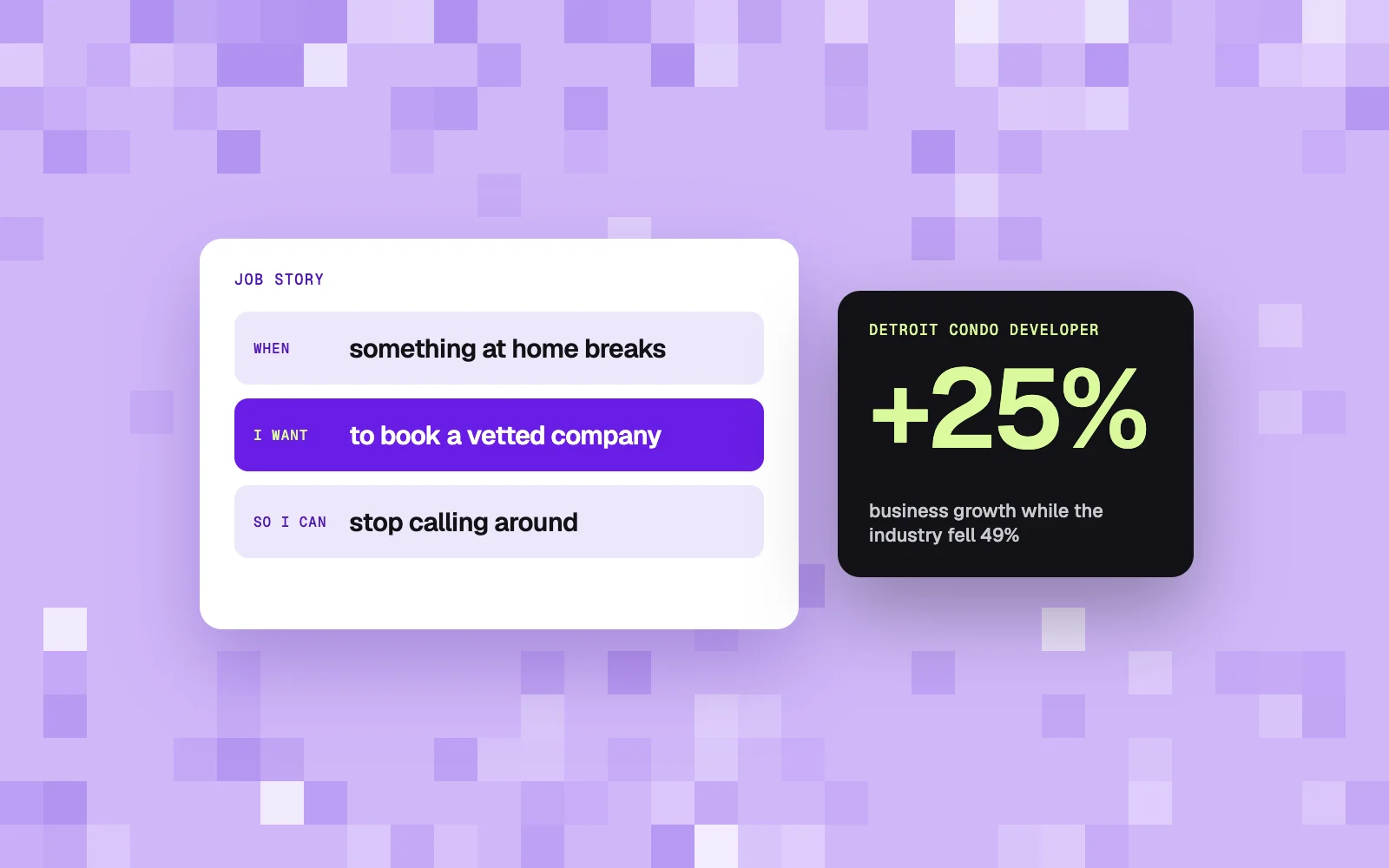
The condos. A Detroit-area builder priced its units at $120,000 to $200,000 for people downsizing from a family home. Interest was high and sales were weak. Bob Moesta asked buyers to draw a timeline of how they got there. One thread kept coming back: the dining room table. One buyer said that as soon as they figured out what to do with it, they were free to move.
The company understood that its business was not construction but transitioning lives. It added moving services, two years of storage and a sorting room within the development. According to the HBR article it raised prices by $3,500, which profitably covered moving and storage. By 2007, when industry sales were off by 49%, the developers had grown business by 25%.
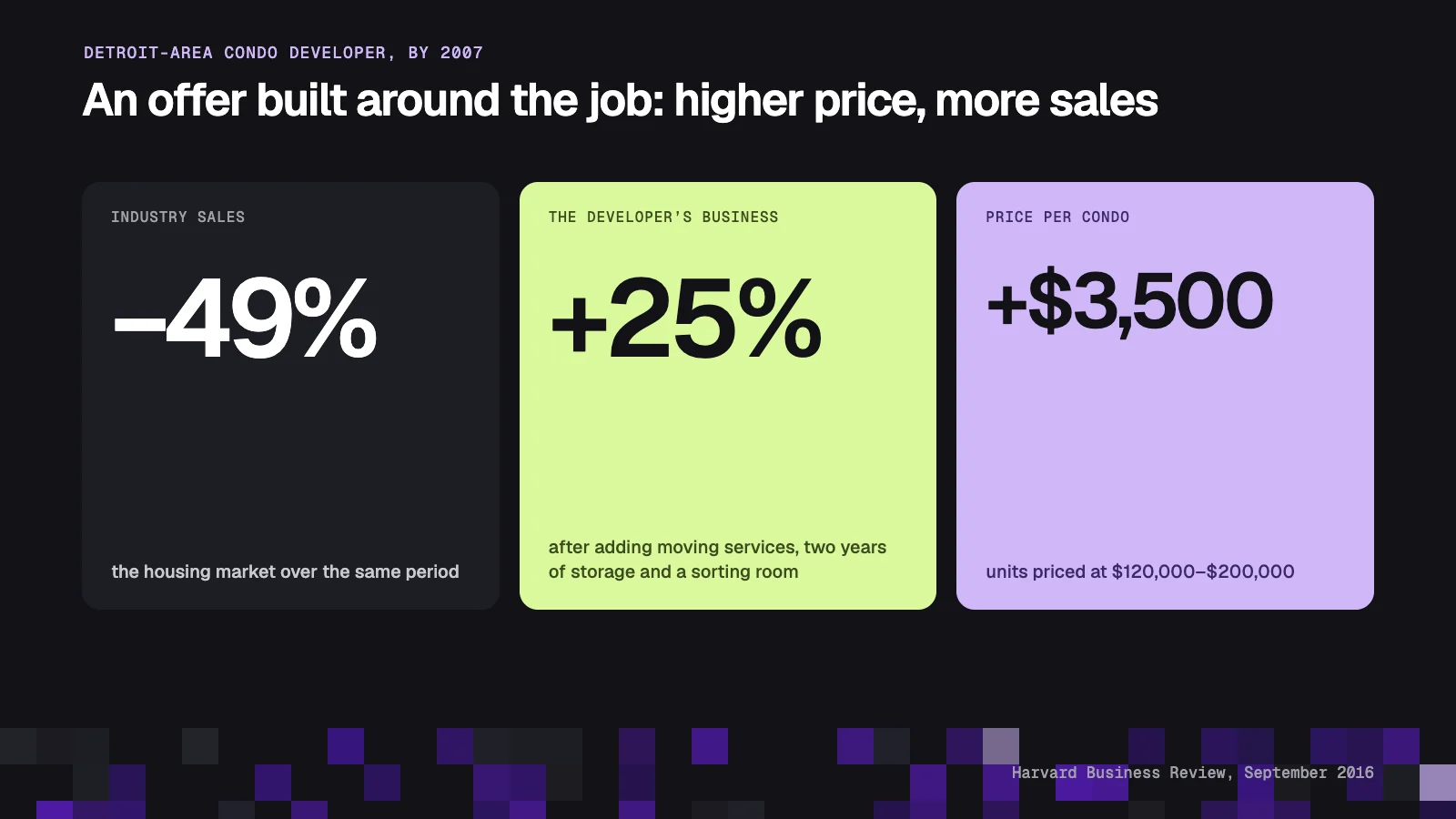
The second example answers the question in the title. The customer was paying for a way to close one chapter of life calmly, and the condo was only part of that service.
How to write a job to be done: three formats
A customer's job is written down in three ways: as a job statement (verb, object, context), as a desired outcome (direction, metric, object, context) or as a job story (when, I want to, so I can). The first two formats come from Ulwick, the third from the Intercom blog.
| Jobs to be done format | Pattern | Example from the source | What it is for |
|---|---|---|---|
| Job statement | Verb + object of the verb + contextual clarifier | "Listen to music while commuting to work." | Naming the market and the core job |
| Desired outcome | Direction of improvement + metric + object of control + contextual clarifier | "Minimize the time it takes to identify the correct drill bit size for the material being drilled." | A list of needs to rate in a survey |
| Job story | When ___, I want to ___, so I can ___ | "When an important new customer signs up, I want to be notified, so I can start a conversation with them." | Describing a feature for a designer and a developer |
The first two patterns and examples are in the Strategyn template. Paul Adams published the third on the Intercom blog on September 18, 2013, and Alan Klement developed it under the name job stories. If you want a fill-in jobs to be done template, these three patterns are the core of it.
A good statement contains no solution ("listen to music", and not "use a streaming app"), stays stable over time and can be measured, or at least checked in a conversation.
Ulwick adds a job map. In HBR in May 2008, with Lance Bettencourt, he described eight steps common to every job: define the objectives, locate the inputs, prepare, confirm that everything is ready, execute, monitor, modify and conclude. At each step you ask what is slow, unreliable or left to guesswork today.
The four forces of progress: why customers switch
The four forces of progress are a model by Bob Moesta and Chris Spiek that explains when a customer really moves to a new solution. Two forces push toward the switch and two hold the customer in place. The switch happens when the first pair outweighs the second.
| Force | Direction | The authors' definition | Interview question |
|---|---|---|---|
| Push | Toward the switch | The problem with the current situation | What stopped working in the old way? |
| Pull | Toward the switch | The magnetism of the new way | What did you imagine would be better? |
| Anxiety | Against the switch | The fear of the unknown | What worried you before you bought? |
| Habit | Against the switch | The comfortable inertia of what people already know and do | What was good enough about the old solution? |
The authors put it in one line on their four forces page: Push + Pull > Anxiety + Habit, and the switch happens.
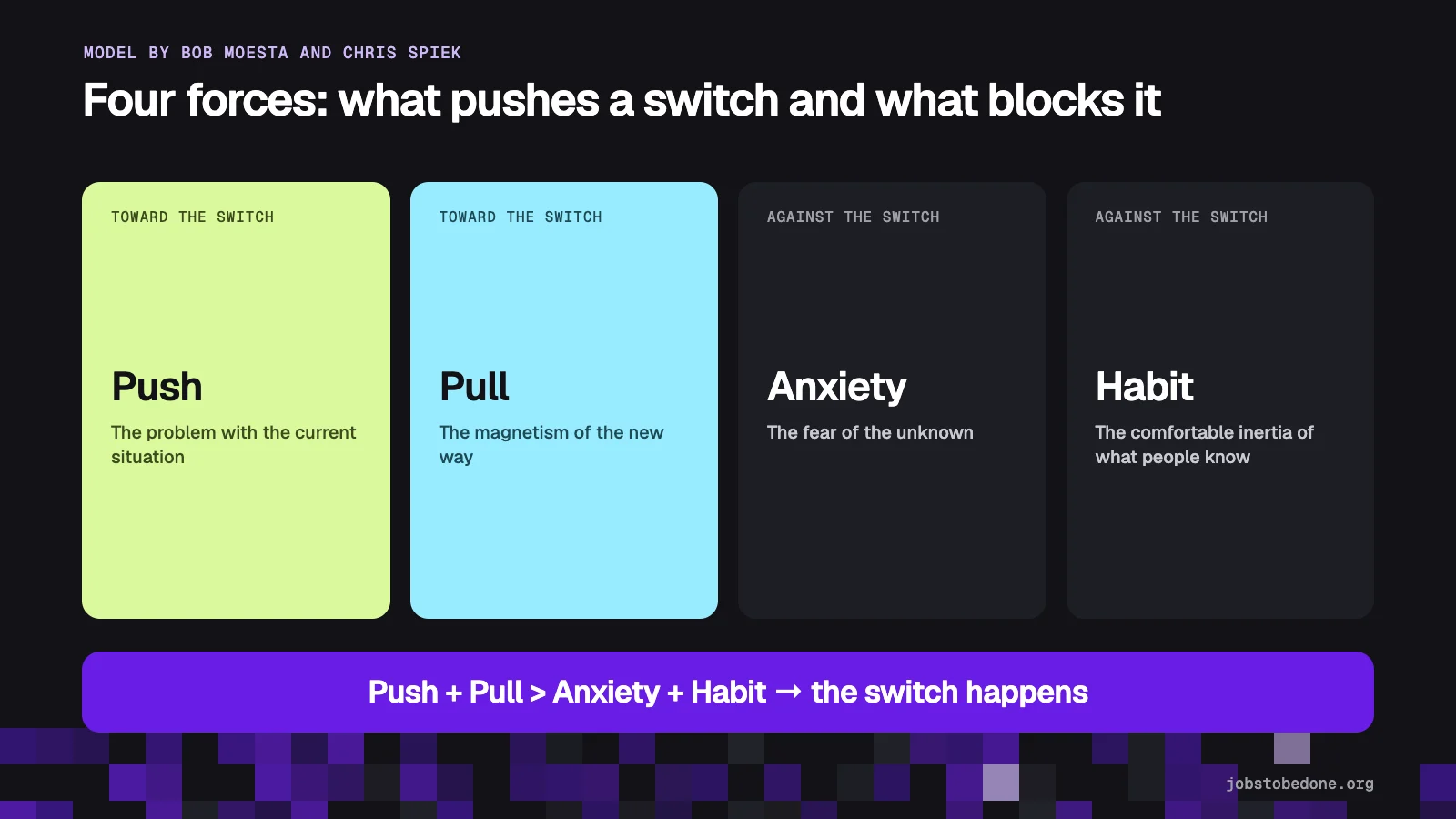
For a founder the right-hand side matters most. Most teams add features, which strengthens the pull, while the customer does not buy because they fear the rollout. A trial period, data migration or a guarantee reduce anxiety, and none of them is a product feature.
The switch interview: a script
A switch interview is a one-on-one conversation with someone who recently bought or switched, in which you rebuild their story from the first thought to using the product. Moesta and Spiek recommend people who switched in the last 30 to 90 days and 45 to 90 minutes per conversation (their description of the switch interview).
The conversation follows a timeline. The authors mark its stages: first thought, passive looking, a first event, active looking, a second event, then decision, purchase and consumption. You do not ask for opinions or for what the customer would like. You ask what happened.
The script we use has 12 questions arranged along the timeline and the four forces. The first question and the follow-up "and then what happened?" come from the authors' page. We wrote the rest.
- When did you first start thinking about this?
- What was going on in the business or at home at that time?
- How were you dealing with it before?
- What stopped being enough in the old way? (push)
- When did you start actively looking, and what made you?
- What else did you consider, including doing nothing?
- What did you imagine would change after buying? (pull)
- What almost stopped you? (anxiety)
- What was good about the old solution that you did not want to lose? (habit)
- Who else was part of the decision?
- What happened on the day you decided?
- What was different after the first week from what you expected?
After each answer ask "and then what happened?". Record the call with permission and write down exact phrases, because your website and sales copy will be made from them.
How many interviews you need
The sources give from 5 to 30 interviews, depending on the goal. A few are enough for first patterns. A full list of needs takes a few dozen.
| Source | How many | What it gives you |
|---|---|---|
| Moesta and Spiek, jobstobedone.org | 5 to 8 for a given job | Patterns "start emerging surprisingly fast" |
| The Re-Wired Group (Moesta), 2022 | as few as 10, 15 to 20 if you are new, not 100 | Understanding the job without statistical significance |
| Nielsen Norman Group, 2021 | start with 5 or 6 and analyze as you go | 5 interviews are often not enough |
| Griffin and Hauser, cited by NN/g | 20 to 30 | 90–95% of all customer needs |
The last two rows come from the NN/g article on interview sample size, the second from the Re-Wired Group guide. Our rule: plan 10 and check after the fifth whether the stories repeat.
How to score needs: Anthony Ulwick's opportunity formula
The formula from jobs to be done author Anthony Ulwick turns a list of needs into a ranking: opportunity = importance + max(0, importance − satisfaction). A need that is important and poorly served scores highest. A need that is important but well served by current solutions drops down. The formula is on Strategyn's market opportunity page.
A worked example. The numbers in the table are invented for the arithmetic, on a 0 to 10 scale, and come from no study.
| Desired outcome (booking a home repair) | Importance | Satisfaction | Opportunity |
|---|---|---|---|
| Minimize the time it takes to book a visit | 9 | 3 | 9 + 6 = 15 |
| Minimize the risk that the contractor does not show up | 9 | 5 | 9 + 4 = 13 |
| Minimize the time it takes to find an invoice a year later | 6 | 2 | 6 + 4 = 10 |
| Increase the choice of payment methods | 5 | 8 | 5 + 0 = 5 |
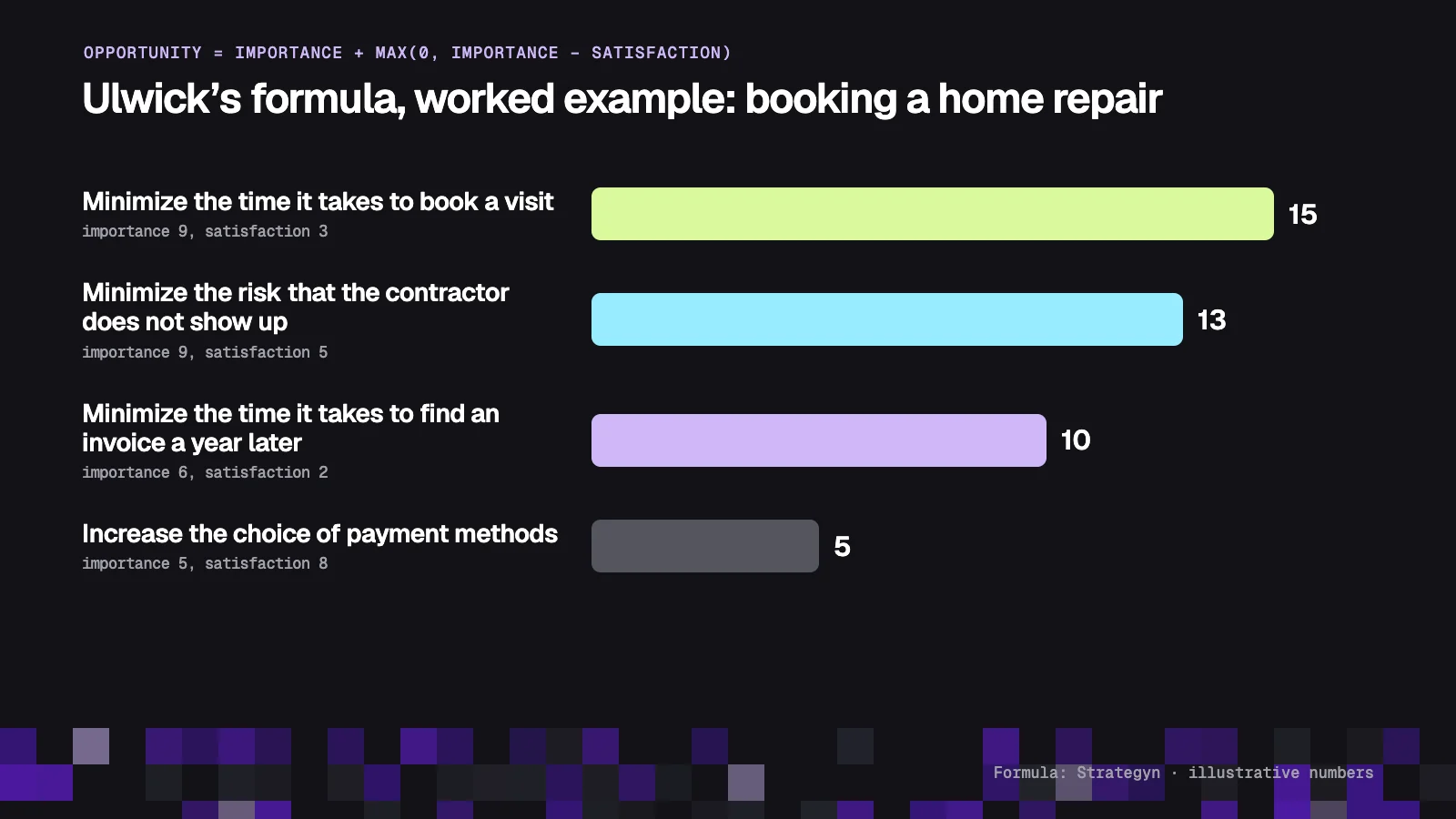
Strategyn says products created with this method succeed 86% of the time, against an industry average of 17%. Read that number with care. According to its description of the ODI process, it means 18 of 21 product launches that were rated successful by the sponsoring companies. It is a claim by the firm that sells the method, on a small base.
If you have no users to survey yet, ask each interviewee to rate five to ten needs for importance and satisfaction. Ten conversations give no statistics, but they show which needs keep landing at the top.
Jobs to be done vs personas and user stories
JTBD and personas complement each other. A persona describes who the user is and how they behave, and a job describes what they are trying to achieve and in what situation. Nielsen Norman Group writes in its 2017 comparison that despite voices suggesting JTBD can replace personas the two are quite compatible, and that this information is already represented in well-executed personas.
| Persona | Jobs to be done | User story | |
|---|---|---|---|
| Question it answers | Who the user is | What they want to achieve and in what situation | What the product should do |
| Unit | A type of person | A situation and progress | A feature |
| Typical form | A description of a person with goals and behaviors | When ___, I want to ___, so I can ___ | As a ___, I want ___, so that ___ |
| Strength | Empathy, language, channels | The cause of the purchase, the real competition | A clear scope for the team |
| Weakness | Slides into demographics with no cause | Says little about how to reach the customer | Assumes the solution up front |
In product work we use all three in sequence. The job decides what to build, the persona suggests how to talk about it, and a user story or job story goes to the team as scope and into the product roadmap.
When jobs to be done does not work
JTBD fails in four situations: when there is nobody to ask about a recent switch, when the job is written so broadly that it fits anything, when the team skips the quantitative check and when the method replaces a decision. These are our conclusions from practice. They are not study results.
- A new category with no switch. If nobody buys anything similar yet, ask about workarounds, meaning how people cope today.
- A job that is too broad. "Save time" is not a job. A sentence that fits a hundred products will not help you choose one.
- Ten interviews as proof. Interviews give hypotheses. Test them with a price: a presale, a pilot or a small first version.
- Method in place of a decision. A job map with eighty outcomes will not tell you what to build in the first month.
There is also the matter of the numbers used to promote the method. Articles on JTBD keep repeating that 95% of new products fail. Christensen wrote in HBR in 2005 that over 90% of the 30,000 consumer products launched each year fail, and gave no source. A peer-reviewed review by Castellion and Markham in the Journal of Product Innovation Management calls failure rates of 80% or higher a persistent myth and reports that empirical studies since 1977 show 40% or less (Crossref record). The method stands without that number.
Example: jobs in two of our projects
In both projects below, writing the job down changed what we treated as the first version of the product. The first is an app for a client in US home services. The second is Podium, Max's own product.
Our client runs several home-services businesses in the US and wants one subscription app where a homeowner can book any of those services, track them and keep the home's service history. The 12-month goal is an MVP with paying subscribers. The feature description reads like a list: booking, tracking, history. Writing the jobs down shows three different situations, each with different competition.
| Situation | Job story (a hypothesis to test in interviews) | What it competes with |
|---|---|---|
| Something broke | When something at home stops working, I want to book a vetted company in a few minutes, so I can stop calling around | A search engine, a neighbor's recommendation |
| Waiting for the visit | When a contractor is booked, I want to know when they will arrive, so I can avoid taking the whole day off | A call to the company's office |
| Selling or insuring the home | When someone asks about the state of the house, I want to show the repair history with invoices, so I can skip digging through inboxes | A folder of paper, email |
These are hypotheses, and each can be tested on its own with the script above. A subscription makes sense only if at least one of these situations comes back often enough for the customer to pay every month. We describe when such a build is worth it at all in our guide to a custom app for a small business.
The second example is about anxiety. Podium tracks how a website appears in AI answers and writes articles for it. The site owner's job can be written like this: when I have no time to write, I want articles to come out regularly, so I can keep the site visible without my involvement. The pull is obvious. What holds people back is the fear that an automated tool will publish something weak on their site.
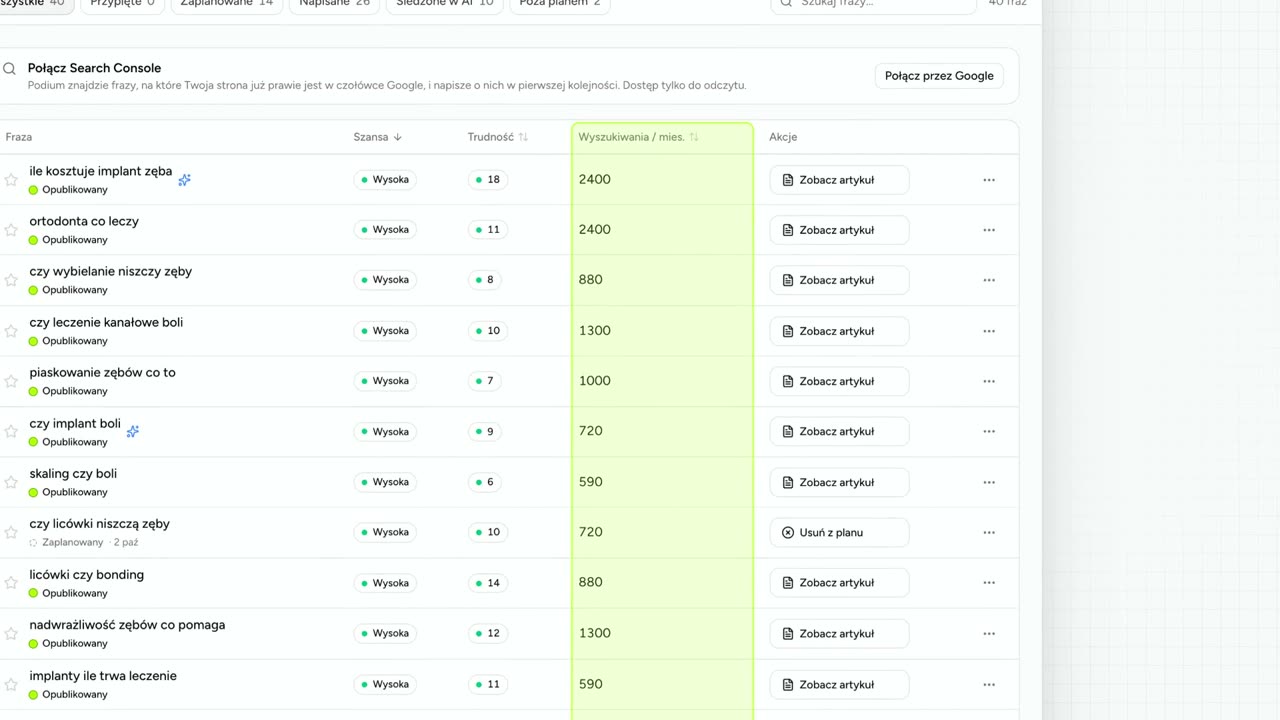
So next to automatic publishing, Podium got two things that add no new writing capability. One is a drafts mode switched on per site. The other is a quality gate: an article that fails the check twice goes to drafts and stays off the site. Both answer the right-hand side of the four forces.
Checklist: the jobs to be done framework in two weeks
A first pass through the framework takes a small team about two weeks. You need a calendar, a recorder and a spreadsheet.
- List 15 people who bought or switched in the last 90 days.
- Book 10 interviews of 45 to 60 minutes and run them along the timeline.
- After each one, write down pushes, pulls, anxieties and habits in the person's own words.
- After the fifth, check what repeats.
- Write one core job as a job statement and three to five job stories.
- List 10 to 20 desired outcomes and ask interviewees to rate importance and satisfaction.
- Calculate opportunity with Ulwick's formula and pick the three highest scores.
- Check that the first version answers those three needs and at least one anxiety.
If you want to go through this for your own idea, you can ask for a free report with ideas for your company, read how we scope a first version or book a 30-minute call. We quote after the call, as a fixed price before each stage.
Frequently asked questions
What is the jobs to be done framework?
The jobs to be done framework is a theory and a set of methods that treat a purchase as hiring a product to make progress in a specific situation. Clayton Christensen defined a job in Harvard Business Review in 2016 as the progress that the customer is trying to make in a given circumstance.
Who created jobs to be done: Clayton Christensen or Anthony Ulwick?
Both shaped it. Anthony Ulwick developed the quantitative approach, Outcome-Driven Innovation, at his firm Strategyn. Clayton Christensen popularized the theory in his articles and in the 2016 book Competing Against Luck. Bob Moesta and Chris Spiek developed the switch interview and the four forces model.
How do you write a jobs to be done statement?
In the Strategyn template a job statement is a verb, the object of the verb and a contextual clarifier, for example "Listen to music while commuting to work." The sentence should contain no solution and no product name.
How many interviews do you need for jobs to be done research?
Moesta and Spiek write that patterns often emerge within 5 to 8 interviews for a given job, and the Re-Wired Group says you can do as few as ten. A fuller list of needs takes 20 to 30 interviews, which according to research cited by Nielsen Norman Group uncover 90–95% of customer needs.
What is the difference between jobs to be done and personas?
A persona describes who the user is, and JTBD describes what they want to achieve and in what situation. Nielsen Norman Group considers the two compatible: a well-executed persona already contains the job.
What is the best jobs to be done book?
Four are recommended most often: Competing Against Luck by Clayton Christensen and co-authors (2016), Jobs to be Done: Theory to Practice by Anthony Ulwick (2016), Demand-Side Sales 101 by Bob Moesta (2020) and The Jobs To Be Done Playbook by Jim Kalbach (2020).