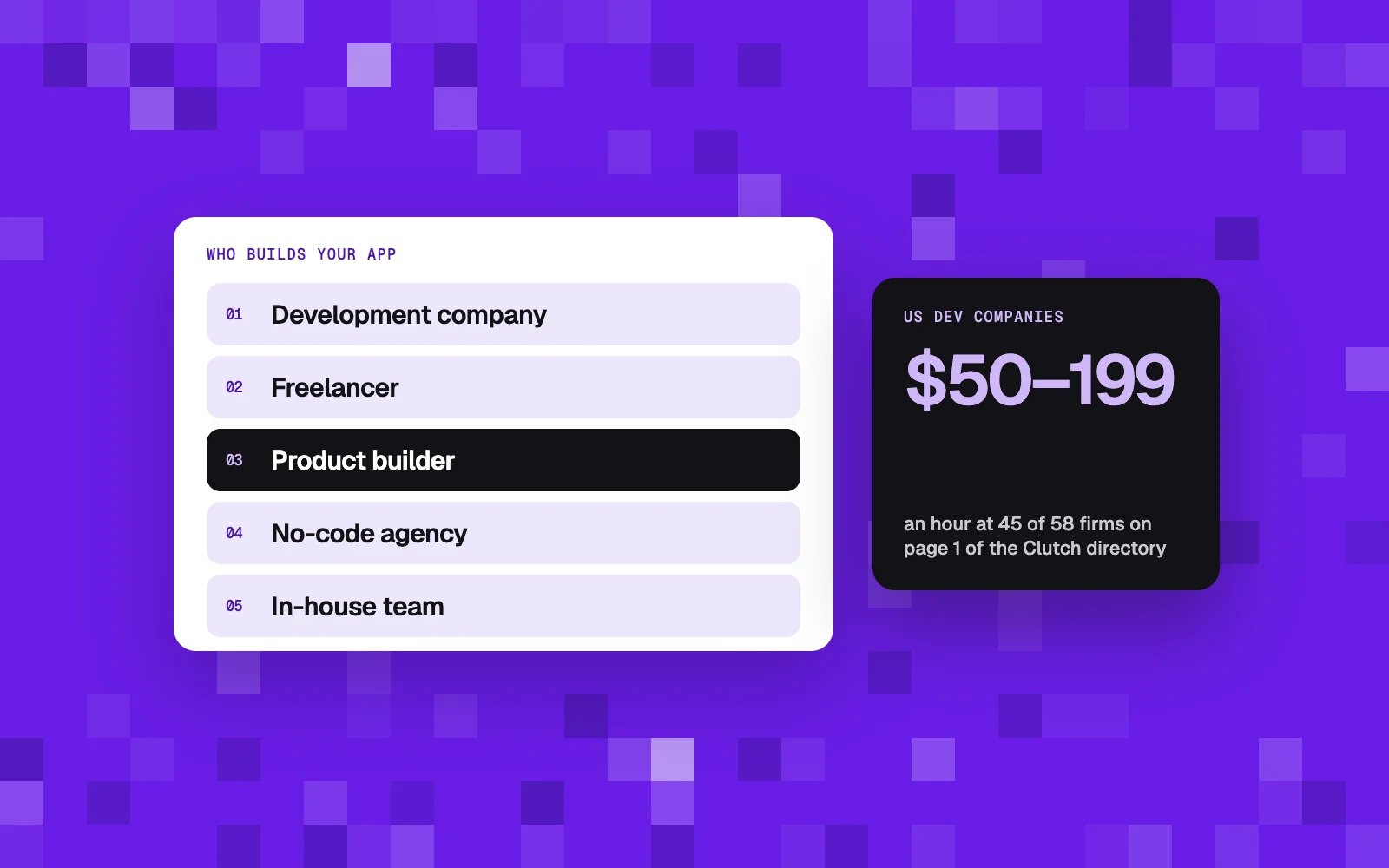
How to validate a business idea before you build: 7 tests, costs and pass thresholds
To validate a business idea, collect evidence that a specific group of people has the problem, looks for a solution and will pay for yours, before you build it. Work up a ladder of evidence: problem interviews first, then a demand test (a landing page or a smoke test), then a payment test (a pre-sale, a deposit or a paid pilot), and deliver the first orders by hand. Opinions and compliments do not count. Money, time and data that people give you do. A first round takes about two weeks and can cost little more than a landing page.
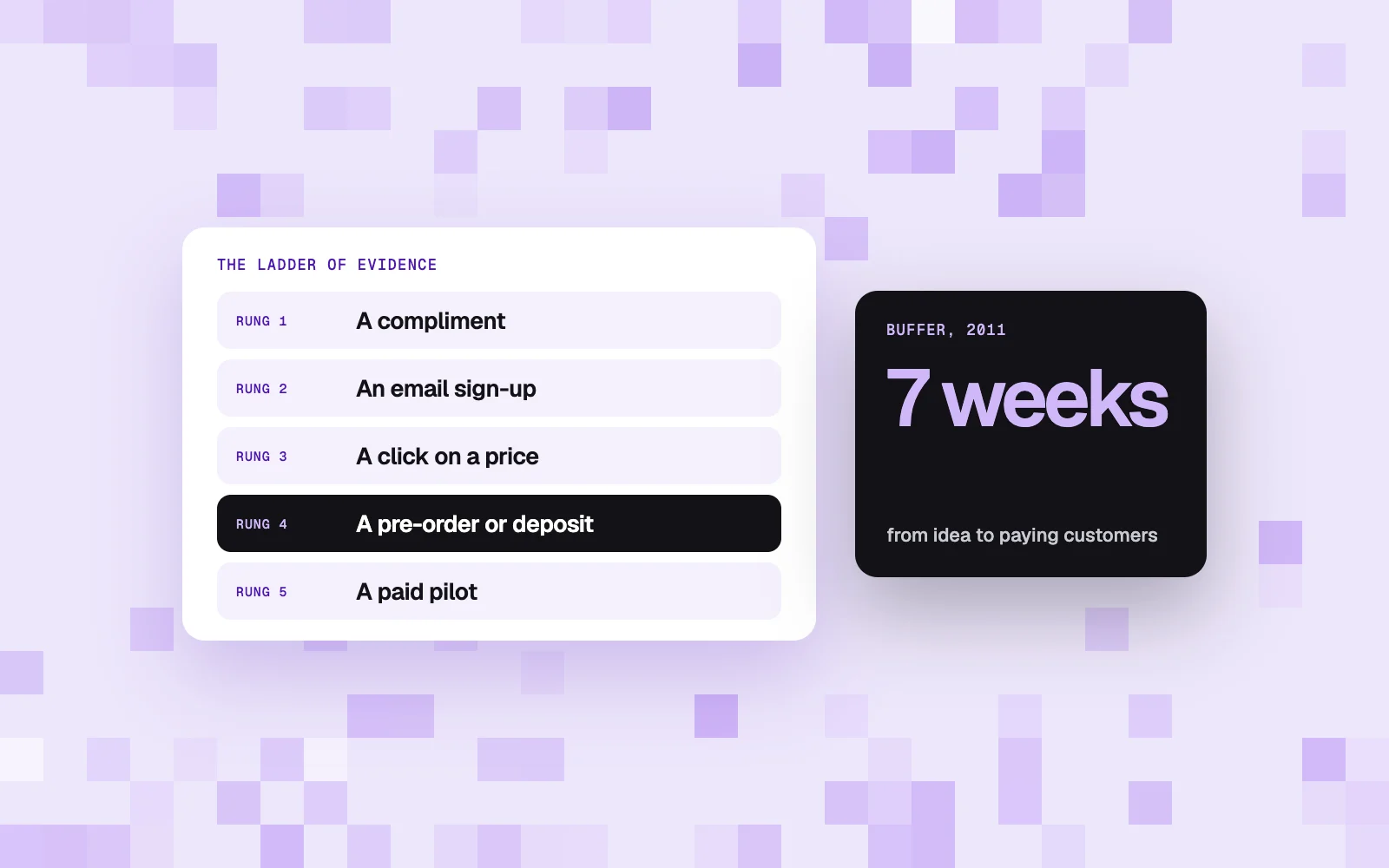
To validate a business idea, you collect evidence that real people have the problem, are looking for a solution and will pay for yours, before you spend months building it. The evidence that counts is behaviour: an email address, a click on a price, a deposit, a signed pilot. Compliments do not count. This guide explains how to validate a business idea step by step, compares seven tests by cost and time, and gives the thresholds we use to say "go" or "stop".
We read the five pages that rank highest for this question in the US: First Round Review, HubSpot, American Public University, SCORE and Entrepreneur. They agree on the basics: talk to customers, research the market, build something small. None compares the methods by cost and time or says what result counts as a pass, and their numbers often have no source. This article fills those gaps.
We've been on both sides: founders who had to validate our own product ideas, and the team that designs and builds products for clients. Max Miskow co-founded Skillsbite, an AI tool for analysing CVs, in 2021, and later built Podium, his own product, from zero. Lessons from that work are near the end.
What is business validation
Business idea validation is the process of testing the riskiest assumptions behind an idea with real customers, cheaply, before you commit serious money to building it. The output is a decision with evidence: build, change the idea or stop.
Validation is easy to confuse with three neighbouring terms. The table shows where each one sits.
| Market research | Idea validation | MVP | Product market fit | |
|---|---|---|---|---|
| Question it answers | How big is the market and who is in it? | Will these people pay for this solution? | Does the first working version solve the problem? | Does the market pull the product? |
| When | Before and alongside validation | Before you build | After validation passes | Months after launch |
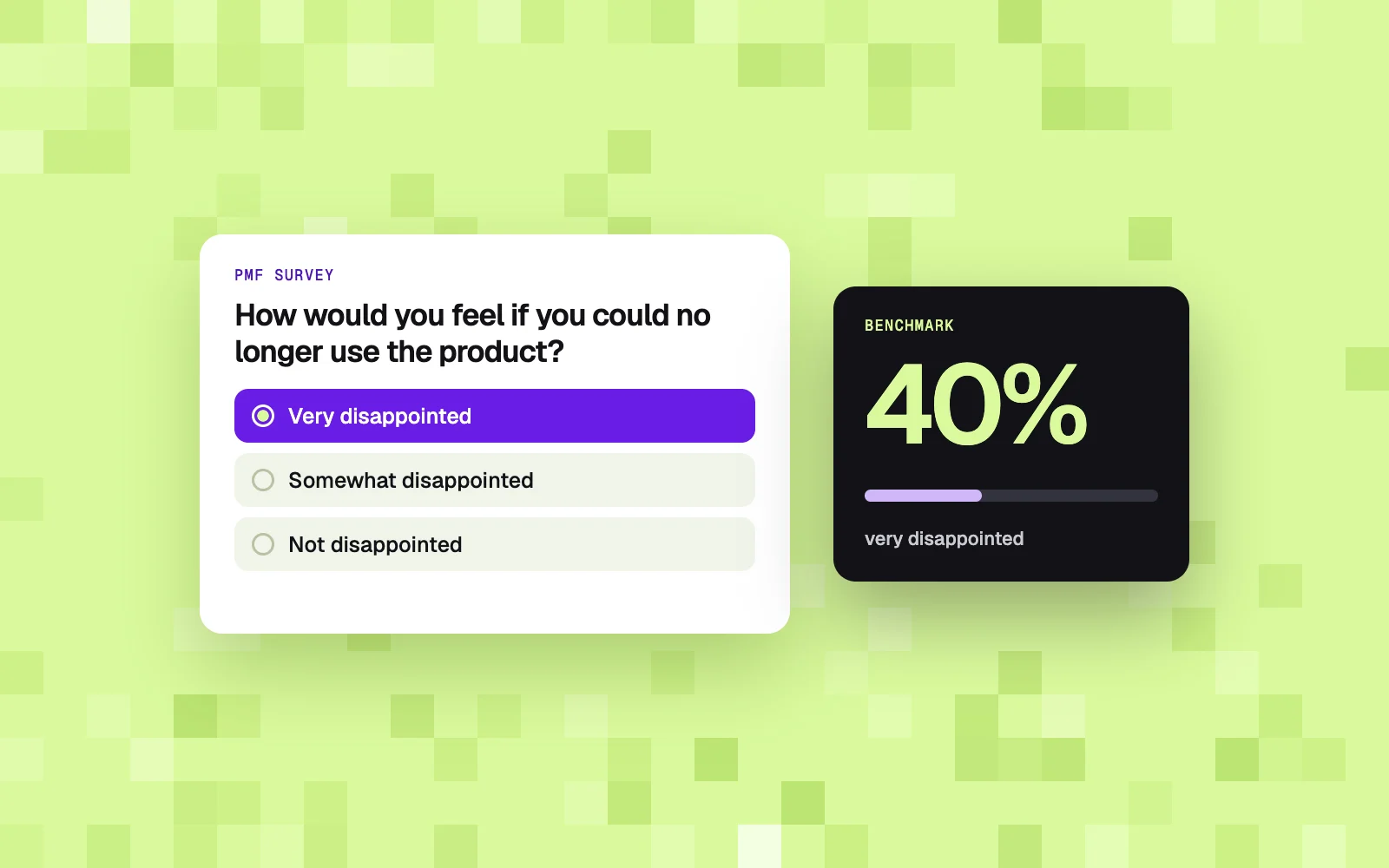
| Typical evidence | Reports, competitor lists, search data | Interviews, sign-ups, pre-orders, paid pilots | Usage and retention of the first version | Retention, the 40% survey, organic growth |
| Typical cost | Hours to days | Days to a few weeks, little money | Weeks to months of building | Ongoing |
| Can it be done without a product? | Yes | Yes | No | No |
Market research tells you a market exists. Validation tells you that your offer can win a piece of it. An MVP is the first product you build after validation passes; our guide on what an MVP is covers the types and how to scope one. Product market fit comes later still, and our article on product market fit questions shows how to measure it.
Why validate a business idea before you build
Validate first because building the wrong thing is the most common way new products die, and validation costs a fraction of a build. In its analysis of startup failures, CB Insights studied 431 venture-backed companies that shut down since 2023. Running out of capital was the final cause for most of them. Among the root causes, poor product market fit was cited by 43%, bad timing by 29% and unsustainable unit economics by 19%.
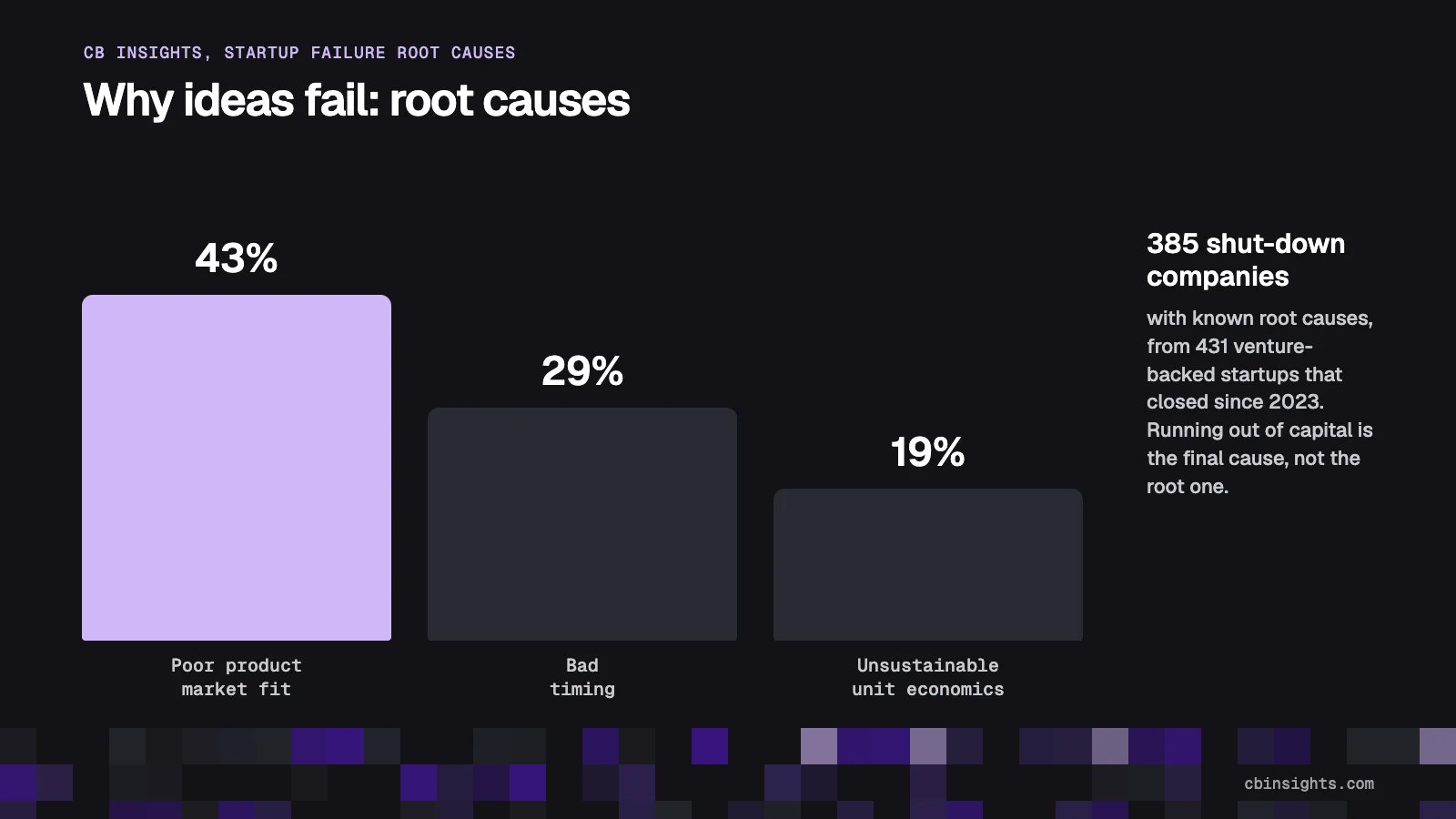
Two of those three causes are what validation tests: "nobody needs this enough" and "they want it, but not at a price that covers the cost". Both can be checked before a line of code is written. Some guides still quote 42% for "no market need" from an older CB Insights report; the current figure is 43%.
How to validate a business idea in 6 steps
To validate your business idea, write it as a testable statement, find the assumption that would kill it, test the problem in interviews, test demand with a page or an ad, test payment with a pre-sale or a pilot, and deliver the first orders by hand. Then decide. Each step needs stronger evidence than the one before it.
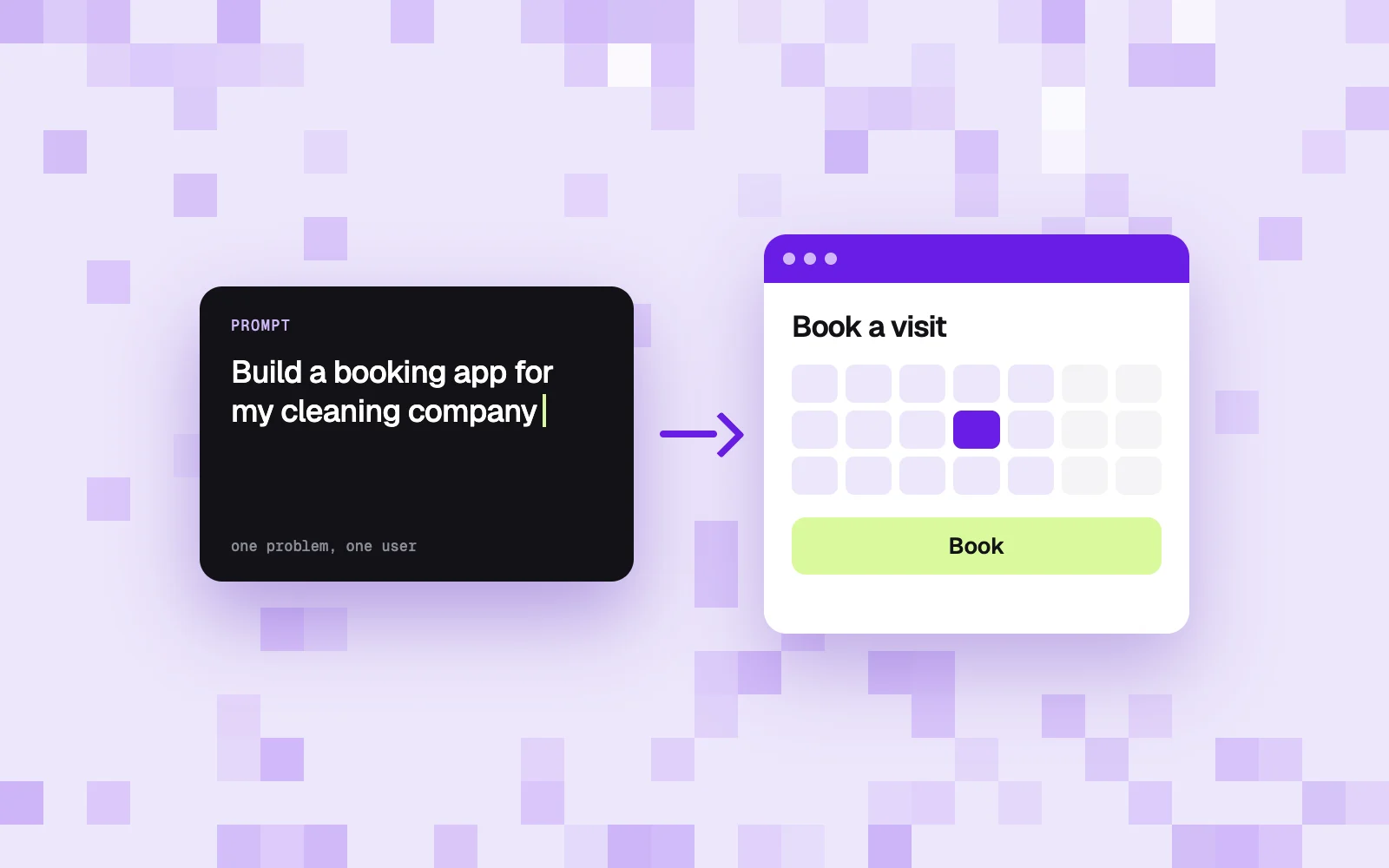
- Write the idea as one testable sentence. Name the customer, the problem, the solution and the price: "Owners of cleaning companies with 5 to 20 staff will pay $X a month for a tool that books recurring jobs online." A vague idea cannot fail a test, so it cannot pass one.
- List the assumptions and pick the riskiest. Write what must be true: the problem exists, it hurts, people look for a solution, they will pay your price, you can reach them. Test first the one that would kill the idea and that you know least about.
- Run problem interviews. Talk to 8 to 10 people from the target group about the last time the problem happened, what they did and what it cost them. Do not pitch. The jobs to be done framework gives good questions for this, and our guide to product discovery covers interview technique in depth.
- Test demand. Put up a landing page that describes the solution with a clear call to action, and send it to the people you interviewed and to a small paid or community audience. Measure who leaves an email or asks for a call.
- Test payment. Show a price and ask for a commitment: a pre-order, a deposit, a letter of intent or a paid pilot. This is the step most founders skip and the one that matters most.
- Deliver by hand and decide. Serve the first customers manually and write down a decision: build, change or stop.
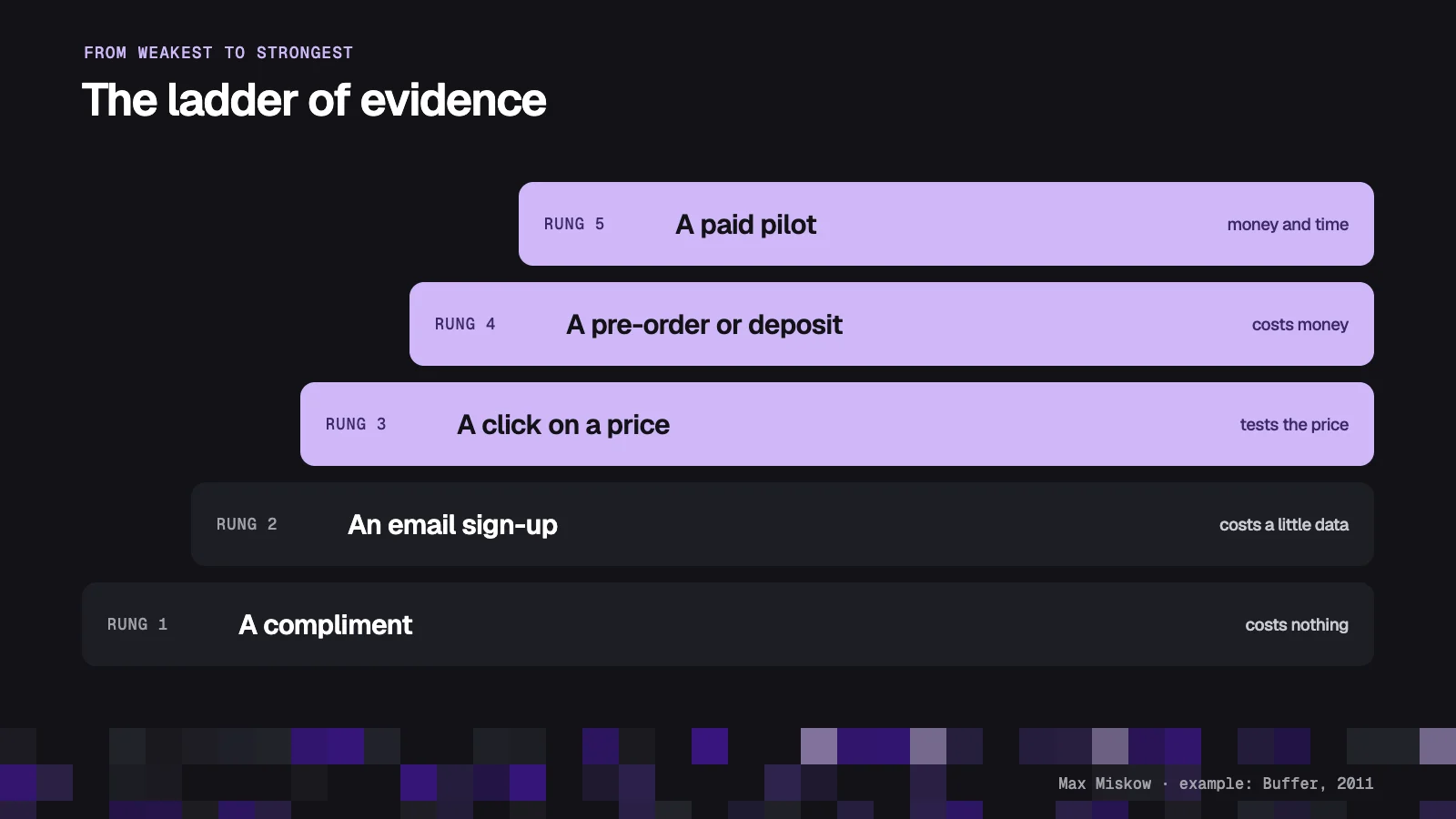
A good example of steps 4 and 5 comes from Buffer. Its founder, Joel Gascoigne, described in 2011 a two-page test: a page explaining the product and a sign-up form. When people left their email, he added a pricing page between the two, so a visitor had to click a plan before signing up. That one extra click tested the price and the strength of demand. He had his first paying customer within 4 days of launching a rough first version, and the post's title sums up the result: idea to paying customers in 7 weeks.
How to test business ideas: 7 methods compared by cost and time
The cheapest tests prove the least, and the strongest tests cost the customer something. The table compares seven common methods for validating business ideas in a small team. Costs are what you pay to run the test, not your time.
| Method | Direct cost | Time to a result | What it proves | What it cannot prove |
|---|---|---|---|---|
| Desk research (search data, competitors, reviews) | $0 | 1 to 2 days | Others see the problem and charge for it | That your customers will choose you |
| Problem interviews (8 to 10 people) | $0, or small gift cards | 1 to 2 weeks | The problem is real, frequent and costly | That people will pay |
| Landing page with a sign-up form | From $19 a year (Carrd Pro) | 1 to 3 weeks | People want the promise enough to leave an email | That they will pay |
| Smoke test with paid ads | The budget you set | 1 to 2 weeks | Strangers click on the promise | Long-term demand or retention |
| Pricing page or fake door | $0 on top of the landing page | 1 to 2 weeks | Interest at a stated price | Real payment |
| Pre-sale, deposit or letter of intent | Payment processing fees | 2 to 4 weeks | Willingness to pay | That the delivered product satisfies |
| Concierge or manual pilot | Your time | 2 to 6 weeks | You can deliver the outcome and people keep paying | That the process scales |
A few notes on the numbers. Carrd, a simple landing page builder, lists Pro plans from $19 a year (checked on November 27, 2026). Paid ads have no fixed price: you set the budget yourself. Google's help page on average daily budgets explains that to turn a monthly budget into a daily one you divide it by 30.4, so decide the total you are willing to lose on the test first and work backwards.
A fake door is a button for a feature or plan that does not exist yet. A click shows interest; the page behind it says honestly that the option is coming and asks for an email.
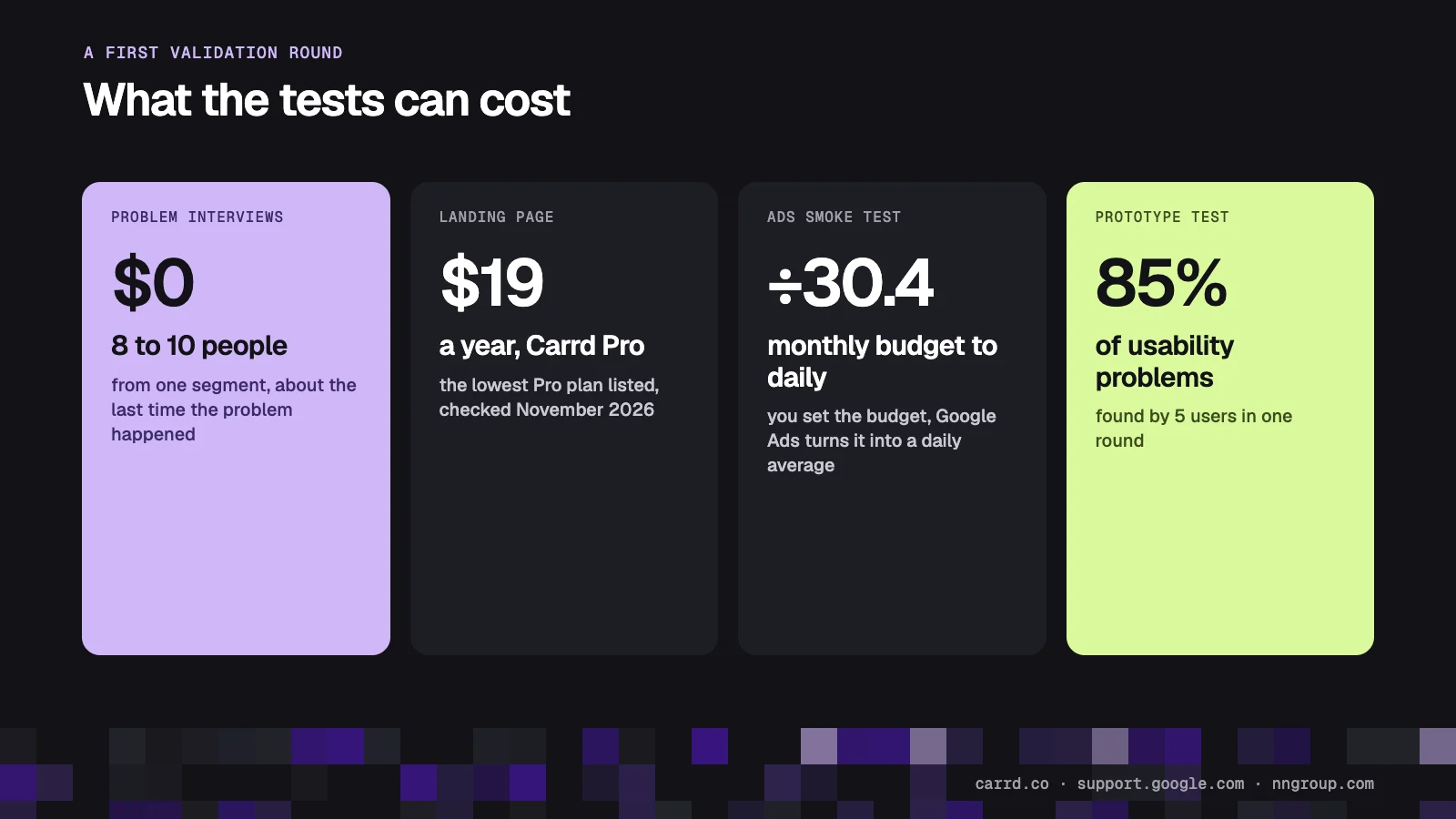
If the idea includes a screen people must use, add a short prototype test. Jakob Nielsen of Nielsen Norman Group showed that a test with five participants finds about 85% of usability problems. It checks usability, not demand.
What counts as validated: pass and kill signals
An idea is validated when people take a step that costs them something, at a rate you set before the test. Write the threshold down in advance; if you set it after you see the result, you will move it. The thresholds below are our working rules for small B2B and service products, not an industry standard. Adjust them to your price and market.
| Test | Sample | Pass signal | Kill or rethink signal |
|---|---|---|---|
| Problem interviews | 8 to 10 people from one segment | Most describe the problem unprompted, recently, and already spend time or money on it | People call it "annoying" but have never tried to fix it |
| Landing page from warm contacts | 30 to 50 targeted visitors | A clear share leaves an email or books a call, and several ask when it launches | Visits without sign-ups, or sign-ups only from friends |
| Smoke test with ads | A few hundred visitors from the target group | Sign-ups at a cost you could afford to pay per customer later | Clicks but no sign-ups, or only the cheapest audience converts |
| Pricing page or fake door | The same visitors | Clicks spread across plans, including paid ones | Everyone picks free, or drops off at the price |
| Pre-sale or deposit | 5 to 10 serious prospects | At least a few pay or sign | "Send me something when it's ready" |
| Paid pilot | 1 to 3 customers | They pay, use it and ask for more | They stop using it once the novelty fades |
An expensive B2B product needs few customers, so a few signed pilots are strong evidence. A cheap consumer product needs volume, so smoke test numbers matter more. Either way, one real payment beats a hundred "I would definitely use that".
Smoke test, pre-selling or concierge MVP: which one to choose
Choose the test by what is riskiest in your idea and by who buys. If you are unsure people want it, start with a smoke test. If you are unsure they will pay your price, go straight to pre-selling. If you are unsure you can deliver the result, run a concierge pilot. Most ideas need two of the three.
| Type of idea | Riskiest assumption | Best first test | Then |
|---|---|---|---|
| B2B tool or app for one industry | They will pay and switch from what they use now | Interviews, then a paid pilot or a letter of intent | Concierge delivery for the first customers |
| Service business (agency, studio, local service) | People will buy from you at this price | Pre-sale of the first package | Deliver by hand, measure repeat orders |
| Consumer app | Enough strangers want it to make acquisition affordable | Smoke test with a landing page and ads | Pricing page or pre-order |
| Marketplace | Both sides will show up | Concierge: match buyers and sellers by hand | Landing pages for each side |
| Internal tool for your own company | The process is worth automating | Run the process manually and count the hours | A small build only if the hours justify it |
The concierge approach has famous examples. Paul Graham's essay Do Things That Don't Scale describes how Airbnb's founders went door to door in New York to recruit hosts and help them improve listings, and how the Stripe founders installed the product for users on the spot instead of sending a link. Graham writes that nearly all startups have to recruit their first users manually.
How to validate a business idea without spending money
You can validate a business idea for almost nothing if you replace money with time and asking. Only real payment needs a payment tool.
- Desk research. Competitors, their prices and their reviews. Complaints in reviews list problems people already pay to have solved badly.
- Interviews from your network and communities. Ask people in the target group for 20 minutes, not friends who will be polite.
- A free landing page. Many site builders have a free plan with their own subdomain, which is enough for a test with warm traffic.
- A manual pre-sale. Send an invoice or a payment link for the first package and refund it if you do not deliver. You pay only processing fees on what you receive.
- Concierge delivery. Deliver the outcome by hand with email and a spreadsheet before you automate anything.
What you cannot get for free is volume from strangers; ads buy that.
How to validate a business idea quickly: a two-week plan
Two weeks is enough for a first answer when the customers are reachable. The plan below is the starting point we recommend to founders and owner-led companies before any build.
| Day | Task | Output |
|---|---|---|
| 1 | Write the idea as one testable sentence and list the assumptions | One page with the riskiest assumption marked |
| 1 to 2 | Desk research: competitors, prices, reviews, search interest | A short list of alternatives and their prices |
| 2 to 7 | 8 to 10 problem interviews | Notes, with the problem described in customers' own words |
| 6 to 8 | Landing page with the promise, a price and a call to action | A live page and a way to count sign-ups |
| 8 to 12 | Send the page to interviewees and a small targeted audience; ask the warmest for a deposit or a pilot | Sign-ups, clicks on prices, payments or signed pilots |
| 13 to 14 | Compare results with the thresholds written on day 1 | A written decision: build, change or stop |
A short checklist for the decision on day 14:
- Did people describe the problem without being prompted?
- Did anyone take a step that cost them money, data or a real commitment of time?
- Do you know what they use today and why they would switch?
- Is the price you tested enough to cover the cost of serving and reaching a customer?
- Can you describe the first version on one page?
Five yes answers mean you can scope a small first build. Two or fewer mean another round, a different segment or a different idea.
What we learned validating our own and client ideas
The common lesson: the idea that reaches the build is rarely the one the founder started with, and that is the point of validating.
Skillsbite was an idea we had to validate and then pivot. The lesson we took from it is to treat the first idea as a hypothesis and plan a pivot as a normal outcome of validation, not a failure.
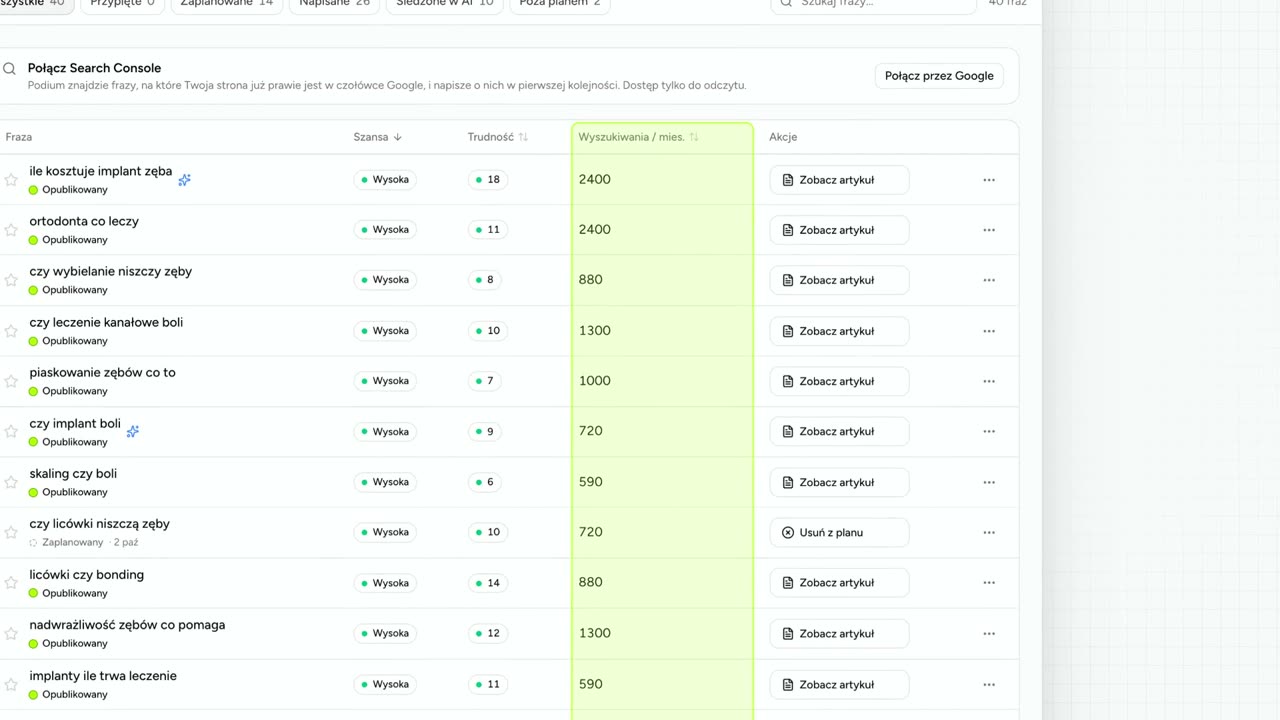
With Podium, Max's own product, building the first live version taught us things no plan showed. The lesson: some assumptions can only be checked by running the real thing, so keep the first live version small enough that being wrong is cheap.
With a current client in the US, a company running home services businesses that wanted one app for its customers, the first step was not design. It was checking whether the app made sense and in what form, so that it solves one concrete problem. The lesson: an idea that sounds like one product often hides several separate bets, and each one needs its own test.
If you want help working out how to validate your business idea before you build, we start with a short call, then a fixed price before each stage. Ranges come after the conversation. You can book 30 minutes or read how we build MVPs.
Common mistakes when validating a business idea
Most mistakes come from listening to what people say instead of watching what they do.
- Asking friends and family. They want to be kind. Rob Fitzpatrick's book The Mom Test is built around this problem: ask about people's lives and past behaviour, not about your idea.
- Skipping the payment test. Interest without a price is the weakest evidence on the ladder.
- Setting thresholds after the test. Write the pass and kill signals before you start.
- Building to validate. A full product is the most expensive test there is. Build after the cheaper tests pass.
Frequently asked questions
What is the best way to validate a business idea?
The best way is to get a real commitment from the people you want to sell to: a pre-order, a deposit or a paid pilot. Start with 8 to 10 problem interviews to make sure the problem is real, then ask for the commitment. Payment is stronger evidence than any survey.
How long does it take to validate a business idea?
A first round takes about two weeks when you can reach customers: one week for interviews and desk research, one for a landing page and a payment test. Buffer went from idea to paying customers in 7 weeks. Ideas with long sales cycles, such as tools for large companies, take longer.
How to validate a startup idea without a product?
To validate a startup idea without a product, use a landing page, a pricing page, a pre-sale or a concierge pilot. None needs a working product. Build only after people have shown, with money or a signed commitment, that they want it.
How many customer interviews do you need to validate an idea?
Plan 8 to 10 interviews with people from one segment. Stop when new interviews stop telling you anything new. If people in the same segment describe very different problems, the segment is too broad, so narrow it and interview again.
What is a smoke test in business?
A smoke test is an experiment that measures demand for a product that does not exist yet. You describe it on a landing page or in an ad, drive visitors to it and count how many sign up or try to buy. It shows whether the promise attracts people, not whether the product will keep them.
Is a survey enough to validate a business idea?
No. A survey measures opinions, and people are bad at predicting what they will buy. Use surveys to size a problem after interviews, and confirm demand with a test that asks for an email, a click on a price or a payment.
What is the difference between idea validation and product market fit?
Validation happens before you build and checks that people want and will pay for the solution. Product market fit is measured after launch and checks that the product keeps customers and spreads. Validation is a filter at the start; product market fit is the result you aim for months later.